

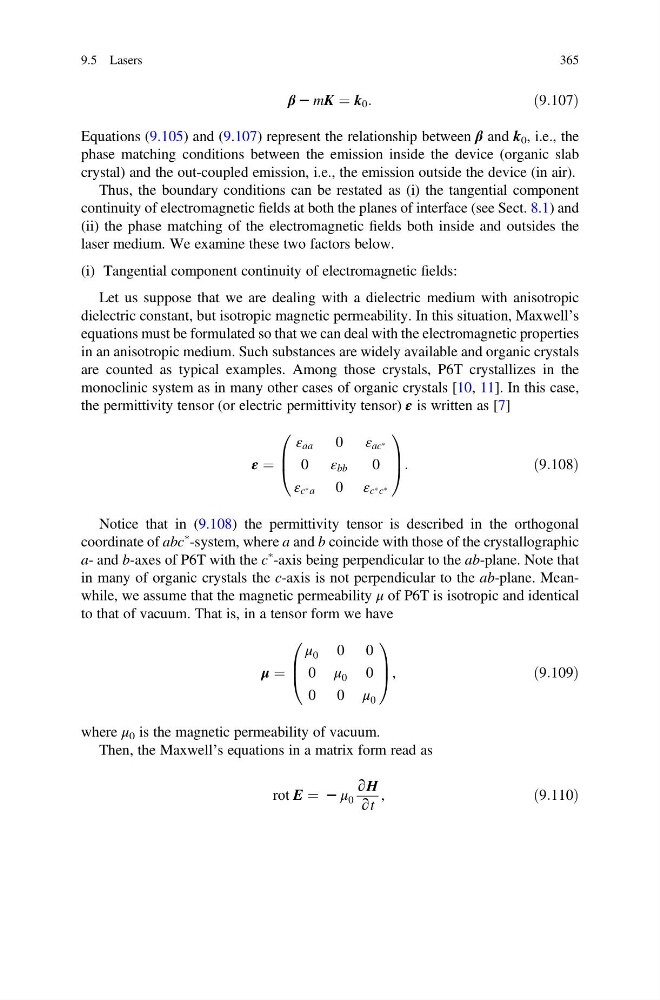
β 2 mK ¼ k 0 :
ð9:107Þ
Equations (9.105) and (9.107) represent the relationship between β and k 0 , i.e., the
phase matching conditions between the emission inside the device (organic slab
crystal) and the out-coupled emission, i.e., the emission outside the device (in air).
Thus, the boundary conditions can be restated as (i) the tangential component
continuity of electromagnetic fields at both the planes of interface (see Sect. 8.1) and
(ii) the phase matching of the electromagnetic fields both inside and outsides the
laser medium. We examine these two factors below.
(i) Tangential component continuity of electromagnetic fields:
Let us suppose that we are dealing with a dielectric medium with anisotropic
dielectric constant, but isotropic magnetic permeability. In this situation, Maxwell’s
equations must be formulated so that we can deal with the electromagnetic properties
in an anisotropic medium. Such substances are widely available and organic crystals
are counted as typical examples. Among those crystals, P6T crystallizes in the
monoclinic system as in many other cases of organic crystals [10, 11]. In this case,
the permittivity tensor (or electric permittivity tensor) ε is written as [7]
ε ¼
ε aa
0 ε ac Ã
0 ε bb
0
ε c à a 0 ε c à c Ã
0
B
@
1
C
A:
ð9:108Þ
Notice that in (9.108) the permittivity tensor is described in the orthogonal
coordinate of abc
à -system, where a and b coincide with those of the crystallographic
a- and b-axes of P6T with the c
à -axis being perpendicular to the ab-plane. Note that
in many of organic crystals the c-axis is not perpendicular to the ab-plane. Meanwhile, we assume that the magnetic permeability μ of P6T is isotropic and identical
to that of vacuum. That is, in a tensor form we have
μ ¼
μ 0 0 0
0 μ 0 0
0 0 μ 0
0
B
@
1
C
A,
ð9:109Þ
where μ 0 is the magnetic permeability of vacuum.
Then, the Maxwell’s equations in a matrix form read as
rot E ¼ 2 μ 0
∂H
∂t
,
ð9:110Þ
9.5 Lasers
365
ð9:107Þ
Equations (9.105) and (9.107) represent the relationship between β and k 0 , i.e., the
phase matching conditions between the emission inside the device (organic slab
crystal) and the out-coupled emission, i.e., the emission outside the device (in air).
Thus, the boundary conditions can be restated as (i) the tangential component
continuity of electromagnetic fields at both the planes of interface (see Sect. 8.1) and
(ii) the phase matching of the electromagnetic fields both inside and outsides the
laser medium. We examine these two factors below.
(i) Tangential component continuity of electromagnetic fields:
Let us suppose that we are dealing with a dielectric medium with anisotropic
dielectric constant, but isotropic magnetic permeability. In this situation, Maxwell’s
equations must be formulated so that we can deal with the electromagnetic properties
in an anisotropic medium. Such substances are widely available and organic crystals
are counted as typical examples. Among those crystals, P6T crystallizes in the
monoclinic system as in many other cases of organic crystals [10, 11]. In this case,
the permittivity tensor (or electric permittivity tensor) ε is written as [7]
ε ¼
ε aa
0 ε ac Ã
0 ε bb
0
ε c à a 0 ε c à c Ã
0
B
@
1
C
A:
ð9:108Þ
Notice that in (9.108) the permittivity tensor is described in the orthogonal
coordinate of abc
à -system, where a and b coincide with those of the crystallographic
a- and b-axes of P6T with the c
à -axis being perpendicular to the ab-plane. Note that
in many of organic crystals the c-axis is not perpendicular to the ab-plane. Meanwhile, we assume that the magnetic permeability μ of P6T is isotropic and identical
to that of vacuum. That is, in a tensor form we have
μ ¼
μ 0 0 0
0 μ 0 0
0 0 μ 0
0
B
@
1
C
A,
ð9:109Þ
where μ 0 is the magnetic permeability of vacuum.
Then, the Maxwell’s equations in a matrix form read as
rot E ¼ 2 μ 0
∂H
∂t
,
ð9:110Þ
9.5 Lasers
365