

rot H ¼ ε 0
ε aa
0 ε ac Ã
0 ε bb
0
ε c à a 0 ε c à c Ã
0
B
@
1
C
A
∂E
∂t
:
ð9:111Þ
In (9.111) the equation is described in the abc
à -system. But, it will be desired to
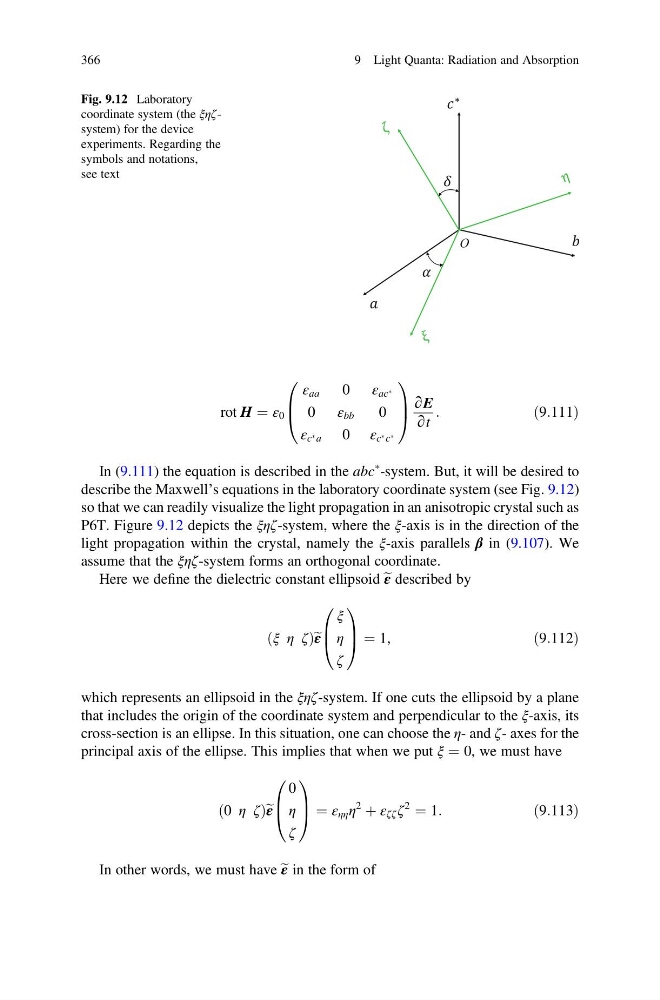
describe the Maxwell’s equations in the laboratory coordinate system (see Fig. 9.12)
so that we can readily visualize the light propagation in an anisotropic crystal such as
P6T. Figure 9.12 depicts the ξηζ-system, where the ξ-axis is in the direction of the
light propagation within the crystal, namely the ξ-axis parallels β in (9.107). We
assume that the ξηζ-system forms an orthogonal coordinate.
Here we define the dielectric constant ellipsoid e ε described by
ξ η ζ
ð
Þe ε
ξ
η
ζ
0
B
@
1
C
A ¼ 1,
ð9:112Þ
which represents an ellipsoid in the ξηζ-system. If one cuts the ellipsoid by a plane
that includes the origin of the coordinate system and perpendicular to the ξ-axis, its
cross-section is an ellipse. In this situation, one can choose the η- and ζ- axes for the
principal axis of the ellipse. This implies that when we put ξ ¼ 0, we must have
0 η ζ
ð
Þe ε
0
η
ζ
0
B
@
1
C
A ¼ ε ηη η
2
þ ε ζζ ζ
2
¼ 1:
ð9:113Þ
In other words, we must have e ε in the form of
∗
O
Fig. 9.12 Laboratory
coordinate system (the ξηζsystem) for the device
experiments. Regarding the
symbols and notations,
see text
366
9 Light Quanta: Radiation and Absorption
ε aa
0 ε ac Ã
0 ε bb
0
ε c à a 0 ε c à c Ã
0
B
@
1
C
A
∂E
∂t
:
ð9:111Þ
In (9.111) the equation is described in the abc
à -system. But, it will be desired to
describe the Maxwell’s equations in the laboratory coordinate system (see Fig. 9.12)
so that we can readily visualize the light propagation in an anisotropic crystal such as
P6T. Figure 9.12 depicts the ξηζ-system, where the ξ-axis is in the direction of the
light propagation within the crystal, namely the ξ-axis parallels β in (9.107). We
assume that the ξηζ-system forms an orthogonal coordinate.
Here we define the dielectric constant ellipsoid e ε described by
ξ η ζ
ð
Þe ε
ξ
η
ζ
0
B
@
1
C
A ¼ 1,
ð9:112Þ
which represents an ellipsoid in the ξηζ-system. If one cuts the ellipsoid by a plane
that includes the origin of the coordinate system and perpendicular to the ξ-axis, its
cross-section is an ellipse. In this situation, one can choose the η- and ζ- axes for the
principal axis of the ellipse. This implies that when we put ξ ¼ 0, we must have
0 η ζ
ð
Þe ε
0
η
ζ
0
B
@
1
C
A ¼ ε ηη η
2
þ ε ζζ ζ
2
¼ 1:
ð9:113Þ
In other words, we must have e ε in the form of
∗
O
Fig. 9.12 Laboratory
coordinate system (the ξηζsystem) for the device
experiments. Regarding the
symbols and notations,
see text
366
9 Light Quanta: Radiation and Absorption