

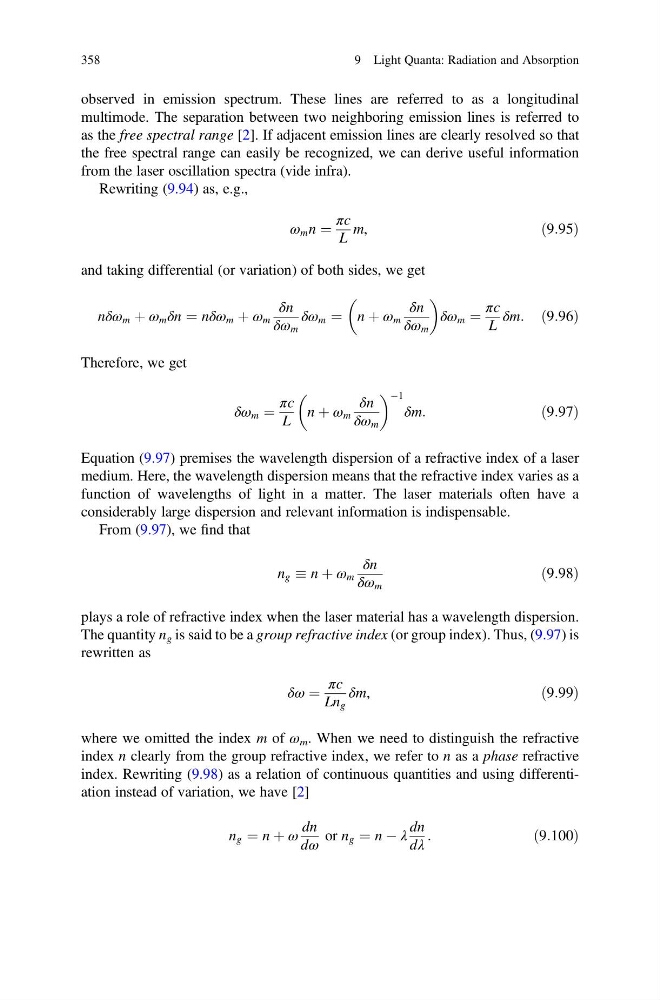
observed in emission spectrum. These lines are referred to as a longitudinal
multimode. The separation between two neighboring emission lines is referred to
as the free spectral range [2]. If adjacent emission lines are clearly resolved so that
the free spectral range can easily be recognized, we can derive useful information
from the laser oscillation spectra (vide infra).
Rewriting (9.94) as, e.g.,
ω m n ¼
πc
L
m,
ð9:95Þ
and taking differential (or variation) of both sides, we get
nδω m þ ω m δn ¼ nδω m þ ω m
δn
δω m
δω m ¼ n þ ω m
δn
δω m
δω m ¼
πc
L
δm: ð9:96Þ
Therefore, we get
δω m ¼
πc
L
n þ ω m
δn
δω m
À1
δm:
ð9:97Þ
Equation (9.97) premises the wavelength dispersion of a refractive index of a laser
medium. Here, the wavelength dispersion means that the refractive index varies as a
function of wavelengths of light in a matter. The laser materials often have a
considerably large dispersion and relevant information is indispensable.
From (9.97), we find that
n g n þ ω m
δn
δω m
ð9:98Þ
plays a role of refractive index when the laser material has a wavelength dispersion.
The quantity n g is said to be a group refractive index (or group index). Thus, (9.97) is
rewritten as
δω ¼
πc
Ln g
δm,
ð9:99Þ
where we omitted the index m of ω m . When we need to distinguish the refractive
index n clearly from the group refractive index, we refer to n as a phase refractive
index. Rewriting (9.98) as a relation of continuous quantities and using differentiation instead of variation, we have [2]
n g ¼ n þ ω
dn
dω
or n g ¼ n À λ
dn
dλ
:
ð9:100Þ
358
9 Light Quanta: Radiation and Absorption
multimode. The separation between two neighboring emission lines is referred to
as the free spectral range [2]. If adjacent emission lines are clearly resolved so that
the free spectral range can easily be recognized, we can derive useful information
from the laser oscillation spectra (vide infra).
Rewriting (9.94) as, e.g.,
ω m n ¼
πc
L
m,
ð9:95Þ
and taking differential (or variation) of both sides, we get
nδω m þ ω m δn ¼ nδω m þ ω m
δn
δω m
δω m ¼ n þ ω m
δn
δω m
δω m ¼
πc
L
δm: ð9:96Þ
Therefore, we get
δω m ¼
πc
L
n þ ω m
δn
δω m
À1
δm:
ð9:97Þ
Equation (9.97) premises the wavelength dispersion of a refractive index of a laser
medium. Here, the wavelength dispersion means that the refractive index varies as a
function of wavelengths of light in a matter. The laser materials often have a
considerably large dispersion and relevant information is indispensable.
From (9.97), we find that
n g n þ ω m
δn
δω m
ð9:98Þ
plays a role of refractive index when the laser material has a wavelength dispersion.
The quantity n g is said to be a group refractive index (or group index). Thus, (9.97) is
rewritten as
δω ¼
πc
Ln g
δm,
ð9:99Þ
where we omitted the index m of ω m . When we need to distinguish the refractive
index n clearly from the group refractive index, we refer to n as a phase refractive
index. Rewriting (9.98) as a relation of continuous quantities and using differentiation instead of variation, we have [2]
n g ¼ n þ ω
dn
dω
or n g ¼ n À λ
dn
dλ
:
ð9:100Þ
358
9 Light Quanta: Radiation and Absorption