

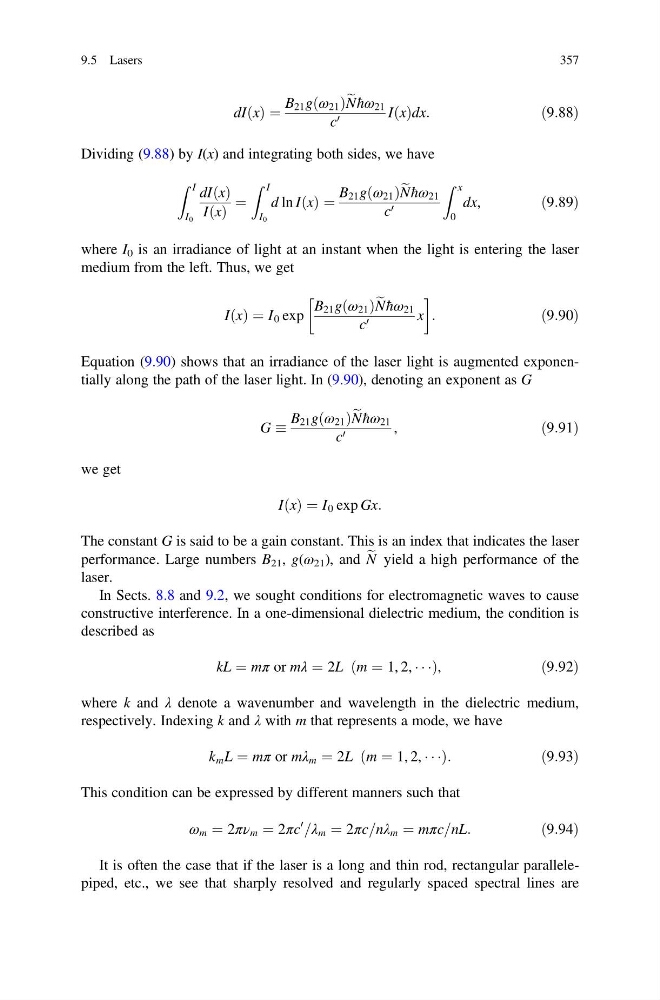
dI x
ð Þ ¼
B 21 g ω 21
ð Þ e
Nħω 21
c 0
I x
ð Þdx:
ð9:88Þ
Dividing (9.88) by I(x) and integrating both sides, we have
Z I
I 0
dI x
ð Þ
I x
ð Þ
¼
Z I
I 0
d ln I x
ð Þ ¼
B 21 g ω 21
ð Þ e
Nħω 21
c 0
Z x
0
dx,
ð9:89Þ
where I 0 is an irradiance of light at an instant when the light is entering the laser
medium from the left. Thus, we get
I x
ð Þ ¼ I 0 exp
B 21 g ω 21
ð Þ e
Nħω 21
c 0
x
!
:
ð9:90Þ
Equation (9.90) shows that an irradiance of the laser light is augmented exponentially along the path of the laser light. In (9.90), denoting an exponent as G
G
B 21 g ω 21
ð Þ e
Nħω 21
c 0
,
ð9:91Þ
we get
I x
ð Þ ¼ I 0 exp Gx:
The constant G is said to be a gain constant. This is an index that indicates the laser
performance. Large numbers B 21 , g(ω 21 ), and e
N yield a high performance of the
laser.
In Sects. 8.8 and 9.2, we sought conditions for electromagnetic waves to cause
constructive interference. In a one-dimensional dielectric medium, the condition is
described as
kL ¼ mπ or mλ ¼ 2L m ¼ 1, 2, Á Á Á
ð
Þ ,
ð9:92Þ
where k and λ denote a wavenumber and wavelength in the dielectric medium,
respectively. Indexing k and λ with m that represents a mode, we have
k m L ¼ mπ or mλ m ¼ 2L m ¼ 1, 2, Á Á Á
ð
Þ :
ð9:93Þ
This condition can be expressed by different manners such that
ω m ¼ 2πν m ¼ 2πc
0
=λ m ¼ 2πc=nλ m ¼ mπc=nL:
ð9:94Þ
It is often the case that if the laser is a long and thin rod, rectangular parallelepiped, etc., we see that sharply resolved and regularly spaced spectral lines are
9.5 Lasers
357
ð Þ ¼
B 21 g ω 21
ð Þ e
Nħω 21
c 0
I x
ð Þdx:
ð9:88Þ
Dividing (9.88) by I(x) and integrating both sides, we have
Z I
I 0
dI x
ð Þ
I x
ð Þ
¼
Z I
I 0
d ln I x
ð Þ ¼
B 21 g ω 21
ð Þ e
Nħω 21
c 0
Z x
0
dx,
ð9:89Þ
where I 0 is an irradiance of light at an instant when the light is entering the laser
medium from the left. Thus, we get
I x
ð Þ ¼ I 0 exp
B 21 g ω 21
ð Þ e
Nħω 21
c 0
x
!
:
ð9:90Þ
Equation (9.90) shows that an irradiance of the laser light is augmented exponentially along the path of the laser light. In (9.90), denoting an exponent as G
G
B 21 g ω 21
ð Þ e
Nħω 21
c 0
,
ð9:91Þ
we get
I x
ð Þ ¼ I 0 exp Gx:
The constant G is said to be a gain constant. This is an index that indicates the laser
performance. Large numbers B 21 , g(ω 21 ), and e
N yield a high performance of the
laser.
In Sects. 8.8 and 9.2, we sought conditions for electromagnetic waves to cause
constructive interference. In a one-dimensional dielectric medium, the condition is
described as
kL ¼ mπ or mλ ¼ 2L m ¼ 1, 2, Á Á Á
ð
Þ ,
ð9:92Þ
where k and λ denote a wavenumber and wavelength in the dielectric medium,
respectively. Indexing k and λ with m that represents a mode, we have
k m L ¼ mπ or mλ m ¼ 2L m ¼ 1, 2, Á Á Á
ð
Þ :
ð9:93Þ
This condition can be expressed by different manners such that
ω m ¼ 2πν m ¼ 2πc
0
=λ m ¼ 2πc=nλ m ¼ mπc=nL:
ð9:94Þ
It is often the case that if the laser is a long and thin rod, rectangular parallelepiped, etc., we see that sharply resolved and regularly spaced spectral lines are
9.5 Lasers
357