

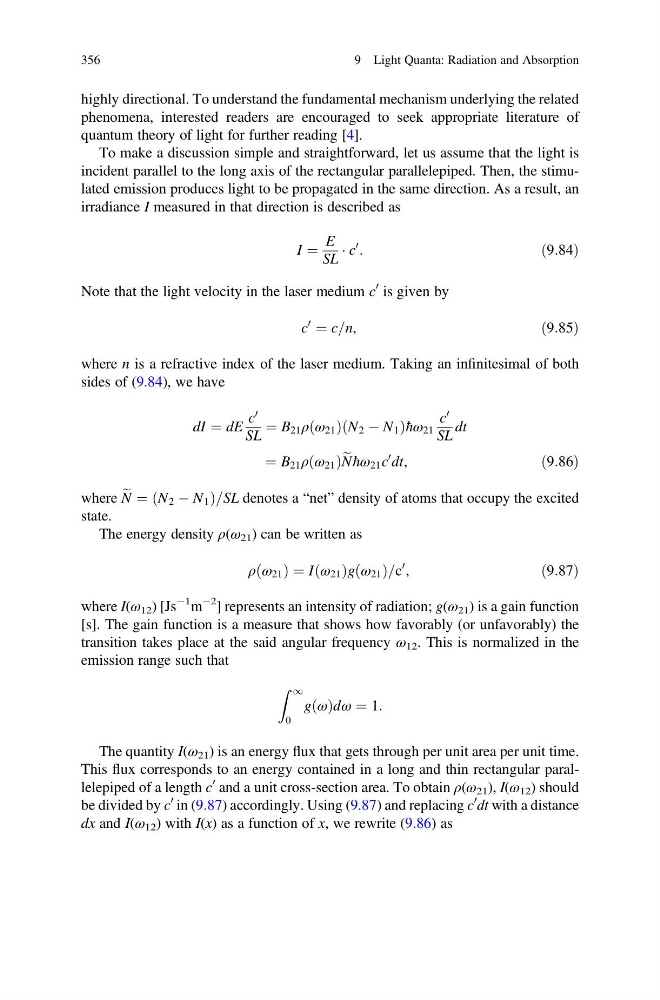
highly directional. To understand the fundamental mechanism underlying the related
phenomena, interested readers are encouraged to seek appropriate literature of
quantum theory of light for further reading [4].
To make a discussion simple and straightforward, let us assume that the light is
incident parallel to the long axis of the rectangular parallelepiped. Then, the stimulated emission produces light to be propagated in the same direction. As a result, an
irradiance I measured in that direction is described as
I ¼
E
SL
Á c
0
:
ð9:84Þ
Note that the light velocity in the laser medium c
0 is given by
c
0
¼ c=n,
ð9:85Þ
where n is a refractive index of the laser medium. Taking an infinitesimal of both
sides of (9.84), we have
dI ¼ dE
c
0
SL
¼ B 21 ρ ω 21
ð Þ N 2 À N 1
ð
Þ ħω 21
c
0
SL
dt
¼ B 21 ρ ω 21
ð Þ e
Nħω 21 c
0 dt,
ð9:86Þ
where e
N ¼ N 2 À N 1
ð
Þ =SL denotes a “net” density of atoms that occupy the excited
state.
The energy density ρ(ω 21 ) can be written as
ρ ω 21
ð Þ ¼ I ω 21
ð Þg ω 21
ð Þ=c
0 ,
ð9:87Þ
where I(ω 12 ) [Js
À1 m
À2 ] represents an intensity of radiation; g(ω 21 ) is a gain function
[s]. The gain function is a measure that shows how favorably (or unfavorably) the
transition takes place at the said angular frequency ω 12 . This is normalized in the
emission range such that
Z 1
0
g ω
ð Þdω ¼ 1:
The quantity I(ω 21 ) is an energy flux that gets through per unit area per unit time.
This flux corresponds to an energy contained in a long and thin rectangular parallelepiped of a length c
0 and a unit cross-section area. To obtain ρ(ω 21 ), I(ω 12 ) should
be divided by c
0 in (9.87) accordingly. Using (9.87) and replacing c
0 dt with a distance
dx and I(ω 12 ) with I(x) as a function of x, we rewrite (9.86) as
356
9 Light Quanta: Radiation and Absorption
phenomena, interested readers are encouraged to seek appropriate literature of
quantum theory of light for further reading [4].
To make a discussion simple and straightforward, let us assume that the light is
incident parallel to the long axis of the rectangular parallelepiped. Then, the stimulated emission produces light to be propagated in the same direction. As a result, an
irradiance I measured in that direction is described as
I ¼
E
SL
Á c
0
:
ð9:84Þ
Note that the light velocity in the laser medium c
0 is given by
c
0
¼ c=n,
ð9:85Þ
where n is a refractive index of the laser medium. Taking an infinitesimal of both
sides of (9.84), we have
dI ¼ dE
c
0
SL
¼ B 21 ρ ω 21
ð Þ N 2 À N 1
ð
Þ ħω 21
c
0
SL
dt
¼ B 21 ρ ω 21
ð Þ e
Nħω 21 c
0 dt,
ð9:86Þ
where e
N ¼ N 2 À N 1
ð
Þ =SL denotes a “net” density of atoms that occupy the excited
state.
The energy density ρ(ω 21 ) can be written as
ρ ω 21
ð Þ ¼ I ω 21
ð Þg ω 21
ð Þ=c
0 ,
ð9:87Þ
where I(ω 12 ) [Js
À1 m
À2 ] represents an intensity of radiation; g(ω 21 ) is a gain function
[s]. The gain function is a measure that shows how favorably (or unfavorably) the
transition takes place at the said angular frequency ω 12 . This is normalized in the
emission range such that
Z 1
0
g ω
ð Þdω ¼ 1:
The quantity I(ω 21 ) is an energy flux that gets through per unit area per unit time.
This flux corresponds to an energy contained in a long and thin rectangular parallelepiped of a length c
0 and a unit cross-section area. To obtain ρ(ω 21 ), I(ω 12 ) should
be divided by c
0 in (9.87) accordingly. Using (9.87) and replacing c
0 dt with a distance
dx and I(ω 12 ) with I(x) as a function of x, we rewrite (9.86) as
356
9 Light Quanta: Radiation and Absorption