

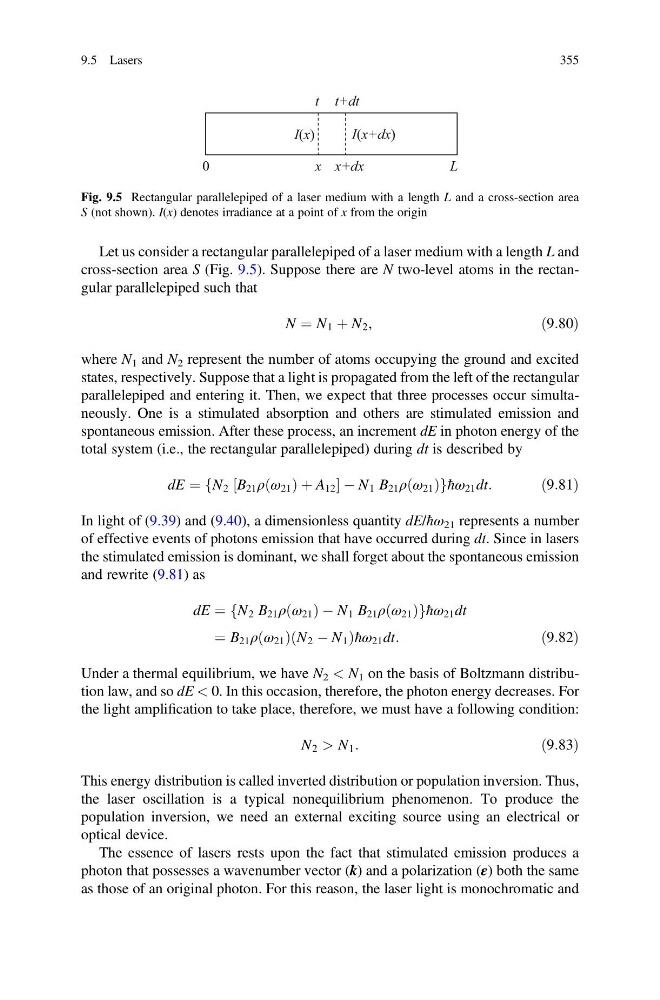
Let us consider a rectangular parallelepiped of a laser medium with a length L and
cross-section area S (Fig. 9.5). Suppose there are N two-level atoms in the rectangular parallelepiped such that
N ¼ N 1 þ N 2 ,
ð9:80Þ
where N 1 and N 2 represent the number of atoms occupying the ground and excited
states, respectively. Suppose that a light is propagated from the left of the rectangular
parallelepiped and entering it. Then, we expect that three processes occur simultaneously. One is a stimulated absorption and others are stimulated emission and
spontaneous emission. After these process, an increment dE in photon energy of the
total system (i.e., the rectangular parallelepiped) during dt is described by
dE ¼ N 2 B 21 ρ ω 21
ð ÞþA 12
½
À N 1 B 21 ρ ω 21
ð Þ
f
g ħω 21 dt:
ð9:81Þ
In light of (9.39) and (9.40), a dimensionless quantity dE/ħω 21 represents a number
of effective events of photons emission that have occurred during dt. Since in lasers
the stimulated emission is dominant, we shall forget about the spontaneous emission
and rewrite (9.81) as
dE ¼ N 2 B 21 ρ ω 21
ð ÞÀN 1 B 21 ρ ω 21
ð Þ
f
g ħω 21 dt
¼ B 21 ρ ω 21
ð Þ N 2 À N 1
ð
Þ ħω 21 dt:
ð9:82Þ
Under a thermal equilibrium, we have N 2 < N 1 on the basis of Boltzmann distribution law, and so dE < 0. In this occasion, therefore, the photon energy decreases. For
the light amplification to take place, therefore, we must have a following condition:
N 2 > N 1 :
ð9:83Þ
This energy distribution is called inverted distribution or population inversion. Thus,
the laser oscillation is a typical nonequilibrium phenomenon. To produce the
population inversion, we need an external exciting source using an electrical or
optical device.
The essence of lasers rests upon the fact that stimulated emission produces a
photon that possesses a wavenumber vector (k) and a polarization (ε) both the same
as those of an original photon. For this reason, the laser light is monochromatic and
0
L
x x+dx
t t+dt
I(x)
I(x+dx)
Fig. 9.5 Rectangular parallelepiped of a laser medium with a length L and a cross-section area
S (not shown). I(x) denotes irradiance at a point of x from the origin
9.5 Lasers
355
cross-section area S (Fig. 9.5). Suppose there are N two-level atoms in the rectangular parallelepiped such that
N ¼ N 1 þ N 2 ,
ð9:80Þ
where N 1 and N 2 represent the number of atoms occupying the ground and excited
states, respectively. Suppose that a light is propagated from the left of the rectangular
parallelepiped and entering it. Then, we expect that three processes occur simultaneously. One is a stimulated absorption and others are stimulated emission and
spontaneous emission. After these process, an increment dE in photon energy of the
total system (i.e., the rectangular parallelepiped) during dt is described by
dE ¼ N 2 B 21 ρ ω 21
ð ÞþA 12
½
À N 1 B 21 ρ ω 21
ð Þ
f
g ħω 21 dt:
ð9:81Þ
In light of (9.39) and (9.40), a dimensionless quantity dE/ħω 21 represents a number
of effective events of photons emission that have occurred during dt. Since in lasers
the stimulated emission is dominant, we shall forget about the spontaneous emission
and rewrite (9.81) as
dE ¼ N 2 B 21 ρ ω 21
ð ÞÀN 1 B 21 ρ ω 21
ð Þ
f
g ħω 21 dt
¼ B 21 ρ ω 21
ð Þ N 2 À N 1
ð
Þ ħω 21 dt:
ð9:82Þ
Under a thermal equilibrium, we have N 2 < N 1 on the basis of Boltzmann distribution law, and so dE < 0. In this occasion, therefore, the photon energy decreases. For
the light amplification to take place, therefore, we must have a following condition:
N 2 > N 1 :
ð9:83Þ
This energy distribution is called inverted distribution or population inversion. Thus,
the laser oscillation is a typical nonequilibrium phenomenon. To produce the
population inversion, we need an external exciting source using an electrical or
optical device.
The essence of lasers rests upon the fact that stimulated emission produces a
photon that possesses a wavenumber vector (k) and a polarization (ε) both the same
as those of an original photon. For this reason, the laser light is monochromatic and
0
L
x x+dx
t t+dt
I(x)
I(x+dx)
Fig. 9.5 Rectangular parallelepiped of a laser medium with a length L and a cross-section area
S (not shown). I(x) denotes irradiance at a point of x from the origin
9.5 Lasers
355