

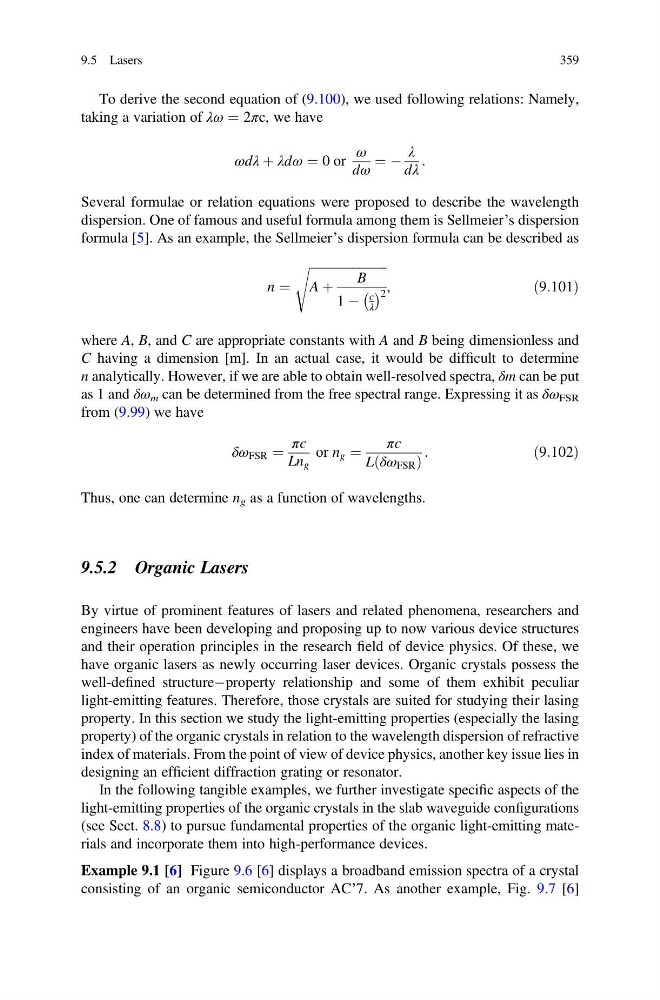
To derive the second equation of (9.100), we used following relations: Namely,
taking a variation of λω ¼ 2πc, we have
ωdλ þ λdω ¼ 0 or
ω
dω
¼ À
λ
dλ
:
Several formulae or relation equations were proposed to describe the wavelength
dispersion. One of famous and useful formula among them is Sellmeier’s dispersion
formula [5]. As an example, the Sellmeier’s dispersion formula can be described as
n ¼
ffiffiffiffiffiffiffiffiffiffiffiffiffiffiffiffiffiffiffiffiffiffiffiffiffi
A þ
B
1 À
c
λ
À Á 2
s
,
ð9:101Þ
where A, B, and C are appropriate constants with A and B being dimensionless and
C having a dimension [m]. In an actual case, it would be difficult to determine
n analytically. However, if we are able to obtain well-resolved spectra, δm can be put
as 1 and δω m can be determined from the free spectral range. Expressing it as δω FSR
from (9.99) we have
δω FSR ¼
πc
Ln g
or n g ¼
πc
L δω FSR
ð
Þ
:
ð9:102Þ
Thus, one can determine n g as a function of wavelengths.
9.5.2 Organic Lasers
By virtue of prominent features of lasers and related phenomena, researchers and
engineers have been developing and proposing up to now various device structures
and their operation principles in the research field of device physics. Of these, we
have organic lasers as newly occurring laser devices. Organic crystals possess the
well-defined structureÀproperty relationship and some of them exhibit peculiar
light-emitting features. Therefore, those crystals are suited for studying their lasing
property. In this section we study the light-emitting properties (especially the lasing
property) of the organic crystals in relation to the wavelength dispersion of refractive
index of materials. From the point of view of device physics, another key issue lies in
designing an efficient diffraction grating or resonator.
In the following tangible examples, we further investigate specific aspects of the
light-emitting properties of the organic crystals in the slab waveguide configurations
(see Sect. 8.8) to pursue fundamental properties of the organic light-emitting materials and incorporate them into high-performance devices.
Example 9.1 [6] Figure 9.6 [6] displays a broadband emission spectra of a crystal
consisting of an organic semiconductor AC’7. As another example, Fig. 9.7 [6]
9.5 Lasers
359
taking a variation of λω ¼ 2πc, we have
ωdλ þ λdω ¼ 0 or
ω
dω
¼ À
λ
dλ
:
Several formulae or relation equations were proposed to describe the wavelength
dispersion. One of famous and useful formula among them is Sellmeier’s dispersion
formula [5]. As an example, the Sellmeier’s dispersion formula can be described as
n ¼
ffiffiffiffiffiffiffiffiffiffiffiffiffiffiffiffiffiffiffiffiffiffiffiffiffi
A þ
B
1 À
c
λ
À Á 2
s
,
ð9:101Þ
where A, B, and C are appropriate constants with A and B being dimensionless and
C having a dimension [m]. In an actual case, it would be difficult to determine
n analytically. However, if we are able to obtain well-resolved spectra, δm can be put
as 1 and δω m can be determined from the free spectral range. Expressing it as δω FSR
from (9.99) we have
δω FSR ¼
πc
Ln g
or n g ¼
πc
L δω FSR
ð
Þ
:
ð9:102Þ
Thus, one can determine n g as a function of wavelengths.
9.5.2 Organic Lasers
By virtue of prominent features of lasers and related phenomena, researchers and
engineers have been developing and proposing up to now various device structures
and their operation principles in the research field of device physics. Of these, we
have organic lasers as newly occurring laser devices. Organic crystals possess the
well-defined structureÀproperty relationship and some of them exhibit peculiar
light-emitting features. Therefore, those crystals are suited for studying their lasing
property. In this section we study the light-emitting properties (especially the lasing
property) of the organic crystals in relation to the wavelength dispersion of refractive
index of materials. From the point of view of device physics, another key issue lies in
designing an efficient diffraction grating or resonator.
In the following tangible examples, we further investigate specific aspects of the
light-emitting properties of the organic crystals in the slab waveguide configurations
(see Sect. 8.8) to pursue fundamental properties of the organic light-emitting materials and incorporate them into high-performance devices.
Example 9.1 [6] Figure 9.6 [6] displays a broadband emission spectra of a crystal
consisting of an organic semiconductor AC’7. As another example, Fig. 9.7 [6]
9.5 Lasers
359