

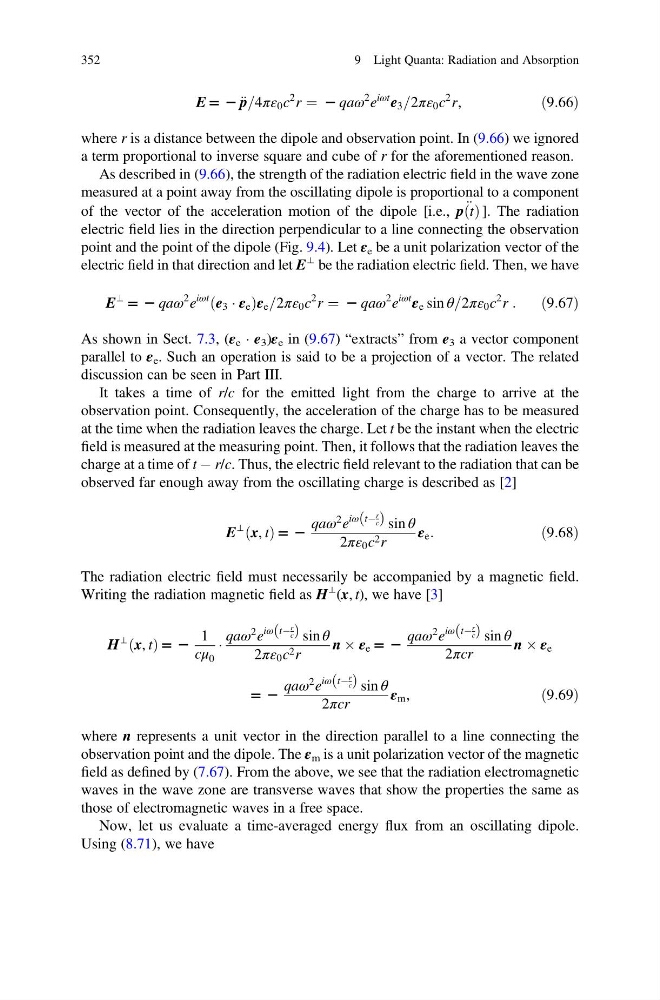
E = 2 € p=4πε 0 c
2 r ¼ 2 qaω
2 e
iωt
e 3 =2πε 0 c
2 r,
ð9:66Þ
where r is a distance between the dipole and observation point. In (9.66) we ignored
a term proportional to inverse square and cube of r for the aforementioned reason.
As described in (9.66), the strength of the radiation electric field in the wave zone
measured at a point away from the oscillating dipole is proportional to a component
of the vector of the acceleration motion of the dipole [i.e., €
p t
ð Þ ]. The radiation
electric field lies in the direction perpendicular to a line connecting the observation
point and the point of the dipole (Fig. 9.4). Let ε e be a unit polarization vector of the
electric field in that direction and let E
⊥ be the radiation electric field. Then, we have
E
⊥
= 2 qaω
2 e
iωt
e 3 Á ε e
ð
Þε e =2πε 0 c
2 r ¼ 2 qaω
2 e
iωt
ε e sin θ=2πε 0 c
2 r :
ð9:67Þ
As shown in Sect. 7.3, (ε e Á e 3 )ε e in (9.67) “extracts” from e 3 a vector component
parallel to ε e . Such an operation is said to be a projection of a vector. The related
discussion can be seen in Part III.
It takes a time of r/c for the emitted light from the charge to arrive at the
observation point. Consequently, the acceleration of the charge has to be measured
at the time when the radiation leaves the charge. Let t be the instant when the electric
field is measured at the measuring point. Then, it follows that the radiation leaves the
charge at a time of t À r/c. Thus, the electric field relevant to the radiation that can be
observed far enough away from the oscillating charge is described as [2]
E
⊥
x, t
ð Þ= 2
qaω
2 e
iω tÀ
r
c
ð Þ sin θ
2πε 0 c 2 r
ε e :
ð9:68Þ
The radiation electric field must necessarily be accompanied by a magnetic field.
Writing the radiation magnetic field as H
⊥
(x, t), we have [3]
H
⊥
x, t
ð Þ= 2
1
cμ 0
Á
qaω
2 e
iω tÀ
r
c
ð Þ sin θ
2πε 0 c 2 r
n  ε e = 2
qaω
2 e
iω tÀ
r
c
ð Þ sin θ
2πcr
n  ε e
= 2
qaω
2 e
iω tÀ
r
c
ð Þ sin θ
2πcr
ε m ,
ð9:69Þ
where n represents a unit vector in the direction parallel to a line connecting the
observation point and the dipole. The ε m is a unit polarization vector of the magnetic
field as defined by (7.67). From the above, we see that the radiation electromagnetic
waves in the wave zone are transverse waves that show the properties the same as
those of electromagnetic waves in a free space.
Now, let us evaluate a time-averaged energy flux from an oscillating dipole.
Using (8.71), we have
352
9 Light Quanta: Radiation and Absorption
2 r ¼ 2 qaω
2 e
iωt
e 3 =2πε 0 c
2 r,
ð9:66Þ
where r is a distance between the dipole and observation point. In (9.66) we ignored
a term proportional to inverse square and cube of r for the aforementioned reason.
As described in (9.66), the strength of the radiation electric field in the wave zone
measured at a point away from the oscillating dipole is proportional to a component
of the vector of the acceleration motion of the dipole [i.e., €
p t
ð Þ ]. The radiation
electric field lies in the direction perpendicular to a line connecting the observation
point and the point of the dipole (Fig. 9.4). Let ε e be a unit polarization vector of the
electric field in that direction and let E
⊥ be the radiation electric field. Then, we have
E
⊥
= 2 qaω
2 e
iωt
e 3 Á ε e
ð
Þε e =2πε 0 c
2 r ¼ 2 qaω
2 e
iωt
ε e sin θ=2πε 0 c
2 r :
ð9:67Þ
As shown in Sect. 7.3, (ε e Á e 3 )ε e in (9.67) “extracts” from e 3 a vector component
parallel to ε e . Such an operation is said to be a projection of a vector. The related
discussion can be seen in Part III.
It takes a time of r/c for the emitted light from the charge to arrive at the
observation point. Consequently, the acceleration of the charge has to be measured
at the time when the radiation leaves the charge. Let t be the instant when the electric
field is measured at the measuring point. Then, it follows that the radiation leaves the
charge at a time of t À r/c. Thus, the electric field relevant to the radiation that can be
observed far enough away from the oscillating charge is described as [2]
E
⊥
x, t
ð Þ= 2
qaω
2 e
iω tÀ
r
c
ð Þ sin θ
2πε 0 c 2 r
ε e :
ð9:68Þ
The radiation electric field must necessarily be accompanied by a magnetic field.
Writing the radiation magnetic field as H
⊥
(x, t), we have [3]
H
⊥
x, t
ð Þ= 2
1
cμ 0
Á
qaω
2 e
iω tÀ
r
c
ð Þ sin θ
2πε 0 c 2 r
n  ε e = 2
qaω
2 e
iω tÀ
r
c
ð Þ sin θ
2πcr
n  ε e
= 2
qaω
2 e
iω tÀ
r
c
ð Þ sin θ
2πcr
ε m ,
ð9:69Þ
where n represents a unit vector in the direction parallel to a line connecting the
observation point and the dipole. The ε m is a unit polarization vector of the magnetic
field as defined by (7.67). From the above, we see that the radiation electromagnetic
waves in the wave zone are transverse waves that show the properties the same as
those of electromagnetic waves in a free space.
Now, let us evaluate a time-averaged energy flux from an oscillating dipole.
Using (8.71), we have
352
9 Light Quanta: Radiation and Absorption