

S θ
ð Þ ¼
1
2
E Â H
Ã
=
1
2
Á
qaω
2 e
iω tÀ
r
c
ð Þ sin θ
2πε 0 c 2 r
Á
qaω
2 e
Àiω tÀ
r
c
ð Þ sin θ
2πcr
n
=
ω
4 sin
2
θ
8π 2 ε 0 c 3 r 2 qa
ð Þ
2 n:
ð9:70Þ
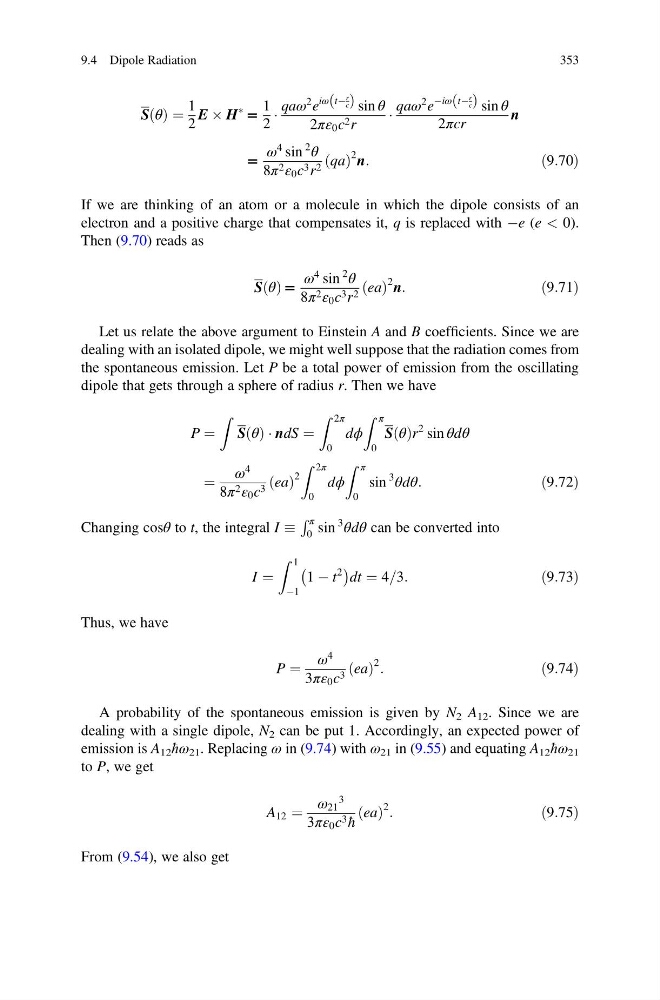
If we are thinking of an atom or a molecule in which the dipole consists of an
electron and a positive charge that compensates it, q is replaced with Àe (e < 0).
Then (9.70) reads as
S θ
ð Þ =
ω
4 sin
2
θ
8π 2 ε 0 c 3 r 2 ea
ð Þ
2 n:
ð9:71Þ
Let us relate the above argument to Einstein A and B coefficients. Since we are
dealing with an isolated dipole, we might well suppose that the radiation comes from
the spontaneous emission. Let P be a total power of emission from the oscillating
dipole that gets through a sphere of radius r. Then we have
P ¼
Z
S θ
ð Þ Á ndS ¼
Z 2π
0
dϕ
Z π
0
S θ
ð Þr
2 sin θdθ
¼
ω
4
8π 2 ε 0 c 3 ea
ð Þ
2
Z 2π
0
dϕ
Z π
0
sin
3
θdθ:
ð9:72Þ
Changing cosθ to t, the integral I
R π
0 sin
3
θdθ can be converted into
I ¼
Z 1
À1
1 À t
2
À
Á
dt ¼ 4=3:
ð9:73Þ
Thus, we have
P ¼
ω
4
3πε 0 c 3 ea
ð Þ
2 :
ð9:74Þ
A probability of the spontaneous emission is given by N 2 A 12 . Since we are
dealing with a single dipole, N 2 can be put 1. Accordingly, an expected power of
emission is A 12 ħω 21 . Replacing ω in (9.74) with ω 21 in (9.55) and equating A 12 ħω 21
to P, we get
A 12 ¼
ω 21
3
3πε 0 c 3 ħ
ea
ð Þ
2 :
ð9:75Þ
From (9.54), we also get
9.4 Dipole Radiation
353
ð Þ ¼
1
2
E Â H
Ã
=
1
2
Á
qaω
2 e
iω tÀ
r
c
ð Þ sin θ
2πε 0 c 2 r
Á
qaω
2 e
Àiω tÀ
r
c
ð Þ sin θ
2πcr
n
=
ω
4 sin
2
θ
8π 2 ε 0 c 3 r 2 qa
ð Þ
2 n:
ð9:70Þ
If we are thinking of an atom or a molecule in which the dipole consists of an
electron and a positive charge that compensates it, q is replaced with Àe (e < 0).
Then (9.70) reads as
S θ
ð Þ =
ω
4 sin
2
θ
8π 2 ε 0 c 3 r 2 ea
ð Þ
2 n:
ð9:71Þ
Let us relate the above argument to Einstein A and B coefficients. Since we are
dealing with an isolated dipole, we might well suppose that the radiation comes from
the spontaneous emission. Let P be a total power of emission from the oscillating
dipole that gets through a sphere of radius r. Then we have
P ¼
Z
S θ
ð Þ Á ndS ¼
Z 2π
0
dϕ
Z π
0
S θ
ð Þr
2 sin θdθ
¼
ω
4
8π 2 ε 0 c 3 ea
ð Þ
2
Z 2π
0
dϕ
Z π
0
sin
3
θdθ:
ð9:72Þ
Changing cosθ to t, the integral I
R π
0 sin
3
θdθ can be converted into
I ¼
Z 1
À1
1 À t
2
À
Á
dt ¼ 4=3:
ð9:73Þ
Thus, we have
P ¼
ω
4
3πε 0 c 3 ea
ð Þ
2 :
ð9:74Þ
A probability of the spontaneous emission is given by N 2 A 12 . Since we are
dealing with a single dipole, N 2 can be put 1. Accordingly, an expected power of
emission is A 12 ħω 21 . Replacing ω in (9.74) with ω 21 in (9.55) and equating A 12 ħω 21
to P, we get
A 12 ¼
ω 21
3
3πε 0 c 3 ħ
ea
ð Þ
2 :
ð9:75Þ
From (9.54), we also get
9.4 Dipole Radiation
353