

dipole and surrounding space of it. For the electromagnetic radiation, an accelerated
motion of the dipole is of primary importance. The electromagnetic fields produced
by €
p t
ð Þ vary as the inverse of r, where r is a macroscopic distance between the dipole
and observation point. Namely, r is much larger compared to the dipole size.
There are other electromagnetic fields that result from the dipole moment. The
fields result from p(t) and _
p t
ð Þ. Strictly speaking, we have to include those quantities
that are responsible for the electromagnetic fields associated with the dipole radiation. Nevertheless, the fields produced by p(t) and _
p t
ð Þ vary as a function of the
inverse cube and inverse square of r, respectively. Therefore, the surface integral of
the square of the fields associated with p(t) and _
p t
ð Þ asymptotically reaches zero with
enough large r with respect to a sphere enveloping the dipole. Regarding €
p t
ð Þ, on the
other hand, the surface integral of the square of the fields remains finite even with
enough large r. For this reason, we refer to the spatial region where €
p t
ð Þ does not
vanish as a wave zone.
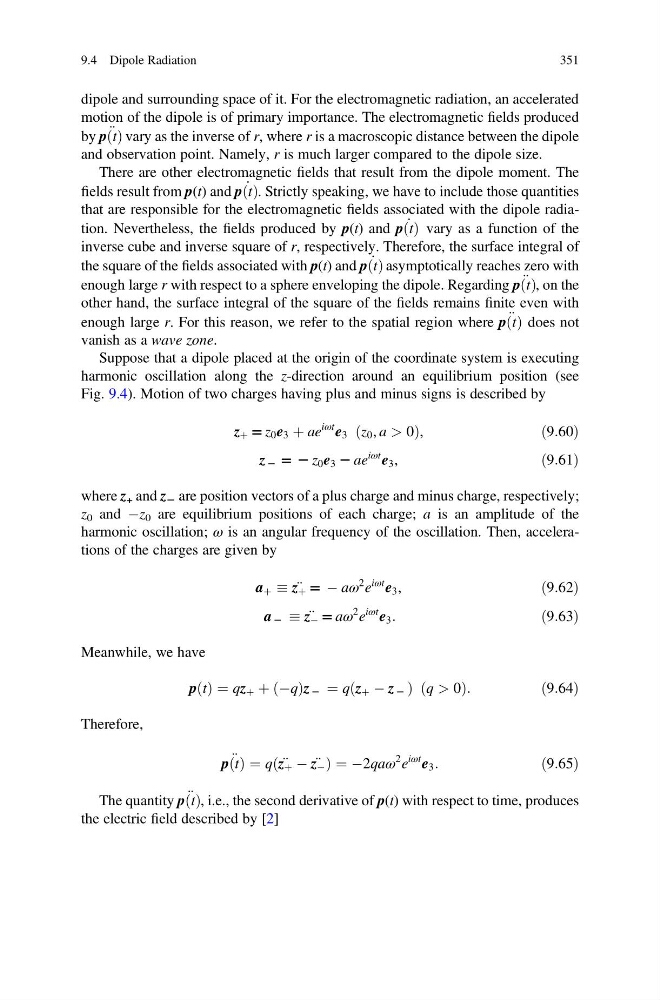
Suppose that a dipole placed at the origin of the coordinate system is executing
harmonic oscillation along the z-direction around an equilibrium position (see
Fig. 9.4). Motion of two charges having plus and minus signs is described by
z þ = z 0 e 3 þ ae
iωt
e 3 z 0 , a > 0
ð
Þ ,
ð9:60Þ
z 2 = 2 z 0 e 3 2 ae
iωt
e 3 ,
ð9:61Þ
where z + and z 2 are position vectors of a plus charge and minus charge, respectively;
z 0 and Àz 0 are equilibrium positions of each charge; a is an amplitude of the
harmonic oscillation; ω is an angular frequency of the oscillation. Then, accelerations of the charges are given by
a þ €
z þ = À aω
2 e
iωt
e 3 ,
ð9:62Þ
a 2 €
z À = aω
2 e
iωt
e 3 :
ð9:63Þ
Meanwhile, we have
p t
ð Þ ¼ qz þ þ Àq
ð Þz 2 ¼ q z þ À z 2
ð
Þ q > 0
ð
Þ:
ð9:64Þ
Therefore,
€
p t
ð Þ ¼ q €
z þ À €
z À
ð
Þ¼À 2qaω
2 e
iωt
e 3 :
ð9:65Þ
The quantity €
p t
ð Þ, i.e., the second derivative of p(t) with respect to time, produces
the electric field described by [2]
9.4 Dipole Radiation
351
motion of the dipole is of primary importance. The electromagnetic fields produced
by €
p t
ð Þ vary as the inverse of r, where r is a macroscopic distance between the dipole
and observation point. Namely, r is much larger compared to the dipole size.
There are other electromagnetic fields that result from the dipole moment. The
fields result from p(t) and _
p t
ð Þ. Strictly speaking, we have to include those quantities
that are responsible for the electromagnetic fields associated with the dipole radiation. Nevertheless, the fields produced by p(t) and _
p t
ð Þ vary as a function of the
inverse cube and inverse square of r, respectively. Therefore, the surface integral of
the square of the fields associated with p(t) and _
p t
ð Þ asymptotically reaches zero with
enough large r with respect to a sphere enveloping the dipole. Regarding €
p t
ð Þ, on the
other hand, the surface integral of the square of the fields remains finite even with
enough large r. For this reason, we refer to the spatial region where €
p t
ð Þ does not
vanish as a wave zone.
Suppose that a dipole placed at the origin of the coordinate system is executing
harmonic oscillation along the z-direction around an equilibrium position (see
Fig. 9.4). Motion of two charges having plus and minus signs is described by
z þ = z 0 e 3 þ ae
iωt
e 3 z 0 , a > 0
ð
Þ ,
ð9:60Þ
z 2 = 2 z 0 e 3 2 ae
iωt
e 3 ,
ð9:61Þ
where z + and z 2 are position vectors of a plus charge and minus charge, respectively;
z 0 and Àz 0 are equilibrium positions of each charge; a is an amplitude of the
harmonic oscillation; ω is an angular frequency of the oscillation. Then, accelerations of the charges are given by
a þ €
z þ = À aω
2 e
iωt
e 3 ,
ð9:62Þ
a 2 €
z À = aω
2 e
iωt
e 3 :
ð9:63Þ
Meanwhile, we have
p t
ð Þ ¼ qz þ þ Àq
ð Þz 2 ¼ q z þ À z 2
ð
Þ q > 0
ð
Þ:
ð9:64Þ
Therefore,
€
p t
ð Þ ¼ q €
z þ À €
z À
ð
Þ¼À 2qaω
2 e
iωt
e 3 :
ð9:65Þ
The quantity €
p t
ð Þ, i.e., the second derivative of p(t) with respect to time, produces
the electric field described by [2]
9.4 Dipole Radiation
351