

p
0 t
ð Þ ¼
X
i
q i x
0
i ¼
X
i
q i x 0 þ x i
ð
Þ¼
X
i
q i
x 0 þ
X
i
q i x i ¼
X
i
q i x i
¼ p t
ð Þ:
ð9:58Þ
Notice that with the third equality the first term vanishes because the total charge is
zero. The system comprising two point charges that have an opposite charge (Æq) is
particularly simple but very important. In that case we have
p t
ð Þ ¼ qx 1 þ Àq
ð Þx 2 ¼ q x 1 À x 2
ð
Þ¼qe x:
ð9:59Þ
Here we assume that q > 0 according to the custom and, hence, e x is a vector directing
from the minus point charge to the plus charge.
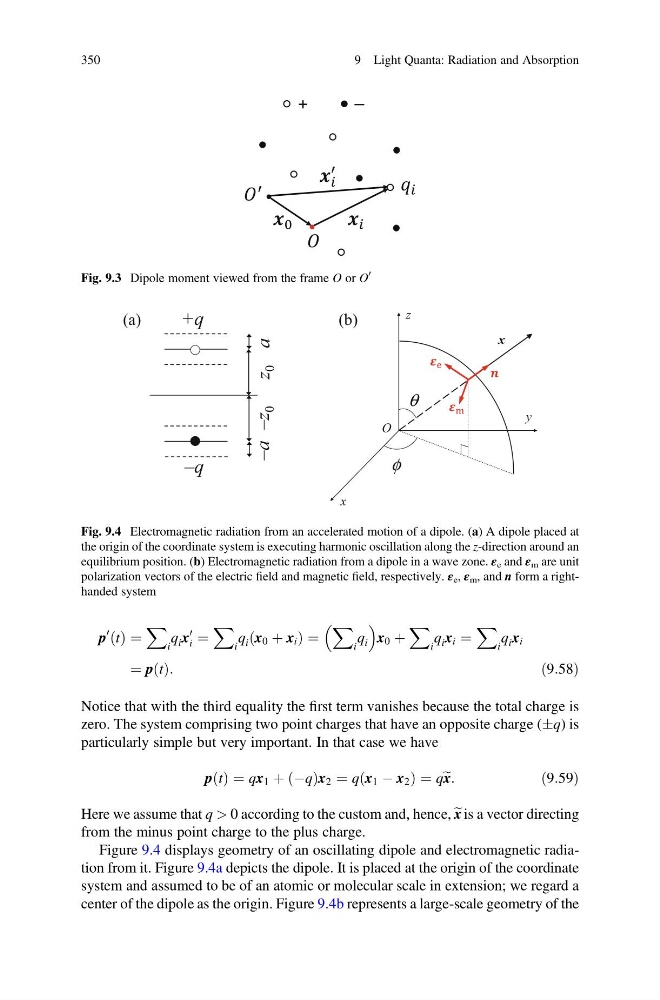
Figure 9.4 displays geometry of an oscillating dipole and electromagnetic radiation from it. Figure 9.4a depicts the dipole. It is placed at the origin of the coordinate
system and assumed to be of an atomic or molecular scale in extension; we regard a
center of the dipole as the origin. Figure 9.4b represents a large-scale geometry of the
ಥ
.
᧧
.
Fig. 9.3 Dipole moment viewed from the frame O or O
0
(a)
(b)
a
z
0
‒z
0
‒a
+q
‒q
y
x
z
O
θ
φ
x
Fig. 9.4 Electromagnetic radiation from an accelerated motion of a dipole. (a) A dipole placed at
the origin of the coordinate system is executing harmonic oscillation along the z-direction around an
equilibrium position. (b) Electromagnetic radiation from a dipole in a wave zone. ε e and ε m are unit
polarization vectors of the electric field and magnetic field, respectively. ε e , ε m , and n form a righthanded system
350
9 Light Quanta: Radiation and Absorption
0 t
ð Þ ¼
X
i
q i x
0
i ¼
X
i
q i x 0 þ x i
ð
Þ¼
X
i
q i
x 0 þ
X
i
q i x i ¼
X
i
q i x i
¼ p t
ð Þ:
ð9:58Þ
Notice that with the third equality the first term vanishes because the total charge is
zero. The system comprising two point charges that have an opposite charge (Æq) is
particularly simple but very important. In that case we have
p t
ð Þ ¼ qx 1 þ Àq
ð Þx 2 ¼ q x 1 À x 2
ð
Þ¼qe x:
ð9:59Þ
Here we assume that q > 0 according to the custom and, hence, e x is a vector directing
from the minus point charge to the plus charge.
Figure 9.4 displays geometry of an oscillating dipole and electromagnetic radiation from it. Figure 9.4a depicts the dipole. It is placed at the origin of the coordinate
system and assumed to be of an atomic or molecular scale in extension; we regard a
center of the dipole as the origin. Figure 9.4b represents a large-scale geometry of the
ಥ
.
᧧
.
Fig. 9.3 Dipole moment viewed from the frame O or O
0
(a)
(b)
a
z
0
‒z
0
‒a
+q
‒q
y
x
z
O
θ
φ
x
Fig. 9.4 Electromagnetic radiation from an accelerated motion of a dipole. (a) A dipole placed at
the origin of the coordinate system is executing harmonic oscillation along the z-direction around an
equilibrium position. (b) Electromagnetic radiation from a dipole in a wave zone. ε e and ε m are unit
polarization vectors of the electric field and magnetic field, respectively. ε e , ε m , and n form a righthanded system
350
9 Light Quanta: Radiation and Absorption