

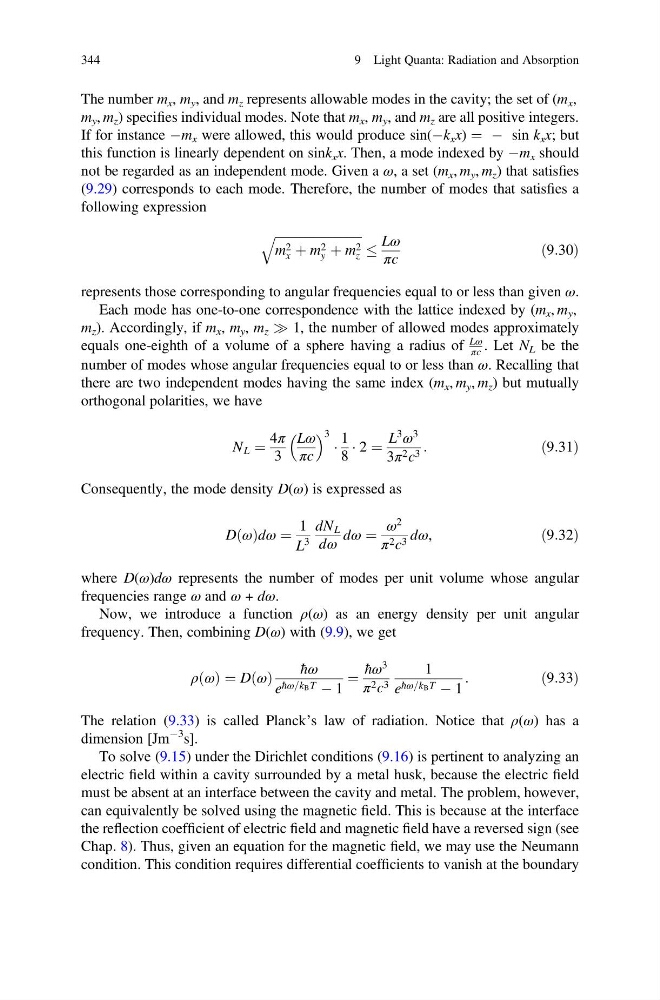
The number m x , m y , and m z represents allowable modes in the cavity; the set of (m x ,
m y , m z ) specifies individual modes. Note that m x , m y , and m z are all positive integers.
If for instance Àm x were allowed, this would produce sin(Àk x x) ¼ À sin k x x; but
this function is linearly dependent on sink x x. Then, a mode indexed by Àm x should
not be regarded as an independent mode. Given a ω, a set (m x , m y , m z ) that satisfies
(9.29) corresponds to each mode. Therefore, the number of modes that satisfies a
following expression
ffiffiffiffiffiffiffiffiffiffiffiffiffiffiffiffiffiffiffiffiffiffiffiffiffiffiffiffi
m 2
x þ m 2
y þ m 2
z
q
Lω
πc
ð9:30Þ
represents those corresponding to angular frequencies equal to or less than given ω.
Each mode has one-to-one correspondence with the lattice indexed by (m x , m y ,
m z ). Accordingly, if m x , m y , m z ) 1, the number of allowed modes approximately
equals one-eighth of a volume of a sphere having a radius of
Lω
πc . Let N L be the
number of modes whose angular frequencies equal to or less than ω. Recalling that
there are two independent modes having the same index (m x , m y , m z ) but mutually
orthogonal polarities, we have
N L ¼
4π
3
Lω
πc
3
Á
1
8
Á 2 ¼
L
3
ω
3
3π 2 c 3 :
ð9:31Þ
Consequently, the mode density D(ω) is expressed as
D ω
ð Þdω ¼
1
L
3
dN L
dω
dω ¼
ω
2
π 2 c 3 dω,
ð9:32Þ
where D(ω)dω represents the number of modes per unit volume whose angular
frequencies range ω and ω + dω.
Now, we introduce a function ρ(ω) as an energy density per unit angular
frequency. Then, combining D(ω) with (9.9), we get
ρ ω
ð Þ ¼ D ω
ð Þ
ħω
e ħω=k B T À 1
¼
ħω
3
π 2 c 3
1
e ħω=k B T À 1
:
ð9:33Þ
The relation (9.33) is called Planck’s law of radiation. Notice that ρ(ω) has a
dimension [Jm
À3 s].
To solve (9.15) under the Dirichlet conditions (9.16) is pertinent to analyzing an
electric field within a cavity surrounded by a metal husk, because the electric field
must be absent at an interface between the cavity and metal. The problem, however,
can equivalently be solved using the magnetic field. This is because at the interface
the reflection coefficient of electric field and magnetic field have a reversed sign (see
Chap. 8). Thus, given an equation for the magnetic field, we may use the Neumann
condition. This condition requires differential coefficients to vanish at the boundary
344
9 Light Quanta: Radiation and Absorption
m y , m z ) specifies individual modes. Note that m x , m y , and m z are all positive integers.
If for instance Àm x were allowed, this would produce sin(Àk x x) ¼ À sin k x x; but
this function is linearly dependent on sink x x. Then, a mode indexed by Àm x should
not be regarded as an independent mode. Given a ω, a set (m x , m y , m z ) that satisfies
(9.29) corresponds to each mode. Therefore, the number of modes that satisfies a
following expression
ffiffiffiffiffiffiffiffiffiffiffiffiffiffiffiffiffiffiffiffiffiffiffiffiffiffiffiffi
m 2
x þ m 2
y þ m 2
z
q
Lω
πc
ð9:30Þ
represents those corresponding to angular frequencies equal to or less than given ω.
Each mode has one-to-one correspondence with the lattice indexed by (m x , m y ,
m z ). Accordingly, if m x , m y , m z ) 1, the number of allowed modes approximately
equals one-eighth of a volume of a sphere having a radius of
Lω
πc . Let N L be the
number of modes whose angular frequencies equal to or less than ω. Recalling that
there are two independent modes having the same index (m x , m y , m z ) but mutually
orthogonal polarities, we have
N L ¼
4π
3
Lω
πc
3
Á
1
8
Á 2 ¼
L
3
ω
3
3π 2 c 3 :
ð9:31Þ
Consequently, the mode density D(ω) is expressed as
D ω
ð Þdω ¼
1
L
3
dN L
dω
dω ¼
ω
2
π 2 c 3 dω,
ð9:32Þ
where D(ω)dω represents the number of modes per unit volume whose angular
frequencies range ω and ω + dω.
Now, we introduce a function ρ(ω) as an energy density per unit angular
frequency. Then, combining D(ω) with (9.9), we get
ρ ω
ð Þ ¼ D ω
ð Þ
ħω
e ħω=k B T À 1
¼
ħω
3
π 2 c 3
1
e ħω=k B T À 1
:
ð9:33Þ
The relation (9.33) is called Planck’s law of radiation. Notice that ρ(ω) has a
dimension [Jm
À3 s].
To solve (9.15) under the Dirichlet conditions (9.16) is pertinent to analyzing an
electric field within a cavity surrounded by a metal husk, because the electric field
must be absent at an interface between the cavity and metal. The problem, however,
can equivalently be solved using the magnetic field. This is because at the interface
the reflection coefficient of electric field and magnetic field have a reversed sign (see
Chap. 8). Thus, given an equation for the magnetic field, we may use the Neumann
condition. This condition requires differential coefficients to vanish at the boundary
344
9 Light Quanta: Radiation and Absorption