

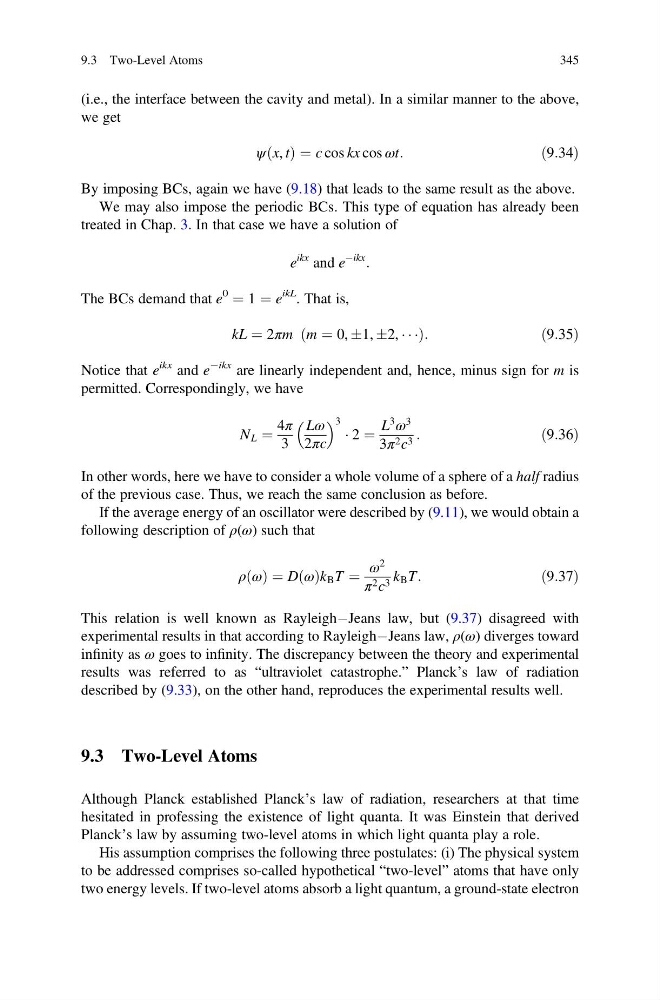
(i.e., the interface between the cavity and metal). In a similar manner to the above,
we get
ψ x, t
ð Þ ¼ c cos kx cos ωt:
ð9:34Þ
By imposing BCs, again we have (9.18) that leads to the same result as the above.
We may also impose the periodic BCs. This type of equation has already been
treated in Chap. 3. In that case we have a solution of
e
ikx and e
Àikx
:
The BCs demand that e
0 ¼ 1 ¼ e
ikL . That is,
kL ¼ 2πm m ¼ 0, Æ1, Æ2, Á Á Á
ð
Þ :
ð9:35Þ
Notice that e
ikx and e
Àikx are linearly independent and, hence, minus sign for m is
permitted. Correspondingly, we have
N L ¼
4π
3
Lω
2πc
3
Á 2 ¼
L
3
ω
3
3π 2 c 3 :
ð9:36Þ
In other words, here we have to consider a whole volume of a sphere of a half radius
of the previous case. Thus, we reach the same conclusion as before.
If the average energy of an oscillator were described by (9.11), we would obtain a
following description of ρ(ω) such that
ρ ω
ð Þ ¼ D ω
ð Þk B T ¼
ω
2
π 2 c 3 k B T:
ð9:37Þ
This relation is well known as RayleighÀJeans law, but (9.37) disagreed with
experimental results in that according to RayleighÀJeans law, ρ(ω) diverges toward
infinity as ω goes to infinity. The discrepancy between the theory and experimental
results was referred to as “ultraviolet catastrophe.” Planck’s law of radiation
described by (9.33), on the other hand, reproduces the experimental results well.
9.3 Two-Level Atoms
Although Planck established Planck’s law of radiation, researchers at that time
hesitated in professing the existence of light quanta. It was Einstein that derived
Planck’s law by assuming two-level atoms in which light quanta play a role.
His assumption comprises the following three postulates: (i) The physical system
to be addressed comprises so-called hypothetical “two-level” atoms that have only
two energy levels. If two-level atoms absorb a light quantum, a ground-state electron
9.3 Two-Level Atoms
345
we get
ψ x, t
ð Þ ¼ c cos kx cos ωt:
ð9:34Þ
By imposing BCs, again we have (9.18) that leads to the same result as the above.
We may also impose the periodic BCs. This type of equation has already been
treated in Chap. 3. In that case we have a solution of
e
ikx and e
Àikx
:
The BCs demand that e
0 ¼ 1 ¼ e
ikL . That is,
kL ¼ 2πm m ¼ 0, Æ1, Æ2, Á Á Á
ð
Þ :
ð9:35Þ
Notice that e
ikx and e
Àikx are linearly independent and, hence, minus sign for m is
permitted. Correspondingly, we have
N L ¼
4π
3
Lω
2πc
3
Á 2 ¼
L
3
ω
3
3π 2 c 3 :
ð9:36Þ
In other words, here we have to consider a whole volume of a sphere of a half radius
of the previous case. Thus, we reach the same conclusion as before.
If the average energy of an oscillator were described by (9.11), we would obtain a
following description of ρ(ω) such that
ρ ω
ð Þ ¼ D ω
ð Þk B T ¼
ω
2
π 2 c 3 k B T:
ð9:37Þ
This relation is well known as RayleighÀJeans law, but (9.37) disagreed with
experimental results in that according to RayleighÀJeans law, ρ(ω) diverges toward
infinity as ω goes to infinity. The discrepancy between the theory and experimental
results was referred to as “ultraviolet catastrophe.” Planck’s law of radiation
described by (9.33), on the other hand, reproduces the experimental results well.
9.3 Two-Level Atoms
Although Planck established Planck’s law of radiation, researchers at that time
hesitated in professing the existence of light quanta. It was Einstein that derived
Planck’s law by assuming two-level atoms in which light quanta play a role.
His assumption comprises the following three postulates: (i) The physical system
to be addressed comprises so-called hypothetical “two-level” atoms that have only
two energy levels. If two-level atoms absorb a light quantum, a ground-state electron
9.3 Two-Level Atoms
345