

E = E 1 ε e e
i kzÀωt
ð
Þ
þ e
i ÀkzÀωt
ð
Þ
h
i
¼ E 1 ε e e
Àiωt e
ikz
þ e
Àikz
À
Á ¼ 2E 1 ε e e
Àiωt cos kz:
ð8:197Þ
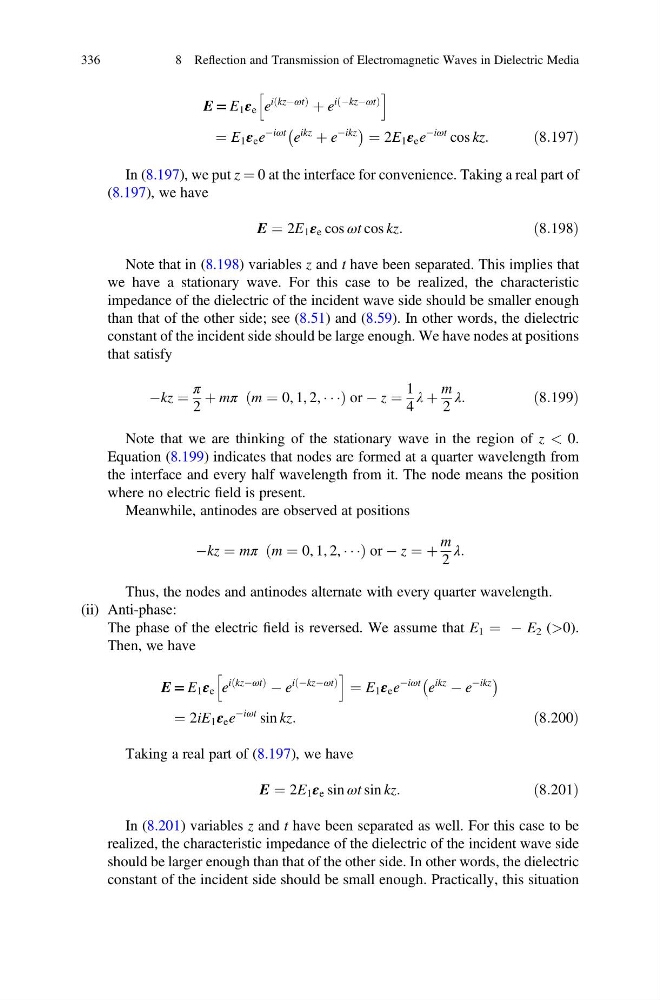
In (8.197), we put z ¼ 0 at the interface for convenience. Taking a real part of
(8.197), we have
E ¼ 2E 1 ε e cos ωt cos kz:
ð8:198Þ
Note that in (8.198) variables z and t have been separated. This implies that
we have a stationary wave. For this case to be realized, the characteristic
impedance of the dielectric of the incident wave side should be smaller enough
than that of the other side; see (8.51) and (8.59). In other words, the dielectric
constant of the incident side should be large enough. We have nodes at positions
that satisfy
Àkz ¼
π
2
þ mπ m ¼ 0, 1, 2, Á Á Á
ð
Þ or À z ¼
1
4
λ þ
m
2
λ:
ð8:199Þ
Note that we are thinking of the stationary wave in the region of z < 0.
Equation (8.199) indicates that nodes are formed at a quarter wavelength from
the interface and every half wavelength from it. The node means the position
where no electric field is present.
Meanwhile, antinodes are observed at positions
Àkz ¼ mπ m ¼ 0, 1, 2, Á Á Á
ð
Þ or À z ¼ þ
m
2
λ:
Thus, the nodes and antinodes alternate with every quarter wavelength.
(ii) Anti-phase:
The phase of the electric field is reversed. We assume that E 1 ¼ À E 2 (>0).
Then, we have
E = E 1 ε e e
i kzÀωt
ð
Þ
À e
i ÀkzÀωt
ð
Þ
h
i
¼ E 1 ε e e
Àiωt e
ikz
À e
Àikz
À
Á
¼ 2iE 1 ε e e
Àiωt sin kz:
ð8:200Þ
Taking a real part of (8.197), we have
E ¼ 2E 1 ε e sin ωt sin kz:
ð8:201Þ
In (8.201) variables z and t have been separated as well. For this case to be
realized, the characteristic impedance of the dielectric of the incident wave side
should be larger enough than that of the other side. In other words, the dielectric
constant of the incident side should be small enough. Practically, this situation
336
8 Reflection and Transmission of Electromagnetic Waves in Dielectric Media
i kzÀωt
ð
Þ
þ e
i ÀkzÀωt
ð
Þ
h
i
¼ E 1 ε e e
Àiωt e
ikz
þ e
Àikz
À
Á ¼ 2E 1 ε e e
Àiωt cos kz:
ð8:197Þ
In (8.197), we put z ¼ 0 at the interface for convenience. Taking a real part of
(8.197), we have
E ¼ 2E 1 ε e cos ωt cos kz:
ð8:198Þ
Note that in (8.198) variables z and t have been separated. This implies that
we have a stationary wave. For this case to be realized, the characteristic
impedance of the dielectric of the incident wave side should be smaller enough
than that of the other side; see (8.51) and (8.59). In other words, the dielectric
constant of the incident side should be large enough. We have nodes at positions
that satisfy
Àkz ¼
π
2
þ mπ m ¼ 0, 1, 2, Á Á Á
ð
Þ or À z ¼
1
4
λ þ
m
2
λ:
ð8:199Þ
Note that we are thinking of the stationary wave in the region of z < 0.
Equation (8.199) indicates that nodes are formed at a quarter wavelength from
the interface and every half wavelength from it. The node means the position
where no electric field is present.
Meanwhile, antinodes are observed at positions
Àkz ¼ mπ m ¼ 0, 1, 2, Á Á Á
ð
Þ or À z ¼ þ
m
2
λ:
Thus, the nodes and antinodes alternate with every quarter wavelength.
(ii) Anti-phase:
The phase of the electric field is reversed. We assume that E 1 ¼ À E 2 (>0).
Then, we have
E = E 1 ε e e
i kzÀωt
ð
Þ
À e
i ÀkzÀωt
ð
Þ
h
i
¼ E 1 ε e e
Àiωt e
ikz
À e
Àikz
À
Á
¼ 2iE 1 ε e e
Àiωt sin kz:
ð8:200Þ
Taking a real part of (8.197), we have
E ¼ 2E 1 ε e sin ωt sin kz:
ð8:201Þ
In (8.201) variables z and t have been separated as well. For this case to be
realized, the characteristic impedance of the dielectric of the incident wave side
should be larger enough than that of the other side. In other words, the dielectric
constant of the incident side should be small enough. Practically, this situation
336
8 Reflection and Transmission of Electromagnetic Waves in Dielectric Media