

can easily be attained choosing a metal of high reflectance for the wall material.
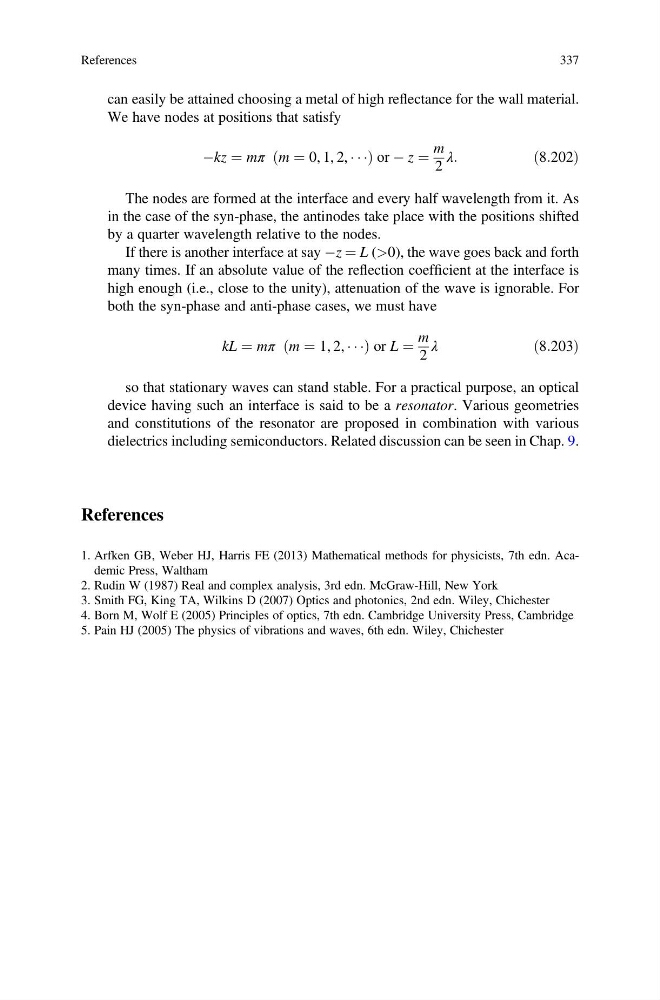
We have nodes at positions that satisfy
Àkz ¼ mπ m ¼ 0, 1, 2, Á Á Á
ð
Þ or À z ¼
m
2
λ:
ð8:202Þ
The nodes are formed at the interface and every half wavelength from it. As
in the case of the syn-phase, the antinodes take place with the positions shifted
by a quarter wavelength relative to the nodes.
If there is another interface at say Àz ¼ L (>0), the wave goes back and forth
many times. If an absolute value of the reflection coefficient at the interface is
high enough (i.e., close to the unity), attenuation of the wave is ignorable. For
both the syn-phase and anti-phase cases, we must have
kL ¼ mπ m ¼ 1, 2, Á Á Á
ð
Þor L ¼
m
2
λ
ð8:203Þ
so that stationary waves can stand stable. For a practical purpose, an optical
device having such an interface is said to be a resonator. Various geometries
and constitutions of the resonator are proposed in combination with various
dielectrics including semiconductors. Related discussion can be seen in Chap. 9.
References
1. Arfken GB, Weber HJ, Harris FE (2013) Mathematical methods for physicists, 7th edn. Academic Press, Waltham
2. Rudin W (1987) Real and complex analysis, 3rd edn. McGraw-Hill, New York
3. Smith FG, King TA, Wilkins D (2007) Optics and photonics, 2nd edn. Wiley, Chichester
4. Born M, Wolf E (2005) Principles of optics, 7th edn. Cambridge University Press, Cambridge
5. Pain HJ (2005) The physics of vibrations and waves, 6th edn. Wiley, Chichester
References
337
We have nodes at positions that satisfy
Àkz ¼ mπ m ¼ 0, 1, 2, Á Á Á
ð
Þ or À z ¼
m
2
λ:
ð8:202Þ
The nodes are formed at the interface and every half wavelength from it. As
in the case of the syn-phase, the antinodes take place with the positions shifted
by a quarter wavelength relative to the nodes.
If there is another interface at say Àz ¼ L (>0), the wave goes back and forth
many times. If an absolute value of the reflection coefficient at the interface is
high enough (i.e., close to the unity), attenuation of the wave is ignorable. For
both the syn-phase and anti-phase cases, we must have
kL ¼ mπ m ¼ 1, 2, Á Á Á
ð
Þor L ¼
m
2
λ
ð8:203Þ
so that stationary waves can stand stable. For a practical purpose, an optical
device having such an interface is said to be a resonator. Various geometries
and constitutions of the resonator are proposed in combination with various
dielectrics including semiconductors. Related discussion can be seen in Chap. 9.
References
1. Arfken GB, Weber HJ, Harris FE (2013) Mathematical methods for physicists, 7th edn. Academic Press, Waltham
2. Rudin W (1987) Real and complex analysis, 3rd edn. McGraw-Hill, New York
3. Smith FG, King TA, Wilkins D (2007) Optics and photonics, 2nd edn. Wiley, Chichester
4. Born M, Wolf E (2005) Principles of optics, 7th edn. Cambridge University Press, Cambridge
5. Pain HJ (2005) The physics of vibrations and waves, 6th edn. Wiley, Chichester
References
337