

In other words, there is no instant t 0 when ψ(x, t 0 ) ¼ 0 for any x. From the aspect of
energy transport of electromagnetic waves, if |a 1 | > j a 2 j (where a 1 and a 2 represent
an amplitude of the forward and backward waves, respectively), the net energy flow
takes place in the travelling direction of the forward wave. If, on the other hand, |
a 1 | > ja 2 j, the net energy flow takes place in the travelling direction of the backward
wave. In this respect, think of Poynting vectors.
In case |a 1 | ¼ ja 2 j, the situation is particularly simple. No net energy flow takes
place in this case. Correspondingly, we observe nodes. Such waves are called
stationary waves. Let us consider this simple situation for an electromagnetic wave
that is incident perpendicularly to the interface between two dielectrics (one of them
may be a metal).
Returning back to (7.58) and (7.66), we describe two electromagnetic waves that
are propagating in the positive and negative direction of the z-axis such that
E 1 = E 1 ε e e
i kzÀωt
ð
Þ and E 2 = E 2 ε e e
i ÀkzÀωt
ð
Þ ,
ð8:195Þ
where ε e is a unit polarization vector arbitrarily fixed so that it can be parallel to the
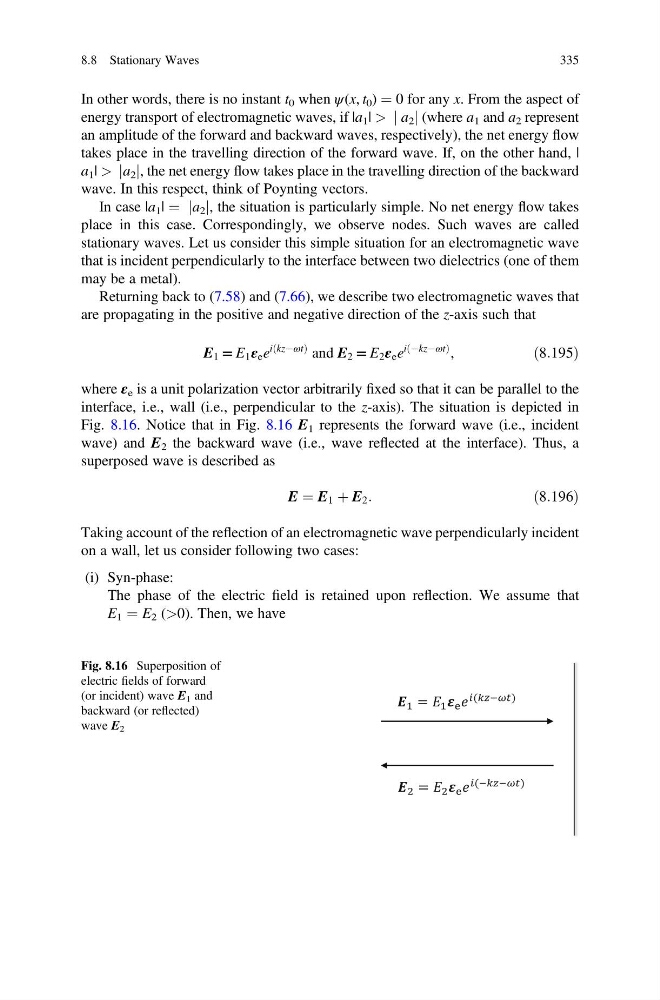
interface, i.e., wall (i.e., perpendicular to the z-axis). The situation is depicted in
Fig. 8.16. Notice that in Fig. 8.16 E 1 represents the forward wave (i.e., incident
wave) and E 2 the backward wave (i.e., wave reflected at the interface). Thus, a
superposed wave is described as
E ¼ E 1 þ E 2 :
ð8:196Þ
Taking account of the reflection of an electromagnetic wave perpendicularly incident
on a wall, let us consider following two cases:
(i) Syn-phase:
The phase of the electric field is retained upon reflection. We assume that
E 1 ¼ E 2 (>0). Then, we have
=
(
)
=
(
)
Fig. 8.16 Superposition of
electric fields of forward
(or incident) wave E 1 and
backward (or reflected)
wave E 2
8.8 Stationary Waves
335
energy transport of electromagnetic waves, if |a 1 | > j a 2 j (where a 1 and a 2 represent
an amplitude of the forward and backward waves, respectively), the net energy flow
takes place in the travelling direction of the forward wave. If, on the other hand, |
a 1 | > ja 2 j, the net energy flow takes place in the travelling direction of the backward
wave. In this respect, think of Poynting vectors.
In case |a 1 | ¼ ja 2 j, the situation is particularly simple. No net energy flow takes
place in this case. Correspondingly, we observe nodes. Such waves are called
stationary waves. Let us consider this simple situation for an electromagnetic wave
that is incident perpendicularly to the interface between two dielectrics (one of them
may be a metal).
Returning back to (7.58) and (7.66), we describe two electromagnetic waves that
are propagating in the positive and negative direction of the z-axis such that
E 1 = E 1 ε e e
i kzÀωt
ð
Þ and E 2 = E 2 ε e e
i ÀkzÀωt
ð
Þ ,
ð8:195Þ
where ε e is a unit polarization vector arbitrarily fixed so that it can be parallel to the
interface, i.e., wall (i.e., perpendicular to the z-axis). The situation is depicted in
Fig. 8.16. Notice that in Fig. 8.16 E 1 represents the forward wave (i.e., incident
wave) and E 2 the backward wave (i.e., wave reflected at the interface). Thus, a
superposed wave is described as
E ¼ E 1 þ E 2 :
ð8:196Þ
Taking account of the reflection of an electromagnetic wave perpendicularly incident
on a wall, let us consider following two cases:
(i) Syn-phase:
The phase of the electric field is retained upon reflection. We assume that
E 1 ¼ E 2 (>0). Then, we have
=
(
)
=
(
)
Fig. 8.16 Superposition of
electric fields of forward
(or incident) wave E 1 and
backward (or reflected)
wave E 2
8.8 Stationary Waves
335