

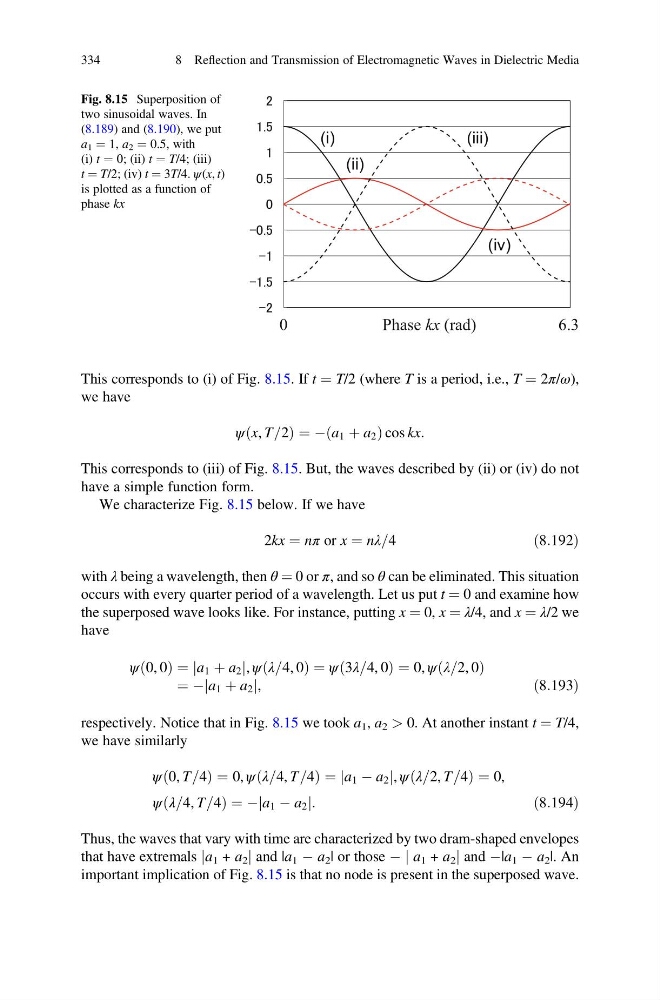
This corresponds to (i) of Fig. 8.15. If t ¼ T/2 (where T is a period, i.e., T ¼ 2π/ω),
we have
ψ x, T=2
ð
Þ¼À a 1 þ a 2
ð
Þcos kx:
This corresponds to (iii) of Fig. 8.15. But, the waves described by (ii) or (iv) do not
have a simple function form.
We characterize Fig. 8.15 below. If we have
2kx ¼ nπ or x ¼ nλ=4
ð8:192Þ
with λ being a wavelength, then θ ¼ 0 or π, and so θ can be eliminated. This situation
occurs with every quarter period of a wavelength. Let us put t ¼ 0 and examine how
the superposed wave looks like. For instance, putting x ¼ 0, x ¼ λ/4, and x ¼ λ/2 we
have
ψ 0, 0
ð Þ ¼ a 1 þ a 2
j
j, ψ λ=4, 0
ð
Þ¼ψ 3λ=4, 0
ð
Þ¼0, ψ λ=2, 0
ð
Þ
¼ À a 1 þ a 2
j
j,
ð8:193Þ
respectively. Notice that in Fig. 8.15 we took a 1 , a 2 > 0. At another instant t ¼ T/4,
we have similarly
ψ 0, T=4
ð
Þ¼0, ψ λ=4, T=4
ð
Þ¼ a 1 À a 2
j
j, ψ λ=2, T=4
ð
Þ¼0,
ψ λ=4, T=4
ð
Þ¼Àa 1 À a 2
j
j :
ð8:194Þ
Thus, the waves that vary with time are characterized by two dram-shaped envelopes
that have extremals ja 1 + a 2 j and |a 1 À a 2 | or those À j a 1 + a 2 j and À|a 1 À a 2 |. An
important implication of Fig. 8.15 is that no node is present in the superposed wave.
㻙㻞
㻙㻝㻚㻡
㻙㻝
㻙㻜㻚㻡
㻜
㻜㻚㻡
㻝
㻝㻚㻡
㻞
Phase kx (rad)
0
6 . 3
(i)
(ii)
(iii)
(iv)
Fig. 8.15 Superposition of
two sinusoidal waves. In
(8.189) and (8.190), we put
a 1 ¼ 1, a 2 ¼ 0.5, with
(i) t ¼ 0; (ii) t ¼ T/4; (iii)
t ¼ T/2; (iv) t ¼ 3T/4. ψ(x, t)
is plotted as a function of
phase kx
334
8 Reflection and Transmission of Electromagnetic Waves in Dielectric Media
we have
ψ x, T=2
ð
Þ¼À a 1 þ a 2
ð
Þcos kx:
This corresponds to (iii) of Fig. 8.15. But, the waves described by (ii) or (iv) do not
have a simple function form.
We characterize Fig. 8.15 below. If we have
2kx ¼ nπ or x ¼ nλ=4
ð8:192Þ
with λ being a wavelength, then θ ¼ 0 or π, and so θ can be eliminated. This situation
occurs with every quarter period of a wavelength. Let us put t ¼ 0 and examine how
the superposed wave looks like. For instance, putting x ¼ 0, x ¼ λ/4, and x ¼ λ/2 we
have
ψ 0, 0
ð Þ ¼ a 1 þ a 2
j
j, ψ λ=4, 0
ð
Þ¼ψ 3λ=4, 0
ð
Þ¼0, ψ λ=2, 0
ð
Þ
¼ À a 1 þ a 2
j
j,
ð8:193Þ
respectively. Notice that in Fig. 8.15 we took a 1 , a 2 > 0. At another instant t ¼ T/4,
we have similarly
ψ 0, T=4
ð
Þ¼0, ψ λ=4, T=4
ð
Þ¼ a 1 À a 2
j
j, ψ λ=2, T=4
ð
Þ¼0,
ψ λ=4, T=4
ð
Þ¼Àa 1 À a 2
j
j :
ð8:194Þ
Thus, the waves that vary with time are characterized by two dram-shaped envelopes
that have extremals ja 1 + a 2 j and |a 1 À a 2 | or those À j a 1 + a 2 j and À|a 1 À a 2 |. An
important implication of Fig. 8.15 is that no node is present in the superposed wave.
㻙㻞
㻙㻝㻚㻡
㻙㻝
㻙㻜㻚㻡
㻜
㻜㻚㻡
㻝
㻝㻚㻡
㻞
Phase kx (rad)
0
6 . 3
(i)
(ii)
(iii)
(iv)
Fig. 8.15 Superposition of
two sinusoidal waves. In
(8.189) and (8.190), we put
a 1 ¼ 1, a 2 ¼ 0.5, with
(i) t ¼ 0; (ii) t ¼ T/4; (iii)
t ¼ T/2; (iv) t ¼ 3T/4. ψ(x, t)
is plotted as a function of
phase kx
334
8 Reflection and Transmission of Electromagnetic Waves in Dielectric Media