

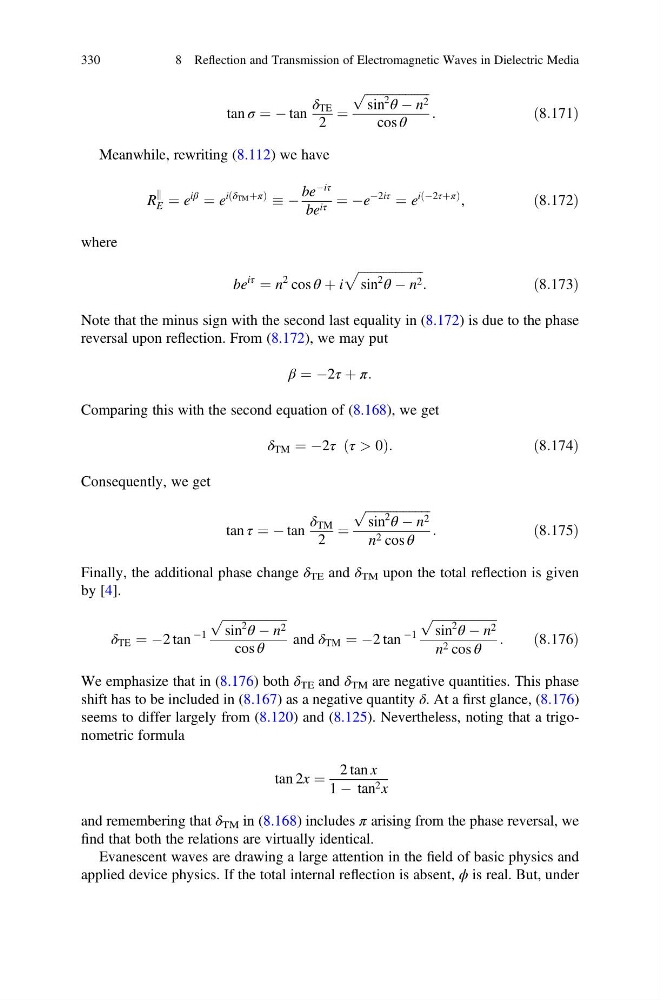
tan σ ¼ À tan
δ TE
2
¼
ffiffiffiffiffiffiffiffiffiffiffiffiffiffiffiffiffiffiffiffiffi
sin
2
θ À n 2
p
cos θ
:
ð8:171Þ
Meanwhile, rewriting (8.112) we have
R
k
E ¼ e
iβ
¼ e
i δ TM þπ
ð
Þ
À
be
Àiτ
be iτ ¼ Àe
À2iτ
¼ e
i À2τþπ
ð
Þ ,
ð8:172Þ
where
be
iτ
¼ n
2 cos θ þ i
ffiffiffiffiffiffiffiffiffiffiffiffiffiffiffiffiffiffiffiffiffi
sin
2
θ À n 2
p
:
ð8:173Þ
Note that the minus sign with the second last equality in (8.172) is due to the phase
reversal upon reflection. From (8.172), we may put
β ¼ À2τ þ π:
Comparing this with the second equation of (8.168), we get
δ TM ¼ À2τ τ > 0
ð
Þ:
ð8:174Þ
Consequently, we get
tan τ ¼ À tan
δ TM
2
¼
ffiffiffiffiffiffiffiffiffiffiffiffiffiffiffiffiffiffiffiffiffi
sin
2
θ À n 2
p
n 2 cos θ
:
ð8:175Þ
Finally, the additional phase change δ TE and δ TM upon the total reflection is given
by [4].
δ TE ¼ À2 tan
À1
ffiffiffiffiffiffiffiffiffiffiffiffiffiffiffiffiffiffiffiffiffi
sin
2
θ À n 2
p
cos θ
and δ TM ¼ À2 tan
À1
ffiffiffiffiffiffiffiffiffiffiffiffiffiffiffiffiffiffiffiffiffi
sin
2
θ À n 2
p
n 2 cos θ
:
ð8:176Þ
We emphasize that in (8.176) both δ TE and δ TM are negative quantities. This phase
shift has to be included in (8.167) as a negative quantity δ. At a first glance, (8.176)
seems to differ largely from (8.120) and (8.125). Nevertheless, noting that a trigonometric formula
tan 2x ¼
2 tan x
1 À tan 2 x
and remembering that δ TM in (8.168) includes π arising from the phase reversal, we
find that both the relations are virtually identical.
Evanescent waves are drawing a large attention in the field of basic physics and
applied device physics. If the total internal reflection is absent, ϕ is real. But, under
330
8 Reflection and Transmission of Electromagnetic Waves in Dielectric Media
δ TE
2
¼
ffiffiffiffiffiffiffiffiffiffiffiffiffiffiffiffiffiffiffiffiffi
sin
2
θ À n 2
p
cos θ
:
ð8:171Þ
Meanwhile, rewriting (8.112) we have
R
k
E ¼ e
iβ
¼ e
i δ TM þπ
ð
Þ
À
be
Àiτ
be iτ ¼ Àe
À2iτ
¼ e
i À2τþπ
ð
Þ ,
ð8:172Þ
where
be
iτ
¼ n
2 cos θ þ i
ffiffiffiffiffiffiffiffiffiffiffiffiffiffiffiffiffiffiffiffiffi
sin
2
θ À n 2
p
:
ð8:173Þ
Note that the minus sign with the second last equality in (8.172) is due to the phase
reversal upon reflection. From (8.172), we may put
β ¼ À2τ þ π:
Comparing this with the second equation of (8.168), we get
δ TM ¼ À2τ τ > 0
ð
Þ:
ð8:174Þ
Consequently, we get
tan τ ¼ À tan
δ TM
2
¼
ffiffiffiffiffiffiffiffiffiffiffiffiffiffiffiffiffiffiffiffiffi
sin
2
θ À n 2
p
n 2 cos θ
:
ð8:175Þ
Finally, the additional phase change δ TE and δ TM upon the total reflection is given
by [4].
δ TE ¼ À2 tan
À1
ffiffiffiffiffiffiffiffiffiffiffiffiffiffiffiffiffiffiffiffiffi
sin
2
θ À n 2
p
cos θ
and δ TM ¼ À2 tan
À1
ffiffiffiffiffiffiffiffiffiffiffiffiffiffiffiffiffiffiffiffiffi
sin
2
θ À n 2
p
n 2 cos θ
:
ð8:176Þ
We emphasize that in (8.176) both δ TE and δ TM are negative quantities. This phase
shift has to be included in (8.167) as a negative quantity δ. At a first glance, (8.176)
seems to differ largely from (8.120) and (8.125). Nevertheless, noting that a trigonometric formula
tan 2x ¼
2 tan x
1 À tan 2 x
and remembering that δ TM in (8.168) includes π arising from the phase reversal, we
find that both the relations are virtually identical.
Evanescent waves are drawing a large attention in the field of basic physics and
applied device physics. If the total internal reflection is absent, ϕ is real. But, under
330
8 Reflection and Transmission of Electromagnetic Waves in Dielectric Media