

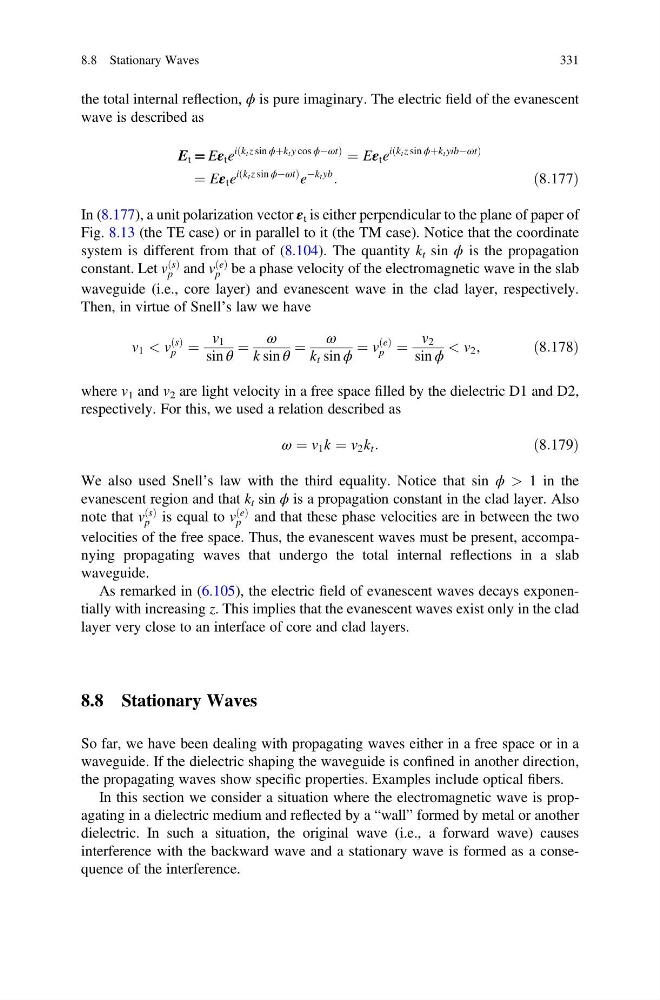
the total internal reflection, ϕ is pure imaginary. The electric field of the evanescent
wave is described as
E t = Eε t e
i k t z sin ϕþk t y cos ϕÀωt
ð
Þ
¼ Eε t e
i k t z sin ϕþk t yibÀωt
ð
Þ
¼ Eε t e
i k t z sin ϕÀωt
ð
Þ e
Àk t yb
:
ð8:177Þ
In (8.177), a unit polarization vector ε t is either perpendicular to the plane of paper of
Fig. 8.13 (the TE case) or in parallel to it (the TM case). Notice that the coordinate
system is different from that of (8.104). The quantity k t sin ϕ is the propagation
constant. Let v
s
ð Þ
p and v
e
ð Þ
p be a phase velocity of the electromagnetic wave in the slab
waveguide (i.e., core layer) and evanescent wave in the clad layer, respectively.
Then, in virtue of Snell’s law we have
v 1 < v
s
ð Þ
p ¼
v 1
sin θ
¼
ω
k sin θ
¼
ω
k t sin ϕ
¼ v
e
ð Þ
p ¼
v 2
sin ϕ
< v 2 ,
ð8:178Þ
where v 1 and v 2 are light velocity in a free space filled by the dielectric D1 and D2,
respectively. For this, we used a relation described as
ω ¼ v 1 k ¼ v 2 k t :
ð8:179Þ
We also used Snell’s law with the third equality. Notice that sin ϕ > 1 in the
evanescent region and that k t sin ϕ is a propagation constant in the clad layer. Also
note that v
s
ð Þ
p is equal to v
e
ð Þ
p and that these phase velocities are in between the two
velocities of the free space. Thus, the evanescent waves must be present, accompanying propagating waves that undergo the total internal reflections in a slab
waveguide.
As remarked in (6.105), the electric field of evanescent waves decays exponentially with increasing z. This implies that the evanescent waves exist only in the clad
layer very close to an interface of core and clad layers.
8.8 Stationary Waves
So far, we have been dealing with propagating waves either in a free space or in a
waveguide. If the dielectric shaping the waveguide is confined in another direction,
the propagating waves show specific properties. Examples include optical fibers.
In this section we consider a situation where the electromagnetic wave is propagating in a dielectric medium and reflected by a “wall” formed by metal or another
dielectric. In such a situation, the original wave (i.e., a forward wave) causes
interference with the backward wave and a stationary wave is formed as a consequence of the interference.
8.8 Stationary Waves
331
wave is described as
E t = Eε t e
i k t z sin ϕþk t y cos ϕÀωt
ð
Þ
¼ Eε t e
i k t z sin ϕþk t yibÀωt
ð
Þ
¼ Eε t e
i k t z sin ϕÀωt
ð
Þ e
Àk t yb
:
ð8:177Þ
In (8.177), a unit polarization vector ε t is either perpendicular to the plane of paper of
Fig. 8.13 (the TE case) or in parallel to it (the TM case). Notice that the coordinate
system is different from that of (8.104). The quantity k t sin ϕ is the propagation
constant. Let v
s
ð Þ
p and v
e
ð Þ
p be a phase velocity of the electromagnetic wave in the slab
waveguide (i.e., core layer) and evanescent wave in the clad layer, respectively.
Then, in virtue of Snell’s law we have
v 1 < v
s
ð Þ
p ¼
v 1
sin θ
¼
ω
k sin θ
¼
ω
k t sin ϕ
¼ v
e
ð Þ
p ¼
v 2
sin ϕ
< v 2 ,
ð8:178Þ
where v 1 and v 2 are light velocity in a free space filled by the dielectric D1 and D2,
respectively. For this, we used a relation described as
ω ¼ v 1 k ¼ v 2 k t :
ð8:179Þ
We also used Snell’s law with the third equality. Notice that sin ϕ > 1 in the
evanescent region and that k t sin ϕ is a propagation constant in the clad layer. Also
note that v
s
ð Þ
p is equal to v
e
ð Þ
p and that these phase velocities are in between the two
velocities of the free space. Thus, the evanescent waves must be present, accompanying propagating waves that undergo the total internal reflections in a slab
waveguide.
As remarked in (6.105), the electric field of evanescent waves decays exponentially with increasing z. This implies that the evanescent waves exist only in the clad
layer very close to an interface of core and clad layers.
8.8 Stationary Waves
So far, we have been dealing with propagating waves either in a free space or in a
waveguide. If the dielectric shaping the waveguide is confined in another direction,
the propagating waves show specific properties. Examples include optical fibers.
In this section we consider a situation where the electromagnetic wave is propagating in a dielectric medium and reflected by a “wall” formed by metal or another
dielectric. In such a situation, the original wave (i.e., a forward wave) causes
interference with the backward wave and a stationary wave is formed as a consequence of the interference.
8.8 Stationary Waves
331