

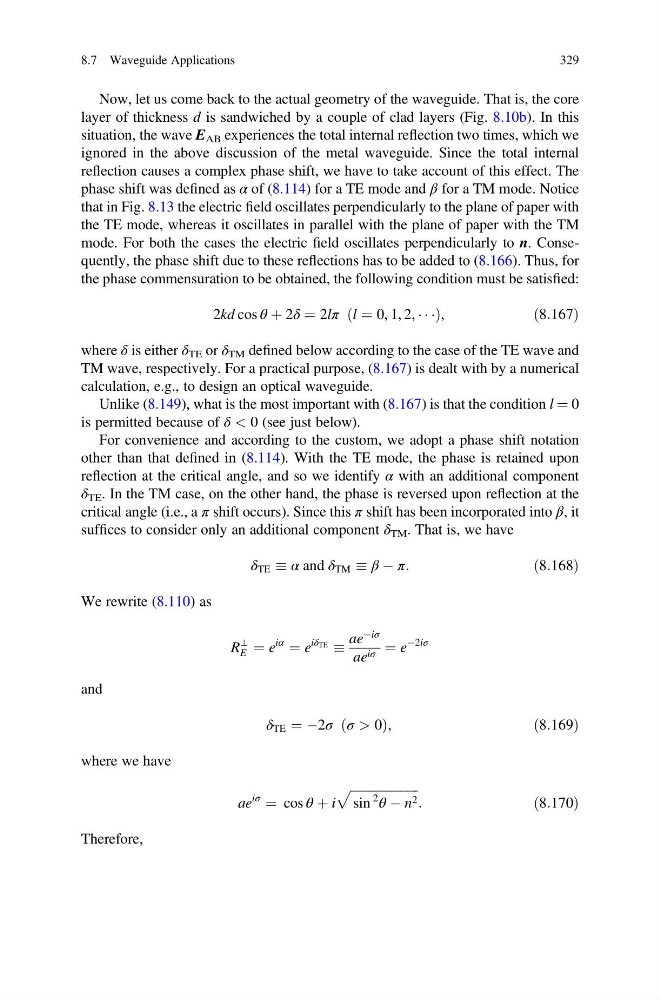
Now, let us come back to the actual geometry of the waveguide. That is, the core
layer of thickness d is sandwiched by a couple of clad layers (Fig. 8.10b). In this
situation, the wave E AB experiences the total internal reflection two times, which we
ignored in the above discussion of the metal waveguide. Since the total internal
reflection causes a complex phase shift, we have to take account of this effect. The
phase shift was defined as α of (8.114) for a TE mode and β for a TM mode. Notice
that in Fig. 8.13 the electric field oscillates perpendicularly to the plane of paper with
the TE mode, whereas it oscillates in parallel with the plane of paper with the TM
mode. For both the cases the electric field oscillates perpendicularly to n. Consequently, the phase shift due to these reflections has to be added to (8.166). Thus, for
the phase commensuration to be obtained, the following condition must be satisfied:
2kd cos θ þ 2δ ¼ 2lπ l ¼ 0, 1, 2, Á Á Á
ð
Þ ,
ð8:167Þ
where δ is either δ TE or δ TM defined below according to the case of the TE wave and
TM wave, respectively. For a practical purpose, (8.167) is dealt with by a numerical
calculation, e.g., to design an optical waveguide.
Unlike (8.149), what is the most important with (8.167) is that the condition l ¼ 0
is permitted because of δ < 0 (see just below).
For convenience and according to the custom, we adopt a phase shift notation
other than that defined in (8.114). With the TE mode, the phase is retained upon
reflection at the critical angle, and so we identify α with an additional component
δ TE . In the TM case, on the other hand, the phase is reversed upon reflection at the
critical angle (i.e., a π shift occurs). Since this π shift has been incorporated into β, it
suffices to consider only an additional component δ TM . That is, we have
δ TE α and δ TM β À π:
ð8:168Þ
We rewrite (8.110) as
R
⊥
E ¼ e
iα
¼ e
iδ TE
ae
Àiσ
ae iσ ¼ e
À2iσ
and
δ TE ¼ À2σ σ > 0
ð
Þ,
ð8:169Þ
where we have
ae
iσ
¼ cos θ þ i
ffiffiffiffiffiffiffiffiffiffiffiffiffiffiffiffiffiffiffiffiffiffi
sin
2
θ À n 2
p
:
ð8:170Þ
Therefore,
8.7 Waveguide Applications
329
layer of thickness d is sandwiched by a couple of clad layers (Fig. 8.10b). In this
situation, the wave E AB experiences the total internal reflection two times, which we
ignored in the above discussion of the metal waveguide. Since the total internal
reflection causes a complex phase shift, we have to take account of this effect. The
phase shift was defined as α of (8.114) for a TE mode and β for a TM mode. Notice
that in Fig. 8.13 the electric field oscillates perpendicularly to the plane of paper with
the TE mode, whereas it oscillates in parallel with the plane of paper with the TM
mode. For both the cases the electric field oscillates perpendicularly to n. Consequently, the phase shift due to these reflections has to be added to (8.166). Thus, for
the phase commensuration to be obtained, the following condition must be satisfied:
2kd cos θ þ 2δ ¼ 2lπ l ¼ 0, 1, 2, Á Á Á
ð
Þ ,
ð8:167Þ
where δ is either δ TE or δ TM defined below according to the case of the TE wave and
TM wave, respectively. For a practical purpose, (8.167) is dealt with by a numerical
calculation, e.g., to design an optical waveguide.
Unlike (8.149), what is the most important with (8.167) is that the condition l ¼ 0
is permitted because of δ < 0 (see just below).
For convenience and according to the custom, we adopt a phase shift notation
other than that defined in (8.114). With the TE mode, the phase is retained upon
reflection at the critical angle, and so we identify α with an additional component
δ TE . In the TM case, on the other hand, the phase is reversed upon reflection at the
critical angle (i.e., a π shift occurs). Since this π shift has been incorporated into β, it
suffices to consider only an additional component δ TM . That is, we have
δ TE α and δ TM β À π:
ð8:168Þ
We rewrite (8.110) as
R
⊥
E ¼ e
iα
¼ e
iδ TE
ae
Àiσ
ae iσ ¼ e
À2iσ
and
δ TE ¼ À2σ σ > 0
ð
Þ,
ð8:169Þ
where we have
ae
iσ
¼ cos θ þ i
ffiffiffiffiffiffiffiffiffiffiffiffiffiffiffiffiffiffiffiffiffiffi
sin
2
θ À n 2
p
:
ð8:170Þ
Therefore,
8.7 Waveguide Applications
329