

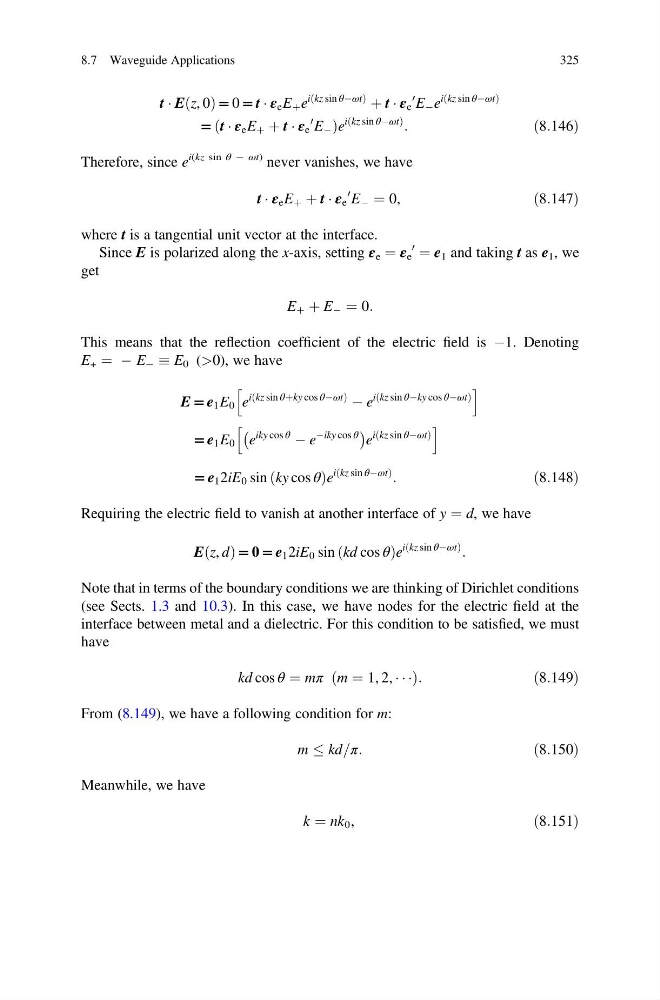
t Á E z, 0
ð Þ= 0 = t Á ε e E þ e
i kz sin θÀωt
ð
Þ
þ t Á ε e
0 E À e
i kz sin θÀωt
ð
Þ
= t Á ε e E þ þ t Á ε e
0 E À
ð
Þ e
i kz sin θÀωt
ð
Þ
:
ð8:146Þ
Therefore, since e
i(kz sin θ À ωt) never vanishes, we have
t Á ε e E þ þ t Á ε e
0 E À ¼ 0,
ð8:147Þ
where t is a tangential unit vector at the interface.
Since E is polarized along the x-axis, setting ε e ¼ ε e
0
¼ e 1 and taking t as e 1 , we
get
E þ þ E À ¼ 0:
This means that the reflection coefficient of the electric field is À1. Denoting
E + ¼ À E À E 0 (>0), we have
E = e 1 E 0 e
i kz sin θþky cos θÀωt
ð
Þ
À e
i kz sin θÀky cos θÀωt
ð
Þ
h
i
= e 1 E 0 e
iky cos θ
À e
Àiky cos θ
À
Á
e
i kz sin θÀωt
ð
Þ
h
i
= e 1 2iE 0 sin ky cos θ
ð
Þ e
i kz sin θÀωt
ð
Þ
:
ð8:148Þ
Requiring the electric field to vanish at another interface of y ¼ d, we have
E z, d
ð Þ= 0 = e 1 2iE 0 sin kd cos θ
ð
Þ e
i kz sin θÀωt
ð
Þ
:
Note that in terms of the boundary conditions we are thinking of Dirichlet conditions
(see Sects. 1.3 and 10.3). In this case, we have nodes for the electric field at the
interface between metal and a dielectric. For this condition to be satisfied, we must
have
kd cos θ ¼ mπ m ¼ 1, 2, Á Á Á
ð
Þ :
ð8:149Þ
From (8.149), we have a following condition for m:
m kd=π:
ð8:150Þ
Meanwhile, we have
k ¼ nk 0 ,
ð8:151Þ
8.7 Waveguide Applications
325
ð Þ= 0 = t Á ε e E þ e
i kz sin θÀωt
ð
Þ
þ t Á ε e
0 E À e
i kz sin θÀωt
ð
Þ
= t Á ε e E þ þ t Á ε e
0 E À
ð
Þ e
i kz sin θÀωt
ð
Þ
:
ð8:146Þ
Therefore, since e
i(kz sin θ À ωt) never vanishes, we have
t Á ε e E þ þ t Á ε e
0 E À ¼ 0,
ð8:147Þ
where t is a tangential unit vector at the interface.
Since E is polarized along the x-axis, setting ε e ¼ ε e
0
¼ e 1 and taking t as e 1 , we
get
E þ þ E À ¼ 0:
This means that the reflection coefficient of the electric field is À1. Denoting
E + ¼ À E À E 0 (>0), we have
E = e 1 E 0 e
i kz sin θþky cos θÀωt
ð
Þ
À e
i kz sin θÀky cos θÀωt
ð
Þ
h
i
= e 1 E 0 e
iky cos θ
À e
Àiky cos θ
À
Á
e
i kz sin θÀωt
ð
Þ
h
i
= e 1 2iE 0 sin ky cos θ
ð
Þ e
i kz sin θÀωt
ð
Þ
:
ð8:148Þ
Requiring the electric field to vanish at another interface of y ¼ d, we have
E z, d
ð Þ= 0 = e 1 2iE 0 sin kd cos θ
ð
Þ e
i kz sin θÀωt
ð
Þ
:
Note that in terms of the boundary conditions we are thinking of Dirichlet conditions
(see Sects. 1.3 and 10.3). In this case, we have nodes for the electric field at the
interface between metal and a dielectric. For this condition to be satisfied, we must
have
kd cos θ ¼ mπ m ¼ 1, 2, Á Á Á
ð
Þ :
ð8:149Þ
From (8.149), we have a following condition for m:
m kd=π:
ð8:150Þ
Meanwhile, we have
k ¼ nk 0 ,
ð8:151Þ
8.7 Waveguide Applications
325