

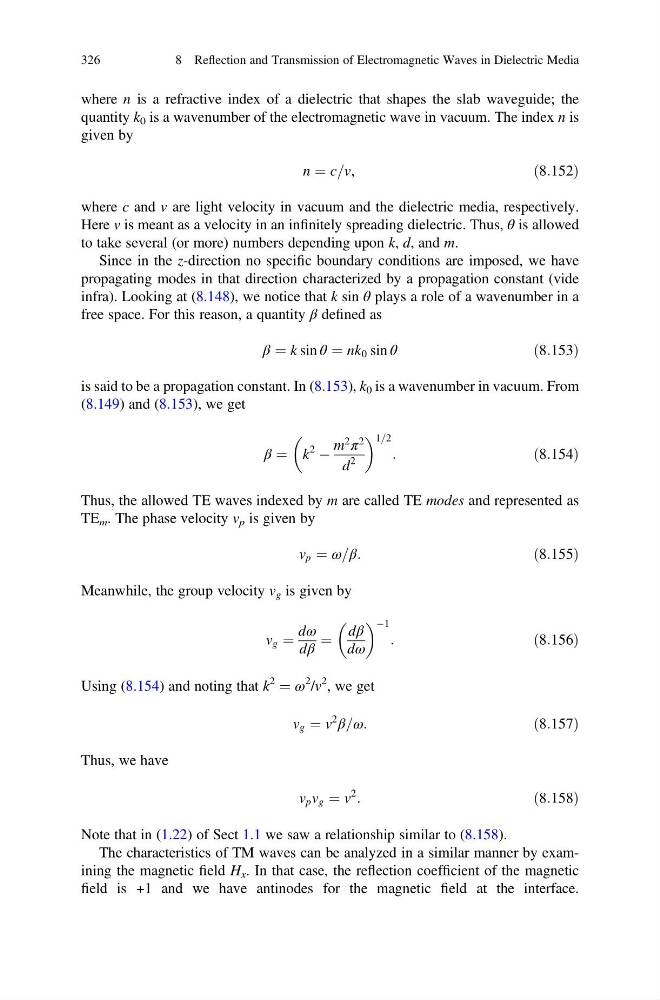
where n is a refractive index of a dielectric that shapes the slab waveguide; the
quantity k 0 is a wavenumber of the electromagnetic wave in vacuum. The index n is
given by
n ¼ c=v,
ð8:152Þ
where c and v are light velocity in vacuum and the dielectric media, respectively.
Here v is meant as a velocity in an infinitely spreading dielectric. Thus, θ is allowed
to take several (or more) numbers depending upon k, d, and m.
Since in the z-direction no specific boundary conditions are imposed, we have
propagating modes in that direction characterized by a propagation constant (vide
infra). Looking at (8.148), we notice that k sin θ plays a role of a wavenumber in a
free space. For this reason, a quantity β defined as
β ¼ k sin θ ¼ nk 0 sin θ
ð8:153Þ
is said to be a propagation constant. In (8.153), k 0 is a wavenumber in vacuum. From
(8.149) and (8.153), we get
β ¼ k
2
À
m
2
π
2
d
2
1=2
:
ð8:154Þ
Thus, the allowed TE waves indexed by m are called TE modes and represented as
TE m . The phase velocity v p is given by
v p ¼ ω=β:
ð8:155Þ
Meanwhile, the group velocity v g is given by
v g ¼
dω
dβ
¼
dβ
dω
À1
:
ð8:156Þ
Using (8.154) and noting that k
2
¼ ω
2 /v
2 , we get
v g ¼ v
2
β=ω:
ð8:157Þ
Thus, we have
v p v g ¼ v
2
:
ð8:158Þ
Note that in (1.22) of Sect 1.1 we saw a relationship similar to (8.158).
The characteristics of TM waves can be analyzed in a similar manner by examining the magnetic field H x . In that case, the reflection coefficient of the magnetic
field is +1 and we have antinodes for the magnetic field at the interface.
326
8 Reflection and Transmission of Electromagnetic Waves in Dielectric Media
quantity k 0 is a wavenumber of the electromagnetic wave in vacuum. The index n is
given by
n ¼ c=v,
ð8:152Þ
where c and v are light velocity in vacuum and the dielectric media, respectively.
Here v is meant as a velocity in an infinitely spreading dielectric. Thus, θ is allowed
to take several (or more) numbers depending upon k, d, and m.
Since in the z-direction no specific boundary conditions are imposed, we have
propagating modes in that direction characterized by a propagation constant (vide
infra). Looking at (8.148), we notice that k sin θ plays a role of a wavenumber in a
free space. For this reason, a quantity β defined as
β ¼ k sin θ ¼ nk 0 sin θ
ð8:153Þ
is said to be a propagation constant. In (8.153), k 0 is a wavenumber in vacuum. From
(8.149) and (8.153), we get
β ¼ k
2
À
m
2
π
2
d
2
1=2
:
ð8:154Þ
Thus, the allowed TE waves indexed by m are called TE modes and represented as
TE m . The phase velocity v p is given by
v p ¼ ω=β:
ð8:155Þ
Meanwhile, the group velocity v g is given by
v g ¼
dω
dβ
¼
dβ
dω
À1
:
ð8:156Þ
Using (8.154) and noting that k
2
¼ ω
2 /v
2 , we get
v g ¼ v
2
β=ω:
ð8:157Þ
Thus, we have
v p v g ¼ v
2
:
ð8:158Þ
Note that in (1.22) of Sect 1.1 we saw a relationship similar to (8.158).
The characteristics of TM waves can be analyzed in a similar manner by examining the magnetic field H x . In that case, the reflection coefficient of the magnetic
field is +1 and we have antinodes for the magnetic field at the interface.
326
8 Reflection and Transmission of Electromagnetic Waves in Dielectric Media