

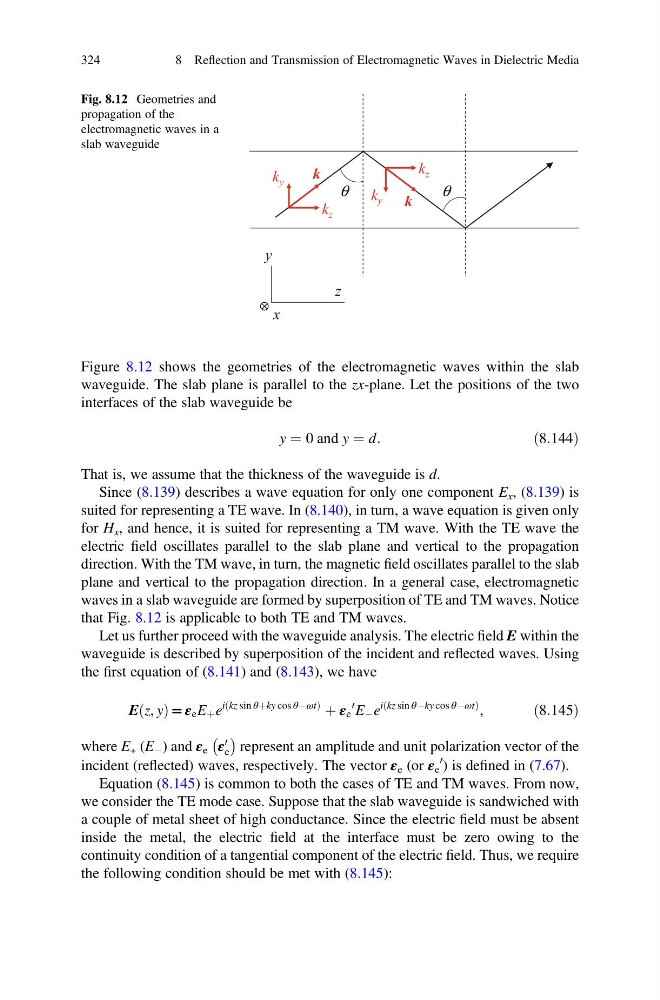
Figure 8.12 shows the geometries of the electromagnetic waves within the slab
waveguide. The slab plane is parallel to the zx-plane. Let the positions of the two
interfaces of the slab waveguide be
y ¼ 0 and y ¼ d:
ð8:144Þ
That is, we assume that the thickness of the waveguide is d.
Since (8.139) describes a wave equation for only one component E x , (8.139) is
suited for representing a TE wave. In (8.140), in turn, a wave equation is given only
for H x , and hence, it is suited for representing a TM wave. With the TE wave the
electric field oscillates parallel to the slab plane and vertical to the propagation
direction. With the TM wave, in turn, the magnetic field oscillates parallel to the slab
plane and vertical to the propagation direction. In a general case, electromagnetic
waves in a slab waveguide are formed by superposition of TE and TM waves. Notice
that Fig. 8.12 is applicable to both TE and TM waves.
Let us further proceed with the waveguide analysis. The electric field E within the
waveguide is described by superposition of the incident and reflected waves. Using
the first equation of (8.141) and (8.143), we have
E z, y
ð Þ= ε e E þ e
i kz sin θþky cos θÀωt
ð
Þ
þ ε e
0 E À e
i kz sin θÀky cos θÀωt
ð
Þ ,
ð8:145Þ
where E + (E À ) and ε e ε
0
e
À Á
represent an amplitude and unit polarization vector of the
incident (reflected) waves, respectively. The vector ε e (or ε e
0 ) is defined in (7.67).
Equation (8.145) is common to both the cases of TE and TM waves. From now,
we consider the TE mode case. Suppose that the slab waveguide is sandwiched with
a couple of metal sheet of high conductance. Since the electric field must be absent
inside the metal, the electric field at the interface must be zero owing to the
continuity condition of a tangential component of the electric field. Thus, we require
the following condition should be met with (8.145):
k y k
k z
k
k z
k y
θ
θ
y
x
z
Fig. 8.12 Geometries and
propagation of the
electromagnetic waves in a
slab waveguide
324
8 Reflection and Transmission of Electromagnetic Waves in Dielectric Media
waveguide. The slab plane is parallel to the zx-plane. Let the positions of the two
interfaces of the slab waveguide be
y ¼ 0 and y ¼ d:
ð8:144Þ
That is, we assume that the thickness of the waveguide is d.
Since (8.139) describes a wave equation for only one component E x , (8.139) is
suited for representing a TE wave. In (8.140), in turn, a wave equation is given only
for H x , and hence, it is suited for representing a TM wave. With the TE wave the
electric field oscillates parallel to the slab plane and vertical to the propagation
direction. With the TM wave, in turn, the magnetic field oscillates parallel to the slab
plane and vertical to the propagation direction. In a general case, electromagnetic
waves in a slab waveguide are formed by superposition of TE and TM waves. Notice
that Fig. 8.12 is applicable to both TE and TM waves.
Let us further proceed with the waveguide analysis. The electric field E within the
waveguide is described by superposition of the incident and reflected waves. Using
the first equation of (8.141) and (8.143), we have
E z, y
ð Þ= ε e E þ e
i kz sin θþky cos θÀωt
ð
Þ
þ ε e
0 E À e
i kz sin θÀky cos θÀωt
ð
Þ ,
ð8:145Þ
where E + (E À ) and ε e ε
0
e
À Á
represent an amplitude and unit polarization vector of the
incident (reflected) waves, respectively. The vector ε e (or ε e
0 ) is defined in (7.67).
Equation (8.145) is common to both the cases of TE and TM waves. From now,
we consider the TE mode case. Suppose that the slab waveguide is sandwiched with
a couple of metal sheet of high conductance. Since the electric field must be absent
inside the metal, the electric field at the interface must be zero owing to the
continuity condition of a tangential component of the electric field. Thus, we require
the following condition should be met with (8.145):
k y k
k z
k
k z
k y
θ
θ
y
x
z
Fig. 8.12 Geometries and
propagation of the
electromagnetic waves in a
slab waveguide
324
8 Reflection and Transmission of Electromagnetic Waves in Dielectric Media