

∂E x
∂z
þ
∂B y
∂t
¼ 0,
ð8:131Þ
À
∂E x
∂y
þ
∂B z
∂t
¼ 0,
ð8:132Þ
∂H z
∂y
2
∂H y
∂z
À
∂D x
∂t
¼ 0,
ð8:133Þ
∂H x
∂z
À
∂D y
∂t
¼ 0,
ð8:134Þ
À
∂H x
∂y
À
∂D z
∂t
¼ 0:
ð8:135Þ
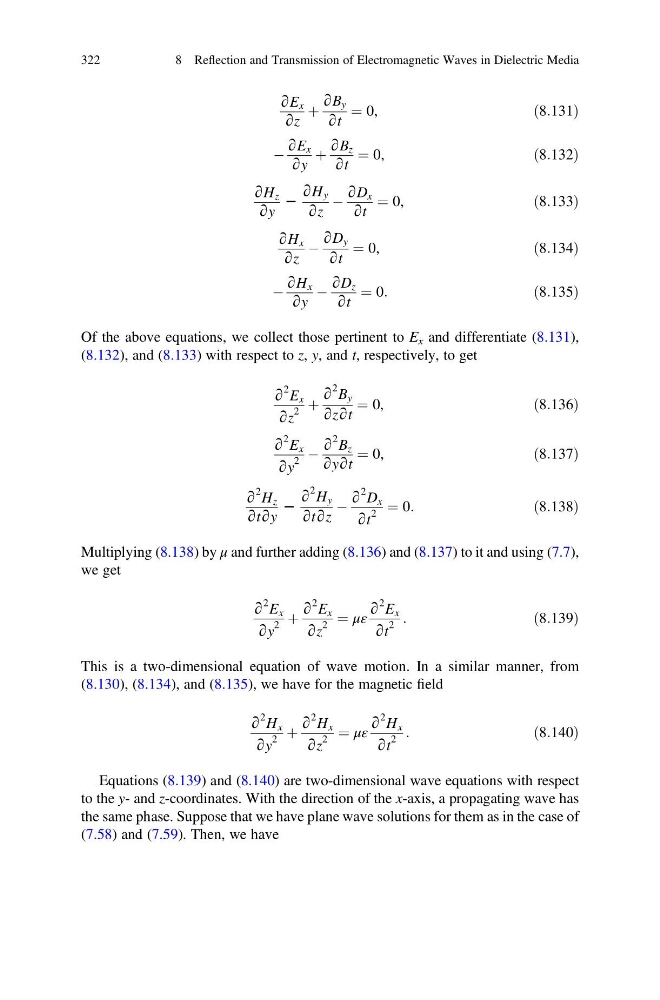
Of the above equations, we collect those pertinent to E x and differentiate (8.131),
(8.132), and (8.133) with respect to z, y, and t, respectively, to get
∂
2 E x
∂z
2
þ
∂
2 B y
∂z∂t
¼ 0,
ð8:136Þ
∂
2 E x
∂y
2
À
∂
2 B z
∂y∂t
¼ 0,
ð8:137Þ
∂
2 H z
∂t∂y
2
∂
2 H y
∂t∂z
À
∂
2 D x
∂t
2
¼ 0:
ð8:138Þ
Multiplying (8.138) by μ and further adding (8.136) and (8.137) to it and using (7.7),
we get
∂
2 E x
∂y
2
þ
∂
2 E x
∂z
2
¼ με
∂
2 E x
∂t
2
:
ð8:139Þ
This is a two-dimensional equation of wave motion. In a similar manner, from
(8.130), (8.134), and (8.135), we have for the magnetic field
∂
2 H x
∂y
2
þ
∂
2 H x
∂z
2
¼ με
∂
2 H x
∂t
2
:
ð8:140Þ
Equations (8.139) and (8.140) are two-dimensional wave equations with respect
to the y- and z-coordinates. With the direction of the x-axis, a propagating wave has
the same phase. Suppose that we have plane wave solutions for them as in the case of
(7.58) and (7.59). Then, we have
322
8 Reflection and Transmission of Electromagnetic Waves in Dielectric Media
∂z
þ
∂B y
∂t
¼ 0,
ð8:131Þ
À
∂E x
∂y
þ
∂B z
∂t
¼ 0,
ð8:132Þ
∂H z
∂y
2
∂H y
∂z
À
∂D x
∂t
¼ 0,
ð8:133Þ
∂H x
∂z
À
∂D y
∂t
¼ 0,
ð8:134Þ
À
∂H x
∂y
À
∂D z
∂t
¼ 0:
ð8:135Þ
Of the above equations, we collect those pertinent to E x and differentiate (8.131),
(8.132), and (8.133) with respect to z, y, and t, respectively, to get
∂
2 E x
∂z
2
þ
∂
2 B y
∂z∂t
¼ 0,
ð8:136Þ
∂
2 E x
∂y
2
À
∂
2 B z
∂y∂t
¼ 0,
ð8:137Þ
∂
2 H z
∂t∂y
2
∂
2 H y
∂t∂z
À
∂
2 D x
∂t
2
¼ 0:
ð8:138Þ
Multiplying (8.138) by μ and further adding (8.136) and (8.137) to it and using (7.7),
we get
∂
2 E x
∂y
2
þ
∂
2 E x
∂z
2
¼ με
∂
2 E x
∂t
2
:
ð8:139Þ
This is a two-dimensional equation of wave motion. In a similar manner, from
(8.130), (8.134), and (8.135), we have for the magnetic field
∂
2 H x
∂y
2
þ
∂
2 H x
∂z
2
¼ με
∂
2 H x
∂t
2
:
ð8:140Þ
Equations (8.139) and (8.140) are two-dimensional wave equations with respect
to the y- and z-coordinates. With the direction of the x-axis, a propagating wave has
the same phase. Suppose that we have plane wave solutions for them as in the case of
(7.58) and (7.59). Then, we have
322
8 Reflection and Transmission of Electromagnetic Waves in Dielectric Media