

other dielectrics. We distinguish this case as the total internal reflection from the
above case (i). We further describe it in Sect. 8.7.2. For the total internal reflection to
take place, the refractive index of the waveguide must be higher than those of other
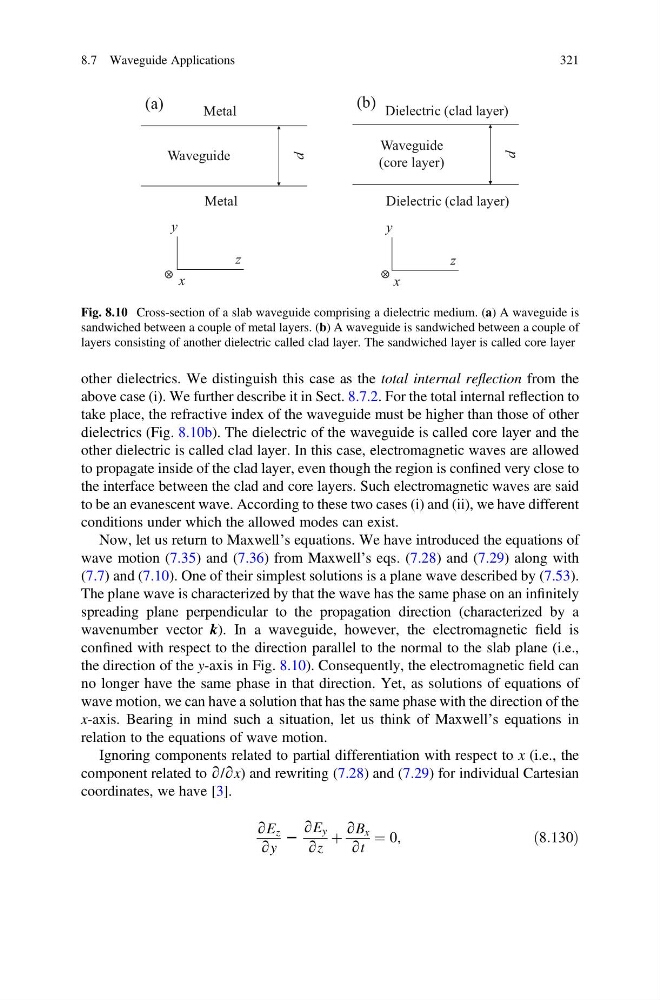
dielectrics (Fig. 8.10b). The dielectric of the waveguide is called core layer and the
other dielectric is called clad layer. In this case, electromagnetic waves are allowed
to propagate inside of the clad layer, even though the region is confined very close to
the interface between the clad and core layers. Such electromagnetic waves are said
to be an evanescent wave. According to these two cases (i) and (ii), we have different
conditions under which the allowed modes can exist.
Now, let us return to Maxwell’s equations. We have introduced the equations of
wave motion (7.35) and (7.36) from Maxwell’s eqs. (7.28) and (7.29) along with
(7.7) and (7.10). One of their simplest solutions is a plane wave described by (7.53).
The plane wave is characterized by that the wave has the same phase on an infinitely
spreading plane perpendicular to the propagation direction (characterized by a
wavenumber vector k). In a waveguide, however, the electromagnetic field is
confined with respect to the direction parallel to the normal to the slab plane (i.e.,
the direction of the y-axis in Fig. 8.10). Consequently, the electromagnetic field can
no longer have the same phase in that direction. Yet, as solutions of equations of
wave motion, we can have a solution that has the same phase with the direction of the
x-axis. Bearing in mind such a situation, let us think of Maxwell’s equations in
relation to the equations of wave motion.
Ignoring components related to partial differentiation with respect to x (i.e., the
component related to ∂/∂x) and rewriting (7.28) and (7.29) for individual Cartesian
coordinates, we have [3].
∂E z
∂y
2
∂E y
∂z
þ
∂B x
∂t
¼ 0,
ð8:130Þ
d
Waveguide
Metal
Metal
(a)
d
Waveguide
(core layer)
(b) Dielectric (clad layer)
y
x
z
y
x
z
Dielectric (clad layer)
Fig. 8.10 Cross-section of a slab waveguide comprising a dielectric medium. (a) A waveguide is
sandwiched between a couple of metal layers. (b) A waveguide is sandwiched between a couple of
layers consisting of another dielectric called clad layer. The sandwiched layer is called core layer
8.7 Waveguide Applications
321
above case (i). We further describe it in Sect. 8.7.2. For the total internal reflection to
take place, the refractive index of the waveguide must be higher than those of other
dielectrics (Fig. 8.10b). The dielectric of the waveguide is called core layer and the
other dielectric is called clad layer. In this case, electromagnetic waves are allowed
to propagate inside of the clad layer, even though the region is confined very close to
the interface between the clad and core layers. Such electromagnetic waves are said
to be an evanescent wave. According to these two cases (i) and (ii), we have different
conditions under which the allowed modes can exist.
Now, let us return to Maxwell’s equations. We have introduced the equations of
wave motion (7.35) and (7.36) from Maxwell’s eqs. (7.28) and (7.29) along with
(7.7) and (7.10). One of their simplest solutions is a plane wave described by (7.53).
The plane wave is characterized by that the wave has the same phase on an infinitely
spreading plane perpendicular to the propagation direction (characterized by a
wavenumber vector k). In a waveguide, however, the electromagnetic field is
confined with respect to the direction parallel to the normal to the slab plane (i.e.,
the direction of the y-axis in Fig. 8.10). Consequently, the electromagnetic field can
no longer have the same phase in that direction. Yet, as solutions of equations of
wave motion, we can have a solution that has the same phase with the direction of the
x-axis. Bearing in mind such a situation, let us think of Maxwell’s equations in
relation to the equations of wave motion.
Ignoring components related to partial differentiation with respect to x (i.e., the
component related to ∂/∂x) and rewriting (7.28) and (7.29) for individual Cartesian
coordinates, we have [3].
∂E z
∂y
2
∂E y
∂z
þ
∂B x
∂t
¼ 0,
ð8:130Þ
d
Waveguide
Metal
Metal
(a)
d
Waveguide
(core layer)
(b) Dielectric (clad layer)
y
x
z
y
x
z
Dielectric (clad layer)
Fig. 8.10 Cross-section of a slab waveguide comprising a dielectric medium. (a) A waveguide is
sandwiched between a couple of metal layers. (b) A waveguide is sandwiched between a couple of
layers consisting of another dielectric called clad layer. The sandwiched layer is called core layer
8.7 Waveguide Applications
321