

8.6 Total Reflection
In Sect. 8.2 we saw that the Snell’s law results from the kinematical requirement. For
this reason, we may consider it as a universal relation that can be extended to
complex refraction angles. In fact, for the Snell’s law to hold with θ > θ c , we
must have
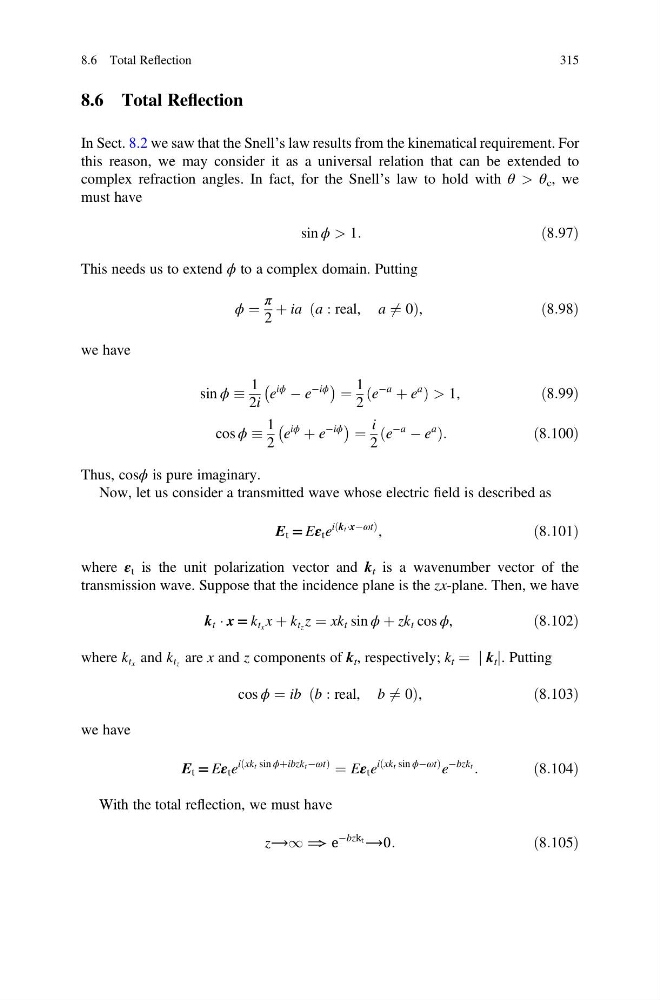
sin ϕ > 1:
ð8:97Þ
This needs us to extend ϕ to a complex domain. Putting
ϕ ¼
π
2
þ ia a : real, a 6 ¼ 0
ð
Þ ,
ð8:98Þ
we have
sin ϕ
1
2i
e
iϕ
À e
Àiϕ
À
Á ¼
1
2
e
Àa
þ e
a
ð
Þ> 1,
ð8:99Þ
cos ϕ
1
2
e
iϕ
þ e
Àiϕ
À
Á ¼
i
2
e
Àa
À e
a
ð
Þ :
ð8:100Þ
Thus, cosϕ is pure imaginary.
Now, let us consider a transmitted wave whose electric field is described as
E t = Eε t e
i k t ÁxÀωt
ð
Þ ,
ð8:101Þ
where ε t is the unit polarization vector and k t is a wavenumber vector of the
transmission wave. Suppose that the incidence plane is the zx-plane. Then, we have
k t Á x = k t x x þ k t z z ¼ xk t sin ϕ þ zk t cos ϕ,
ð8:102Þ
where k t x and k t z are x and z components of k t , respectively; k t ¼ j k t j. Putting
cos ϕ ¼ ib b : real, b 6 ¼ 0
ð
Þ ,
ð8:103Þ
we have
E t = Eε t e
i xk t sin ϕþibzk t Àωt
ð
Þ
¼ Eε t e
i xk t sin ϕÀωt
ð
Þ e
Àbzk t :
ð8:104Þ
With the total reflection, we must have
z⟶1 ⟹ e
Àbzk t ⟶0:
ð8:105Þ
8.6 Total Reflection
315
In Sect. 8.2 we saw that the Snell’s law results from the kinematical requirement. For
this reason, we may consider it as a universal relation that can be extended to
complex refraction angles. In fact, for the Snell’s law to hold with θ > θ c , we
must have
sin ϕ > 1:
ð8:97Þ
This needs us to extend ϕ to a complex domain. Putting
ϕ ¼
π
2
þ ia a : real, a 6 ¼ 0
ð
Þ ,
ð8:98Þ
we have
sin ϕ
1
2i
e
iϕ
À e
Àiϕ
À
Á ¼
1
2
e
Àa
þ e
a
ð
Þ> 1,
ð8:99Þ
cos ϕ
1
2
e
iϕ
þ e
Àiϕ
À
Á ¼
i
2
e
Àa
À e
a
ð
Þ :
ð8:100Þ
Thus, cosϕ is pure imaginary.
Now, let us consider a transmitted wave whose electric field is described as
E t = Eε t e
i k t ÁxÀωt
ð
Þ ,
ð8:101Þ
where ε t is the unit polarization vector and k t is a wavenumber vector of the
transmission wave. Suppose that the incidence plane is the zx-plane. Then, we have
k t Á x = k t x x þ k t z z ¼ xk t sin ϕ þ zk t cos ϕ,
ð8:102Þ
where k t x and k t z are x and z components of k t , respectively; k t ¼ j k t j. Putting
cos ϕ ¼ ib b : real, b 6 ¼ 0
ð
Þ ,
ð8:103Þ
we have
E t = Eε t e
i xk t sin ϕþibzk t Àωt
ð
Þ
¼ Eε t e
i xk t sin ϕÀωt
ð
Þ e
Àbzk t :
ð8:104Þ
With the total reflection, we must have
z⟶1 ⟹ e
Àbzk t ⟶0:
ð8:105Þ
8.6 Total Reflection
315