

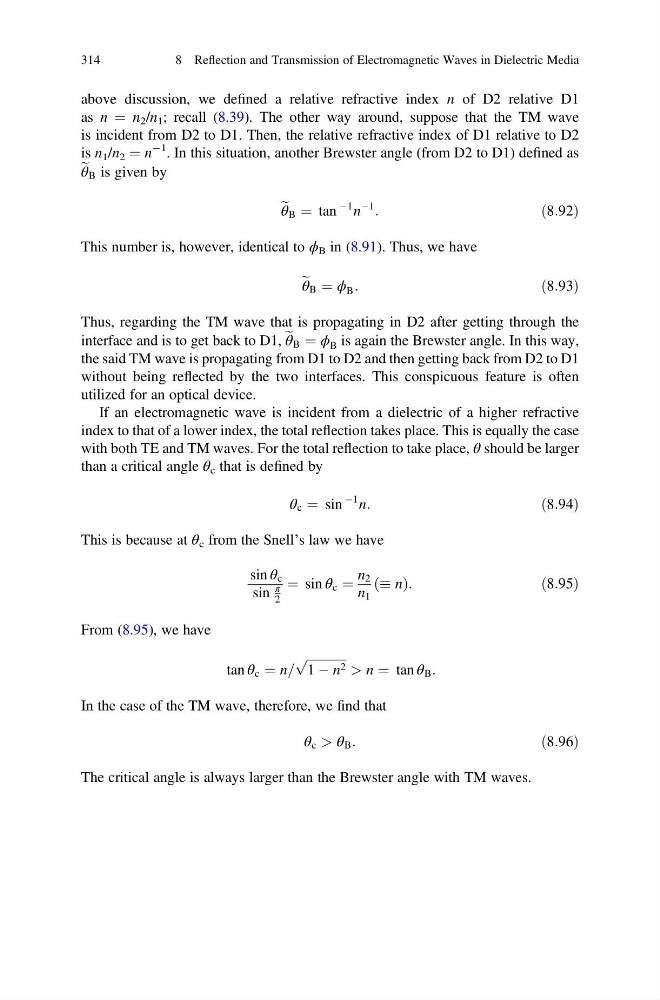
above discussion, we defined a relative refractive index n of D2 relative D1
as n ¼ n 2 /n 1 ; recall (8.39). The other way around, suppose that the TM wave
is incident from D2 to D1. Then, the relative refractive index of D1 relative to D2
is n 1 /n 2 ¼ n
À1 . In this situation, another Brewster angle (from D2 to D1) defined as
e θ B is given by
e θ B ¼ tan
À1 n
À1
:
ð8:92Þ
This number is, however, identical to ϕ B in (8.91). Thus, we have
e θ B ¼ ϕ B :
ð8:93Þ
Thus, regarding the TM wave that is propagating in D2 after getting through the
interface and is to get back to D1, e θ B ¼ ϕ B is again the Brewster angle. In this way,
the said TM wave is propagating from D1 to D2 and then getting back from D2 to D1
without being reflected by the two interfaces. This conspicuous feature is often
utilized for an optical device.
If an electromagnetic wave is incident from a dielectric of a higher refractive
index to that of a lower index, the total reflection takes place. This is equally the case
with both TE and TM waves. For the total reflection to take place, θ should be larger
than a critical angle θ c that is defined by
θ c ¼ sin
À1 n:
ð8:94Þ
This is because at θ c from the Snell’s law we have
sin θ c
sin
π
2
¼ sin θ c ¼
n 2
n 1
n
ð
Þ:
ð8:95Þ
From (8.95), we have
tan θ c ¼ n=
ffiffiffiffiffiffiffiffiffiffiffiffiffi
1 À n 2
p
> n ¼ tan θ B :
In the case of the TM wave, therefore, we find that
θ c > θ B :
ð8:96Þ
The critical angle is always larger than the Brewster angle with TM waves.
314
8 Reflection and Transmission of Electromagnetic Waves in Dielectric Media
as n ¼ n 2 /n 1 ; recall (8.39). The other way around, suppose that the TM wave
is incident from D2 to D1. Then, the relative refractive index of D1 relative to D2
is n 1 /n 2 ¼ n
À1 . In this situation, another Brewster angle (from D2 to D1) defined as
e θ B is given by
e θ B ¼ tan
À1 n
À1
:
ð8:92Þ
This number is, however, identical to ϕ B in (8.91). Thus, we have
e θ B ¼ ϕ B :
ð8:93Þ
Thus, regarding the TM wave that is propagating in D2 after getting through the
interface and is to get back to D1, e θ B ¼ ϕ B is again the Brewster angle. In this way,
the said TM wave is propagating from D1 to D2 and then getting back from D2 to D1
without being reflected by the two interfaces. This conspicuous feature is often
utilized for an optical device.
If an electromagnetic wave is incident from a dielectric of a higher refractive
index to that of a lower index, the total reflection takes place. This is equally the case
with both TE and TM waves. For the total reflection to take place, θ should be larger
than a critical angle θ c that is defined by
θ c ¼ sin
À1 n:
ð8:94Þ
This is because at θ c from the Snell’s law we have
sin θ c
sin
π
2
¼ sin θ c ¼
n 2
n 1
n
ð
Þ:
ð8:95Þ
From (8.95), we have
tan θ c ¼ n=
ffiffiffiffiffiffiffiffiffiffiffiffiffi
1 À n 2
p
> n ¼ tan θ B :
In the case of the TM wave, therefore, we find that
θ c > θ B :
ð8:96Þ
The critical angle is always larger than the Brewster angle with TM waves.
314
8 Reflection and Transmission of Electromagnetic Waves in Dielectric Media