

numerator of 8:85
ð
Þ
½
¼ cos ϕ À n cos θ ¼ cos ϕ À
sin θ
sin ϕ
cos θ
¼
sin ϕ cos ϕ À sin θ cos θ
sin ϕ
¼
sin ϕ À θ
ð
Þcos ϕ þ θ
ð
Þ
sin ϕ
:
ð8:88Þ
With the last equality of (8.88), we used a trigonometric formula. From (8.86) we
know that
sin ϕÀθ
ð
Þ
sin ϕ
does not vanish. Therefore, for R
k
E to vanish, we need cos
(ϕ + θ) ¼ 0. Since 0 < ϕ + θ < π, cos(ϕ + θ) ¼ 0 if and only if
ϕ þ θ ¼ π=2:
ð8:89Þ
In other words, for particular angles θ ¼ θ B and ϕ ¼ ϕ B that satisfy
ϕ B þ θ B ¼ π=2,
ð8:90Þ
we have R
k
E ¼ 0; i.e., we do not observe a reflected wave. The particular angle θ B is
said to be the Brewster angle. For θ B we have
sin ϕ B ¼ sin
π
2
À θ B
¼ cos θ B ,
n ¼ sin θ B = sin ϕ B ¼ sin θ B = cos θ B ¼ tan θ B or θ B ¼ tan
À1 n,
ϕ B ¼ tan
À1 n
À1
:
ð8:91Þ
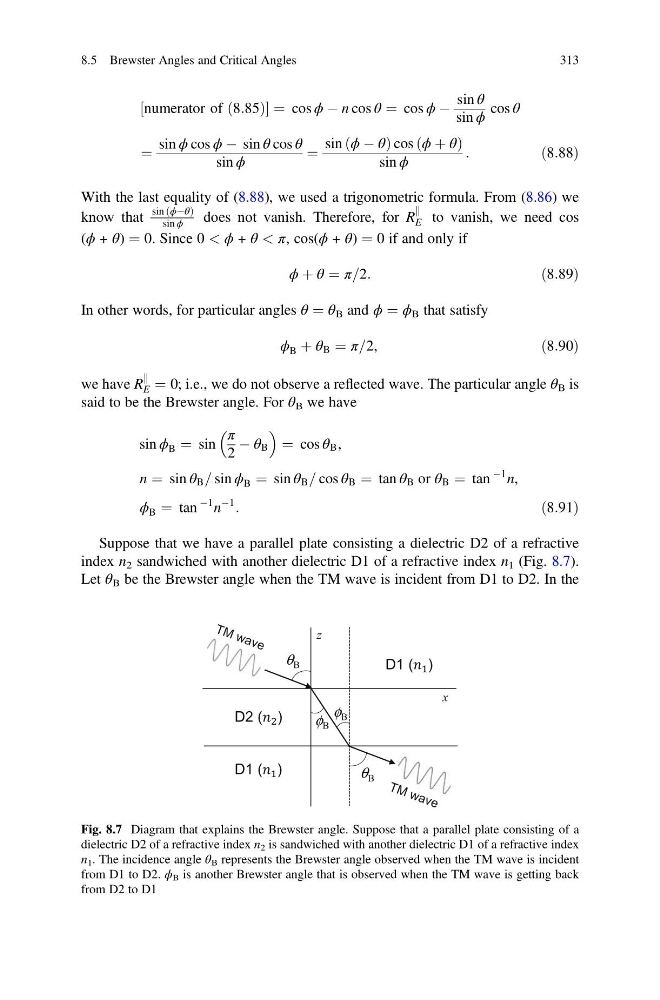
Suppose that we have a parallel plate consisting a dielectric D2 of a refractive
index n 2 sandwiched with another dielectric D1 of a refractive index n 1 (Fig. 8.7).
Let θ B be the Brewster angle when the TM wave is incident from D1 to D2. In the
x
z
θ B
φ B
'
'
'
φ B
θ B
Fig. 8.7 Diagram that explains the Brewster angle. Suppose that a parallel plate consisting of a
dielectric D2 of a refractive index n 2 is sandwiched with another dielectric D1 of a refractive index
n 1 . The incidence angle θ B represents the Brewster angle observed when the TM wave is incident
from D1 to D2. ϕ B is another Brewster angle that is observed when the TM wave is getting back
from D2 to D1
8.5 Brewster Angles and Critical Angles
313
ð
Þ
½
¼ cos ϕ À n cos θ ¼ cos ϕ À
sin θ
sin ϕ
cos θ
¼
sin ϕ cos ϕ À sin θ cos θ
sin ϕ
¼
sin ϕ À θ
ð
Þcos ϕ þ θ
ð
Þ
sin ϕ
:
ð8:88Þ
With the last equality of (8.88), we used a trigonometric formula. From (8.86) we
know that
sin ϕÀθ
ð
Þ
sin ϕ
does not vanish. Therefore, for R
k
E to vanish, we need cos
(ϕ + θ) ¼ 0. Since 0 < ϕ + θ < π, cos(ϕ + θ) ¼ 0 if and only if
ϕ þ θ ¼ π=2:
ð8:89Þ
In other words, for particular angles θ ¼ θ B and ϕ ¼ ϕ B that satisfy
ϕ B þ θ B ¼ π=2,
ð8:90Þ
we have R
k
E ¼ 0; i.e., we do not observe a reflected wave. The particular angle θ B is
said to be the Brewster angle. For θ B we have
sin ϕ B ¼ sin
π
2
À θ B
¼ cos θ B ,
n ¼ sin θ B = sin ϕ B ¼ sin θ B = cos θ B ¼ tan θ B or θ B ¼ tan
À1 n,
ϕ B ¼ tan
À1 n
À1
:
ð8:91Þ
Suppose that we have a parallel plate consisting a dielectric D2 of a refractive
index n 2 sandwiched with another dielectric D1 of a refractive index n 1 (Fig. 8.7).
Let θ B be the Brewster angle when the TM wave is incident from D1 to D2. In the
x
z
θ B
φ B
'
'
'
φ B
θ B
Fig. 8.7 Diagram that explains the Brewster angle. Suppose that a parallel plate consisting of a
dielectric D2 of a refractive index n 2 is sandwiched with another dielectric D1 of a refractive index
n 1 . The incidence angle θ B represents the Brewster angle observed when the TM wave is incident
from D1 to D2. ϕ B is another Brewster angle that is observed when the TM wave is getting back
from D2 to D1
8.5 Brewster Angles and Critical Angles
313