

8.5 Brewster Angles and Critical Angles
In this section and subsequent sections, we deal with nonmagnetic substance as
dielectrics; namely we assume μ r % 1. In that case, as mentioned in Sect. 8.3 we
rewrite, e.g., (8.51) and (8.59) as
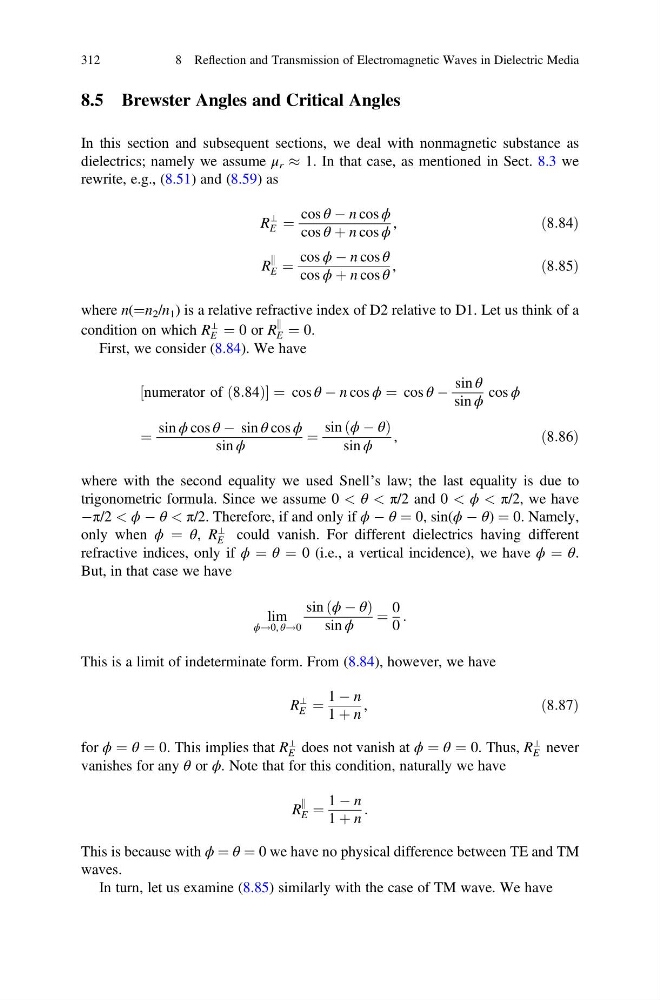
R
⊥
E ¼
cos θ À n cos ϕ
cos θ þ n cos ϕ
,
ð8:84Þ
R
k
E ¼
cos ϕ À n cos θ
cos ϕ þ n cos θ
,
ð8:85Þ
where n(¼n 2 /n 1 ) is a relative refractive index of D2 relative to D1. Let us think of a
condition on which R
⊥
E ¼ 0 or R
k
E ¼ 0.
First, we consider (8.84). We have
numerator of 8:84
ð
Þ
½
¼ cos θ À n cos ϕ ¼ cos θ À
sin θ
sin ϕ
cos ϕ
¼
sin ϕ cos θ À sin θ cos ϕ
sin ϕ
¼
sin ϕ À θ
ð
Þ
sin ϕ
,
ð8:86Þ
where with the second equality we used Snell’s law; the last equality is due to
trigonometric formula. Since we assume 0 < θ < π/2 and 0 < ϕ < π/2, we have
Àπ/2 < ϕ À θ < π/2. Therefore, if and only if ϕ À θ ¼ 0, sin(ϕ À θ) ¼ 0. Namely,
only when ϕ ¼ θ, R
⊥
E could vanish. For different dielectrics having different
refractive indices, only if ϕ ¼ θ ¼ 0 (i.e., a vertical incidence), we have ϕ ¼ θ.
But, in that case we have
lim
ϕ!0, θ!0
sin ϕ À θ
ð
Þ
sin ϕ
¼
0
0
:
This is a limit of indeterminate form. From (8.84), however, we have
R
⊥
E ¼
1 À n
1 þ n
,
ð8:87Þ
for ϕ ¼ θ ¼ 0. This implies that R
⊥
E does not vanish at ϕ ¼ θ ¼ 0. Thus, R
⊥
E never
vanishes for any θ or ϕ. Note that for this condition, naturally we have
R
k
E ¼
1 À n
1 þ n
:
This is because with ϕ ¼ θ ¼ 0 we have no physical difference between TE and TM
waves.
In turn, let us examine (8.85) similarly with the case of TM wave. We have
312
8 Reflection and Transmission of Electromagnetic Waves in Dielectric Media
In this section and subsequent sections, we deal with nonmagnetic substance as
dielectrics; namely we assume μ r % 1. In that case, as mentioned in Sect. 8.3 we
rewrite, e.g., (8.51) and (8.59) as
R
⊥
E ¼
cos θ À n cos ϕ
cos θ þ n cos ϕ
,
ð8:84Þ
R
k
E ¼
cos ϕ À n cos θ
cos ϕ þ n cos θ
,
ð8:85Þ
where n(¼n 2 /n 1 ) is a relative refractive index of D2 relative to D1. Let us think of a
condition on which R
⊥
E ¼ 0 or R
k
E ¼ 0.
First, we consider (8.84). We have
numerator of 8:84
ð
Þ
½
¼ cos θ À n cos ϕ ¼ cos θ À
sin θ
sin ϕ
cos ϕ
¼
sin ϕ cos θ À sin θ cos ϕ
sin ϕ
¼
sin ϕ À θ
ð
Þ
sin ϕ
,
ð8:86Þ
where with the second equality we used Snell’s law; the last equality is due to
trigonometric formula. Since we assume 0 < θ < π/2 and 0 < ϕ < π/2, we have
Àπ/2 < ϕ À θ < π/2. Therefore, if and only if ϕ À θ ¼ 0, sin(ϕ À θ) ¼ 0. Namely,
only when ϕ ¼ θ, R
⊥
E could vanish. For different dielectrics having different
refractive indices, only if ϕ ¼ θ ¼ 0 (i.e., a vertical incidence), we have ϕ ¼ θ.
But, in that case we have
lim
ϕ!0, θ!0
sin ϕ À θ
ð
Þ
sin ϕ
¼
0
0
:
This is a limit of indeterminate form. From (8.84), however, we have
R
⊥
E ¼
1 À n
1 þ n
,
ð8:87Þ
for ϕ ¼ θ ¼ 0. This implies that R
⊥
E does not vanish at ϕ ¼ θ ¼ 0. Thus, R
⊥
E never
vanishes for any θ or ϕ. Note that for this condition, naturally we have
R
k
E ¼
1 À n
1 þ n
:
This is because with ϕ ¼ θ ¼ 0 we have no physical difference between TE and TM
waves.
In turn, let us examine (8.85) similarly with the case of TM wave. We have
312
8 Reflection and Transmission of Electromagnetic Waves in Dielectric Media