

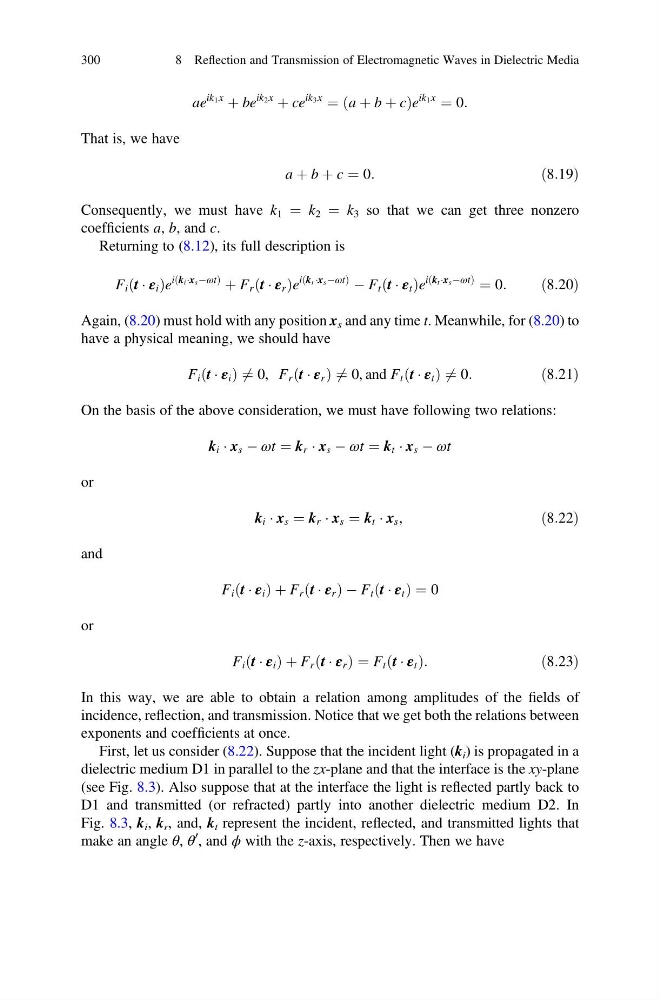
ae
ik 1 x
þ be
ik 2 x
þ ce
ik 3 x
¼ a þ b þ c
ð
Þ e
ik 1 x
¼ 0:
That is, we have
a þ b þ c ¼ 0:
ð8:19Þ
Consequently, we must have k 1 ¼ k 2 ¼ k 3 so that we can get three nonzero
coefficients a, b, and c.
Returning to (8.12), its full description is
F i t Á ε i
ð
Þe
i k i Áx s Àωt
ð
Þ
þ F r t Á ε r
ð
Þe
i k r Áx s Àωt
ð
Þ
À F t t Á ε t
ð
Þe
i k t Áx s Àωt
ð
Þ
¼ 0:
ð8:20Þ
Again, (8.20) must hold with any position x s and any time t. Meanwhile, for (8.20) to
have a physical meaning, we should have
F i t Á ε i
ð
Þ 6 ¼ 0, F r t Á ε r
ð
Þ 6 ¼ 0, and F t t Á ε t
ð
Þ 6 ¼ 0:
ð8:21Þ
On the basis of the above consideration, we must have following two relations:
k i Á x s À ωt ¼ k r Á x s À ωt ¼ k t Á x s À ωt
or
k i Á x s ¼ k r Á x s ¼ k t Á x s ,
ð8:22Þ
and
F i t Á ε i
ð
ÞþF r t Á ε r
ð
ÞÀF t t Á ε t
ð
Þ ¼ 0
or
F i t Á ε i
ð
ÞþF r t Á ε r
ð
Þ¼ F t t Á ε t
ð
Þ:
ð8:23Þ
In this way, we are able to obtain a relation among amplitudes of the fields of
incidence, reflection, and transmission. Notice that we get both the relations between
exponents and coefficients at once.
First, let us consider (8.22). Suppose that the incident light (k i ) is propagated in a
dielectric medium D1 in parallel to the zx-plane and that the interface is the xy-plane
(see Fig. 8.3). Also suppose that at the interface the light is reflected partly back to
D1 and transmitted (or refracted) partly into another dielectric medium D2. In
Fig. 8.3, k i , k r , and, k t represent the incident, reflected, and transmitted lights that
make an angle θ, θ
0 , and ϕ with the z-axis, respectively. Then we have
300
8 Reflection and Transmission of Electromagnetic Waves in Dielectric Media
ik 1 x
þ be
ik 2 x
þ ce
ik 3 x
¼ a þ b þ c
ð
Þ e
ik 1 x
¼ 0:
That is, we have
a þ b þ c ¼ 0:
ð8:19Þ
Consequently, we must have k 1 ¼ k 2 ¼ k 3 so that we can get three nonzero
coefficients a, b, and c.
Returning to (8.12), its full description is
F i t Á ε i
ð
Þe
i k i Áx s Àωt
ð
Þ
þ F r t Á ε r
ð
Þe
i k r Áx s Àωt
ð
Þ
À F t t Á ε t
ð
Þe
i k t Áx s Àωt
ð
Þ
¼ 0:
ð8:20Þ
Again, (8.20) must hold with any position x s and any time t. Meanwhile, for (8.20) to
have a physical meaning, we should have
F i t Á ε i
ð
Þ 6 ¼ 0, F r t Á ε r
ð
Þ 6 ¼ 0, and F t t Á ε t
ð
Þ 6 ¼ 0:
ð8:21Þ
On the basis of the above consideration, we must have following two relations:
k i Á x s À ωt ¼ k r Á x s À ωt ¼ k t Á x s À ωt
or
k i Á x s ¼ k r Á x s ¼ k t Á x s ,
ð8:22Þ
and
F i t Á ε i
ð
ÞþF r t Á ε r
ð
ÞÀF t t Á ε t
ð
Þ ¼ 0
or
F i t Á ε i
ð
ÞþF r t Á ε r
ð
Þ¼ F t t Á ε t
ð
Þ:
ð8:23Þ
In this way, we are able to obtain a relation among amplitudes of the fields of
incidence, reflection, and transmission. Notice that we get both the relations between
exponents and coefficients at once.
First, let us consider (8.22). Suppose that the incident light (k i ) is propagated in a
dielectric medium D1 in parallel to the zx-plane and that the interface is the xy-plane
(see Fig. 8.3). Also suppose that at the interface the light is reflected partly back to
D1 and transmitted (or refracted) partly into another dielectric medium D2. In
Fig. 8.3, k i , k r , and, k t represent the incident, reflected, and transmitted lights that
make an angle θ, θ
0 , and ϕ with the z-axis, respectively. Then we have
300
8 Reflection and Transmission of Electromagnetic Waves in Dielectric Media