

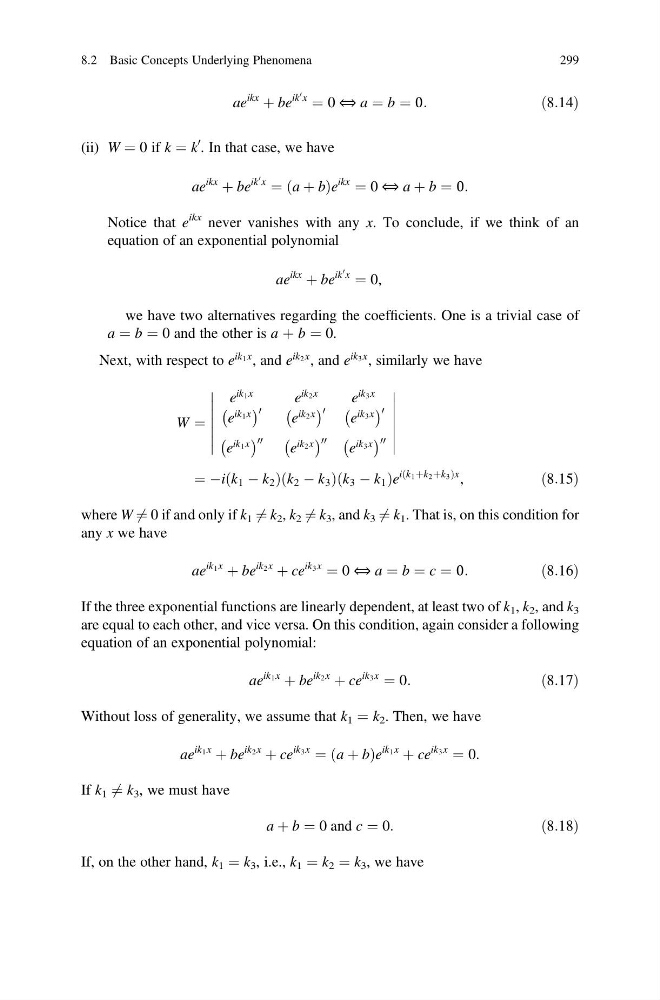
ae
ikx
þ be
ik
0 x
¼ 0 ⟺ a ¼ b ¼ 0:
ð8:14Þ
(ii) W ¼ 0 if k ¼ k
0 . In that case, we have
ae
ikx
þ be
ik
0 x
¼ a þ b
ð
Þe
ikx
¼ 0 ⟺ a þ b ¼ 0:
Notice that e
ikx never vanishes with any x. To conclude, if we think of an
equation of an exponential polynomial
ae
ikx
þ be
ik
0 x
¼ 0,
we have two alternatives regarding the coefficients. One is a trivial case of
a ¼ b ¼ 0 and the other is a þ b ¼ 0.
Next, with respect to e
ik 1 x , and e
ik 2 x , and e
ik 3 x , similarly we have
W ¼
e
ik 1 x
e
ik 2 x
e
ik 3 x
e
ik 1 x
À
Á 0
e
ik 1 x
À
Á 00
e
ik 2 x
À
Á 0
e
ik 3 x
À
Á 0
e
ik 2 x
À
Á 00
e
ik 3 x
À
Á 00
¼ Ài k 1 À k 2
ð
Þk 2 À k 3
ð
Þk 3 À k 1
ð
Þe
i k 1 þk 2 þk 3
ð
Þ x ,
ð8:15Þ
where W 6 ¼ 0 if and only if k 1 6 ¼ k 2 , k 2 6 ¼ k 3 , and k 3 6 ¼ k 1 . That is, on this condition for
any x we have
ae
ik 1 x
þ be
ik 2 x
þ ce
ik 3 x
¼ 0 ⟺ a ¼ b ¼ c ¼ 0:
ð8:16Þ
If the three exponential functions are linearly dependent, at least two of k 1 , k 2 , and k 3
are equal to each other, and vice versa. On this condition, again consider a following
equation of an exponential polynomial:
ae
ik 1 x
þ be
ik 2 x
þ ce
ik 3 x
¼ 0:
ð8:17Þ
Without loss of generality, we assume that k 1 ¼ k 2 . Then, we have
ae
ik 1 x
þ be
ik 2 x
þ ce
ik 3 x
¼ a þ b
ð
Þe
ik 1 x
þ ce
ik 3 x
¼ 0:
If k 1 6 ¼ k 3 , we must have
a þ b ¼ 0 and c ¼ 0:
ð8:18Þ
If, on the other hand, k 1 ¼ k 3 , i.e., k 1 ¼ k 2 ¼ k 3 , we have
8.2 Basic Concepts Underlying Phenomena
299
ikx
þ be
ik
0 x
¼ 0 ⟺ a ¼ b ¼ 0:
ð8:14Þ
(ii) W ¼ 0 if k ¼ k
0 . In that case, we have
ae
ikx
þ be
ik
0 x
¼ a þ b
ð
Þe
ikx
¼ 0 ⟺ a þ b ¼ 0:
Notice that e
ikx never vanishes with any x. To conclude, if we think of an
equation of an exponential polynomial
ae
ikx
þ be
ik
0 x
¼ 0,
we have two alternatives regarding the coefficients. One is a trivial case of
a ¼ b ¼ 0 and the other is a þ b ¼ 0.
Next, with respect to e
ik 1 x , and e
ik 2 x , and e
ik 3 x , similarly we have
W ¼
e
ik 1 x
e
ik 2 x
e
ik 3 x
e
ik 1 x
À
Á 0
e
ik 1 x
À
Á 00
e
ik 2 x
À
Á 0
e
ik 3 x
À
Á 0
e
ik 2 x
À
Á 00
e
ik 3 x
À
Á 00
¼ Ài k 1 À k 2
ð
Þk 2 À k 3
ð
Þk 3 À k 1
ð
Þe
i k 1 þk 2 þk 3
ð
Þ x ,
ð8:15Þ
where W 6 ¼ 0 if and only if k 1 6 ¼ k 2 , k 2 6 ¼ k 3 , and k 3 6 ¼ k 1 . That is, on this condition for
any x we have
ae
ik 1 x
þ be
ik 2 x
þ ce
ik 3 x
¼ 0 ⟺ a ¼ b ¼ c ¼ 0:
ð8:16Þ
If the three exponential functions are linearly dependent, at least two of k 1 , k 2 , and k 3
are equal to each other, and vice versa. On this condition, again consider a following
equation of an exponential polynomial:
ae
ik 1 x
þ be
ik 2 x
þ ce
ik 3 x
¼ 0:
ð8:17Þ
Without loss of generality, we assume that k 1 ¼ k 2 . Then, we have
ae
ik 1 x
þ be
ik 2 x
þ ce
ik 3 x
¼ a þ b
ð
Þe
ik 1 x
þ ce
ik 3 x
¼ 0:
If k 1 6 ¼ k 3 , we must have
a þ b ¼ 0 and c ¼ 0:
ð8:18Þ
If, on the other hand, k 1 ¼ k 3 , i.e., k 1 ¼ k 2 ¼ k 3 , we have
8.2 Basic Concepts Underlying Phenomena
299