

k i ¼ e 1 e 2 e 3
ð
Þ
k i sin θ
0
Àk i cos θ
0
B
@
1
C
A,
ð8:24Þ
x s ¼ e 1 e 2 e 3
ð
Þ
x
y
0
0
B
@
1
C
A,
ð8:25Þ
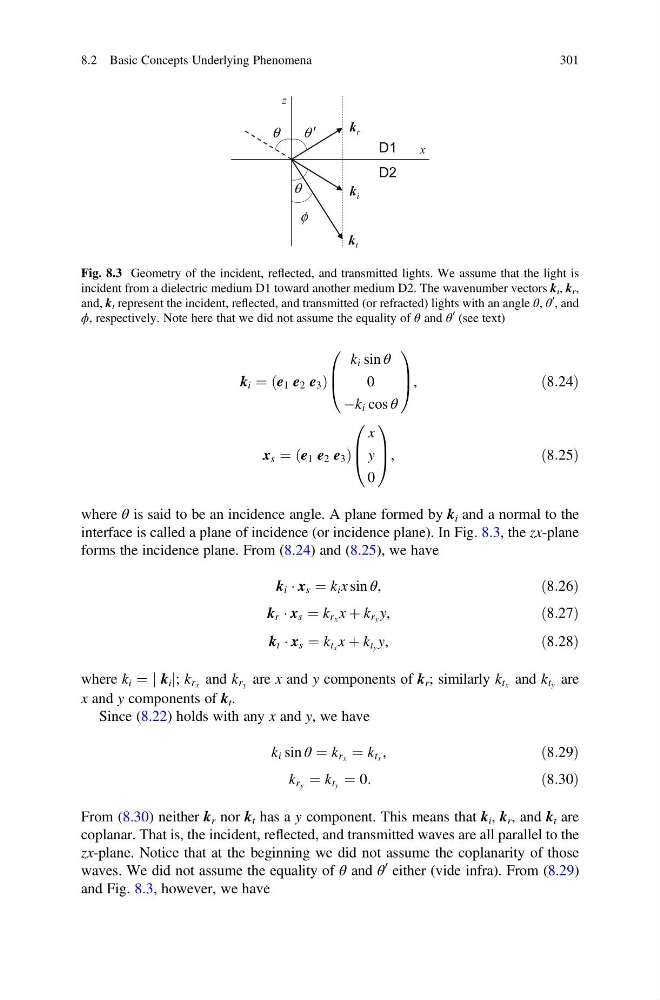
where θ is said to be an incidence angle. A plane formed by k i and a normal to the
interface is called a plane of incidence (or incidence plane). In Fig. 8.3, the zx-plane
forms the incidence plane. From (8.24) and (8.25), we have
k i Á x s ¼ k i x sin θ,
ð8:26Þ
k r Á x s ¼ k r x x þ k r y y,
ð8:27Þ
k t Á x s ¼ k t x x þ k t y y,
ð8:28Þ
where k i ¼ j k i j; k r x and k r y are x and y components of k r ; similarly k t x and k t y are
x and y components of k t .
Since (8.22) holds with any x and y, we have
k i sin θ ¼ k r x ¼ k t x ,
ð8:29Þ
k r y ¼ k t y ¼ 0:
ð8:30Þ
From (8.30) neither k r nor k t has a y component. This means that k i , k r , and k t are
coplanar. That is, the incident, reflected, and transmitted waves are all parallel to the
zx-plane. Notice that at the beginning we did not assume the coplanarity of those
waves. We did not assume the equality of θ and θ
0 either (vide infra). From (8.29)
and Fig. 8.3, however, we have
x
z
k i
k r
k t
θ
θ
φ
θ
'
'
Fig. 8.3 Geometry of the incident, reflected, and transmitted lights. We assume that the light is
incident from a dielectric medium D1 toward another medium D2. The wavenumber vectors k i , k r ,
and, k t represent the incident, reflected, and transmitted (or refracted) lights with an angle θ, θ
0
, and
ϕ, respectively. Note here that we did not assume the equality of θ and θ
0 (see text)
8.2 Basic Concepts Underlying Phenomena
301
ð
Þ
k i sin θ
0
Àk i cos θ
0
B
@
1
C
A,
ð8:24Þ
x s ¼ e 1 e 2 e 3
ð
Þ
x
y
0
0
B
@
1
C
A,
ð8:25Þ
where θ is said to be an incidence angle. A plane formed by k i and a normal to the
interface is called a plane of incidence (or incidence plane). In Fig. 8.3, the zx-plane
forms the incidence plane. From (8.24) and (8.25), we have
k i Á x s ¼ k i x sin θ,
ð8:26Þ
k r Á x s ¼ k r x x þ k r y y,
ð8:27Þ
k t Á x s ¼ k t x x þ k t y y,
ð8:28Þ
where k i ¼ j k i j; k r x and k r y are x and y components of k r ; similarly k t x and k t y are
x and y components of k t .
Since (8.22) holds with any x and y, we have
k i sin θ ¼ k r x ¼ k t x ,
ð8:29Þ
k r y ¼ k t y ¼ 0:
ð8:30Þ
From (8.30) neither k r nor k t has a y component. This means that k i , k r , and k t are
coplanar. That is, the incident, reflected, and transmitted waves are all parallel to the
zx-plane. Notice that at the beginning we did not assume the coplanarity of those
waves. We did not assume the equality of θ and θ
0 either (vide infra). From (8.29)
and Fig. 8.3, however, we have
x
z
k i
k r
k t
θ
θ
φ
θ
'
'
Fig. 8.3 Geometry of the incident, reflected, and transmitted lights. We assume that the light is
incident from a dielectric medium D1 toward another medium D2. The wavenumber vectors k i , k r ,
and, k t represent the incident, reflected, and transmitted (or refracted) lights with an angle θ, θ
0
, and
ϕ, respectively. Note here that we did not assume the equality of θ and θ
0 (see text)
8.2 Basic Concepts Underlying Phenomena
301