

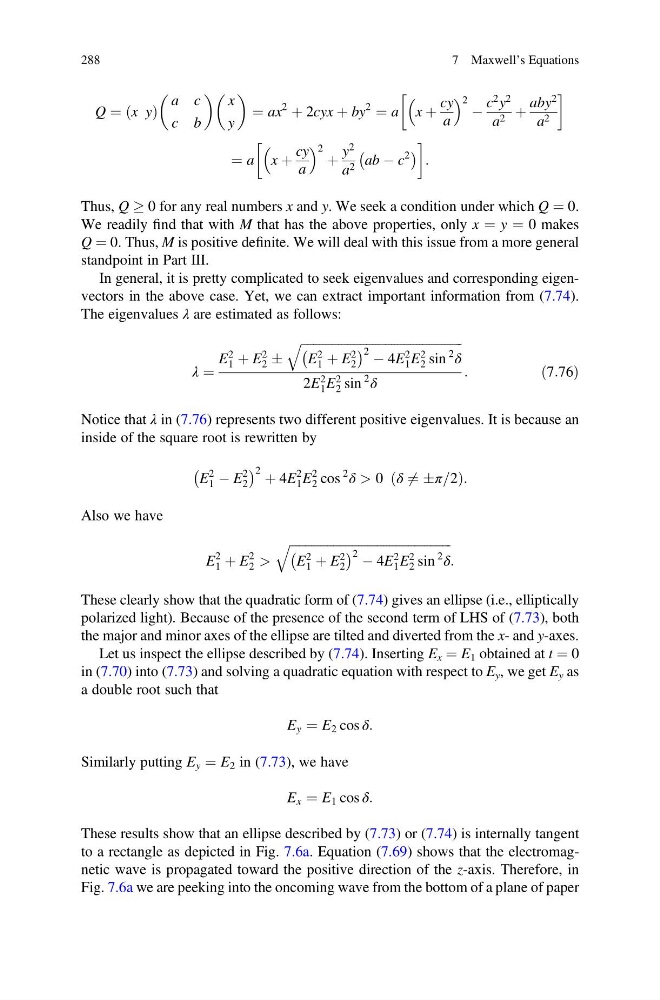
Q ¼ x y
ð Þ
a c
c b
x
y
¼ ax
2
þ 2cyx þ by
2
¼ a x þ
cy
a
2 À
c
2 y
2
a 2 þ
aby
2
a 2
!
¼ a x þ
cy
a
2 þ
y
2
a 2 ab À c
2
À
Á
!
:
Thus, Q ! 0 for any real numbers x and y. We seek a condition under which Q ¼ 0.
We readily find that with M that has the above properties, only x ¼ y ¼ 0 makes
Q ¼ 0. Thus, M is positive definite. We will deal with this issue from a more general
standpoint in Part III.
In general, it is pretty complicated to seek eigenvalues and corresponding eigenvectors in the above case. Yet, we can extract important information from (7.74).
The eigenvalues λ are estimated as follows:
λ ¼
E
2
1 þ E
2
2 Æ
ffiffiffiffiffiffiffiffiffiffiffiffiffiffiffiffiffiffiffiffiffiffiffiffiffiffiffiffiffiffiffiffiffiffiffiffiffiffiffiffiffiffiffiffiffiffiffiffiffiffiffi ffi
E
2
1 þ E
2
2
À
Á 2 À 4E
2
1 E
2
2 sin
2
δ
q
2E
2
1 E
2
2 sin
2
δ
:
ð7:76Þ
Notice that λ in (7.76) represents two different positive eigenvalues. It is because an
inside of the square root is rewritten by
E
2
1 À E
2
2
À
Á 2 þ 4E
2
1 E
2
2 cos
2
δ > 0 δ 6 ¼ Æπ=2
ð
Þ :
Also we have
E
2
1 þ E
2
2 >
ffiffiffiffiffiffiffiffiffiffiffiffiffiffiffiffiffiffiffiffiffiffiffiffiffiffiffiffiffiffiffiffiffiffiffiffiffiffiffiffiffiffiffiffiffiffiffiffiffiffiffi ffi
E
2
1 þ E
2
2
À
Á 2 À 4E
2
1 E
2
2 sin
2
δ
q
:
These clearly show that the quadratic form of (7.74) gives an ellipse (i.e., elliptically
polarized light). Because of the presence of the second term of LHS of (7.73), both
the major and minor axes of the ellipse are tilted and diverted from the x- and y-axes.
Let us inspect the ellipse described by (7.74). Inserting E x ¼ E 1 obtained at t ¼ 0
in (7.70) into (7.73) and solving a quadratic equation with respect to E y , we get E y as
a double root such that
E y ¼ E 2 cos δ:
Similarly putting E y ¼ E 2 in (7.73), we have
E x ¼ E 1 cos δ:
These results show that an ellipse described by (7.73) or (7.74) is internally tangent
to a rectangle as depicted in Fig. 7.6a. Equation (7.69) shows that the electromagnetic wave is propagated toward the positive direction of the z-axis. Therefore, in
Fig. 7.6a we are peeking into the oncoming wave from the bottom of a plane of paper
288
7 Maxwell’s Equations
ð Þ
a c
c b
x
y
¼ ax
2
þ 2cyx þ by
2
¼ a x þ
cy
a
2 À
c
2 y
2
a 2 þ
aby
2
a 2
!
¼ a x þ
cy
a
2 þ
y
2
a 2 ab À c
2
À
Á
!
:
Thus, Q ! 0 for any real numbers x and y. We seek a condition under which Q ¼ 0.
We readily find that with M that has the above properties, only x ¼ y ¼ 0 makes
Q ¼ 0. Thus, M is positive definite. We will deal with this issue from a more general
standpoint in Part III.
In general, it is pretty complicated to seek eigenvalues and corresponding eigenvectors in the above case. Yet, we can extract important information from (7.74).
The eigenvalues λ are estimated as follows:
λ ¼
E
2
1 þ E
2
2 Æ
ffiffiffiffiffiffiffiffiffiffiffiffiffiffiffiffiffiffiffiffiffiffiffiffiffiffiffiffiffiffiffiffiffiffiffiffiffiffiffiffiffiffiffiffiffiffiffiffiffiffiffi ffi
E
2
1 þ E
2
2
À
Á 2 À 4E
2
1 E
2
2 sin
2
δ
q
2E
2
1 E
2
2 sin
2
δ
:
ð7:76Þ
Notice that λ in (7.76) represents two different positive eigenvalues. It is because an
inside of the square root is rewritten by
E
2
1 À E
2
2
À
Á 2 þ 4E
2
1 E
2
2 cos
2
δ > 0 δ 6 ¼ Æπ=2
ð
Þ :
Also we have
E
2
1 þ E
2
2 >
ffiffiffiffiffiffiffiffiffiffiffiffiffiffiffiffiffiffiffiffiffiffiffiffiffiffiffiffiffiffiffiffiffiffiffiffiffiffiffiffiffiffiffiffiffiffiffiffiffiffiffi ffi
E
2
1 þ E
2
2
À
Á 2 À 4E
2
1 E
2
2 sin
2
δ
q
:
These clearly show that the quadratic form of (7.74) gives an ellipse (i.e., elliptically
polarized light). Because of the presence of the second term of LHS of (7.73), both
the major and minor axes of the ellipse are tilted and diverted from the x- and y-axes.
Let us inspect the ellipse described by (7.74). Inserting E x ¼ E 1 obtained at t ¼ 0
in (7.70) into (7.73) and solving a quadratic equation with respect to E y , we get E y as
a double root such that
E y ¼ E 2 cos δ:
Similarly putting E y ¼ E 2 in (7.73), we have
E x ¼ E 1 cos δ:
These results show that an ellipse described by (7.73) or (7.74) is internally tangent
to a rectangle as depicted in Fig. 7.6a. Equation (7.69) shows that the electromagnetic wave is propagated toward the positive direction of the z-axis. Therefore, in
Fig. 7.6a we are peeking into the oncoming wave from the bottom of a plane of paper
288
7 Maxwell’s Equations