

E y
E 2
À cos δ
ð
Þ
E x
E 1
¼ Æ sin δ
ð
Þ
ffiffiffiffiffiffiffiffiffiffiffiffiffiffiffi
1 À
E x
2
E
2
1
s
:
ð7:72Þ
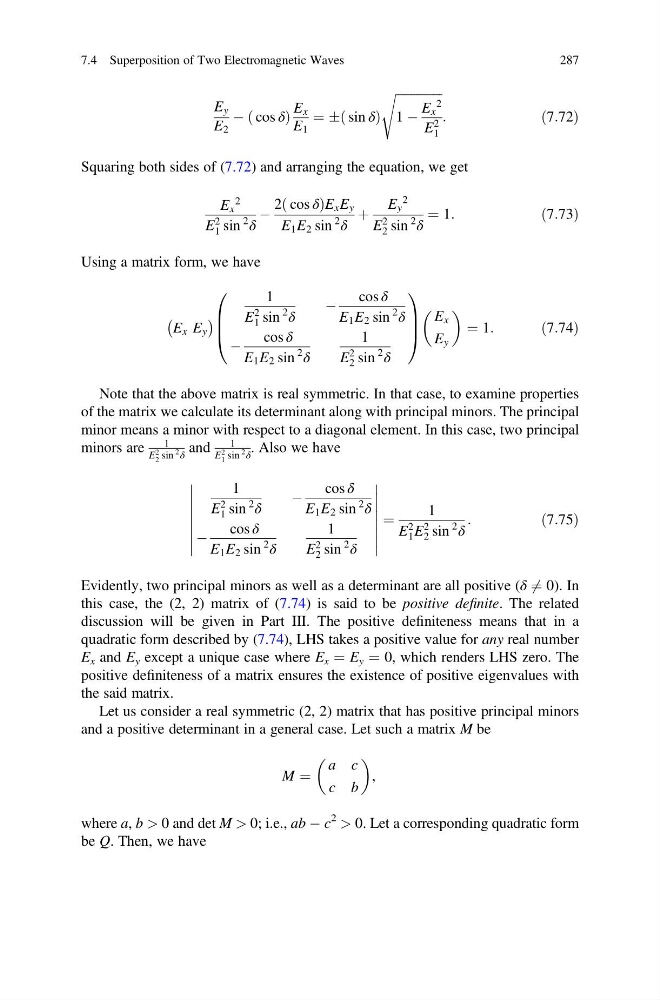
Squaring both sides of (7.72) and arranging the equation, we get
E x
2
E
2
1 sin
2
δ
À
2 cos δ
ð
ÞE x E y
E 1 E 2 sin
2
δ
þ
E y
2
E
2
2 sin
2
δ
¼ 1:
ð7:73Þ
Using a matrix form, we have
E x E y
À
Á
1
E
2
1 sin
2
δ
À
cos δ
E 1 E 2 sin
2
δ
À
cos δ
E 1 E 2 sin
2
δ
1
E
2
2 sin
2
δ
0
B
B
@
1
C
C
A
E x
E y
¼ 1:
ð7:74Þ
Note that the above matrix is real symmetric. In that case, to examine properties
of the matrix we calculate its determinant along with principal minors. The principal
minor means a minor with respect to a diagonal element. In this case, two principal
minors are
1
E
2
2 sin
2 δ
and
1
E
2
1 sin
2 δ
. Also we have
1
E
2
1 sin
2
δ
À
cos δ
E 1 E 2 sin
2
δ
À
cos δ
E 1 E 2 sin
2
δ
1
E
2
2 sin
2
δ
¼
1
E
2
1 E
2
2 sin
2
δ
:
ð7:75Þ
Evidently, two principal minors as well as a determinant are all positive (δ 6 ¼ 0). In
this case, the (2, 2) matrix of (7.74) is said to be positive definite. The related
discussion will be given in Part III. The positive definiteness means that in a
quadratic form described by (7.74), LHS takes a positive value for any real number
E x and E y except a unique case where E x ¼ E y ¼ 0, which renders LHS zero. The
positive definiteness of a matrix ensures the existence of positive eigenvalues with
the said matrix.
Let us consider a real symmetric (2, 2) matrix that has positive principal minors
and a positive determinant in a general case. Let such a matrix M be
M ¼
a c
c b
,
where a, b > 0 and det M > 0; i.e., ab À c
2
> 0. Let a corresponding quadratic form
be Q. Then, we have
7.4 Superposition of Two Electromagnetic Waves
287
E 2
À cos δ
ð
Þ
E x
E 1
¼ Æ sin δ
ð
Þ
ffiffiffiffiffiffiffiffiffiffiffiffiffiffiffi
1 À
E x
2
E
2
1
s
:
ð7:72Þ
Squaring both sides of (7.72) and arranging the equation, we get
E x
2
E
2
1 sin
2
δ
À
2 cos δ
ð
ÞE x E y
E 1 E 2 sin
2
δ
þ
E y
2
E
2
2 sin
2
δ
¼ 1:
ð7:73Þ
Using a matrix form, we have
E x E y
À
Á
1
E
2
1 sin
2
δ
À
cos δ
E 1 E 2 sin
2
δ
À
cos δ
E 1 E 2 sin
2
δ
1
E
2
2 sin
2
δ
0
B
B
@
1
C
C
A
E x
E y
¼ 1:
ð7:74Þ
Note that the above matrix is real symmetric. In that case, to examine properties
of the matrix we calculate its determinant along with principal minors. The principal
minor means a minor with respect to a diagonal element. In this case, two principal
minors are
1
E
2
2 sin
2 δ
and
1
E
2
1 sin
2 δ
. Also we have
1
E
2
1 sin
2
δ
À
cos δ
E 1 E 2 sin
2
δ
À
cos δ
E 1 E 2 sin
2
δ
1
E
2
2 sin
2
δ
¼
1
E
2
1 E
2
2 sin
2
δ
:
ð7:75Þ
Evidently, two principal minors as well as a determinant are all positive (δ 6 ¼ 0). In
this case, the (2, 2) matrix of (7.74) is said to be positive definite. The related
discussion will be given in Part III. The positive definiteness means that in a
quadratic form described by (7.74), LHS takes a positive value for any real number
E x and E y except a unique case where E x ¼ E y ¼ 0, which renders LHS zero. The
positive definiteness of a matrix ensures the existence of positive eigenvalues with
the said matrix.
Let us consider a real symmetric (2, 2) matrix that has positive principal minors
and a positive determinant in a general case. Let such a matrix M be
M ¼
a c
c b
,
where a, b > 0 and det M > 0; i.e., ab À c
2
> 0. Let a corresponding quadratic form
be Q. Then, we have
7.4 Superposition of Two Electromagnetic Waves
287