

at a certain position of z ¼ constant. We set the constant ¼ 0. Then, we find that at
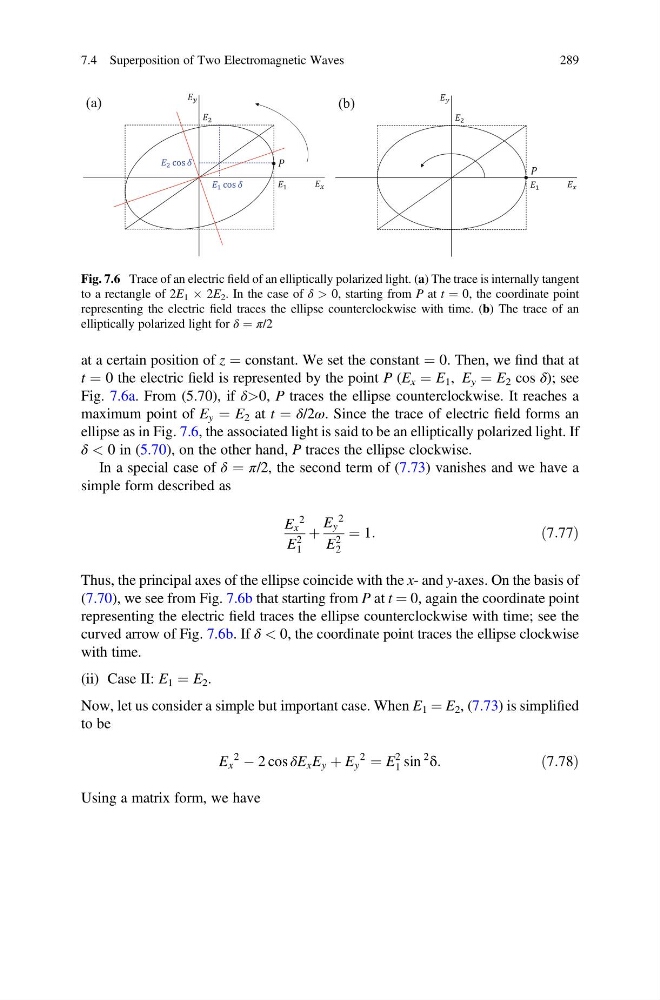
t ¼ 0 the electric field is represented by the point P (E x ¼ E 1 , E y ¼ E 2 cos δ); see
Fig. 7.6a. From (5.70), if δ>0, P traces the ellipse counterclockwise. It reaches a
maximum point of E y ¼ E 2 at t ¼ δ/2ω. Since the trace of electric field forms an
ellipse as in Fig. 7.6, the associated light is said to be an elliptically polarized light. If
δ < 0 in (5.70), on the other hand, P traces the ellipse clockwise.
In a special case of δ ¼ π/2, the second term of (7.73) vanishes and we have a
simple form described as
E x
2
E
2
1
þ
E y
2
E
2
2
¼ 1:
ð7:77Þ
Thus, the principal axes of the ellipse coincide with the x- and y-axes. On the basis of
(7.70), we see from Fig. 7.6b that starting from P at t ¼ 0, again the coordinate point
representing the electric field traces the ellipse counterclockwise with time; see the
curved arrow of Fig. 7.6b. If δ < 0, the coordinate point traces the ellipse clockwise
with time.
(ii) Case II: E 1 ¼ E 2 .
Now, let us consider a simple but important case. When E 1 ¼ E 2 , (7.73) is simplified
to be
E x
2
À 2 cos δE x E y þ E y
2
¼ E
2
1 sin
2
δ:
ð7:78Þ
Using a matrix form, we have
cos
cos
(a)
(b)
Fig. 7.6 Trace of an electric field of an elliptically polarized light. (a) The trace is internally tangent
to a rectangle of 2E 1 Â 2E 2 . In the case of δ > 0, starting from P at t ¼ 0, the coordinate point
representing the electric field traces the ellipse counterclockwise with time. (b) The trace of an
elliptically polarized light for δ ¼ π/2
7.4 Superposition of Two Electromagnetic Waves
289
t ¼ 0 the electric field is represented by the point P (E x ¼ E 1 , E y ¼ E 2 cos δ); see
Fig. 7.6a. From (5.70), if δ>0, P traces the ellipse counterclockwise. It reaches a
maximum point of E y ¼ E 2 at t ¼ δ/2ω. Since the trace of electric field forms an
ellipse as in Fig. 7.6, the associated light is said to be an elliptically polarized light. If
δ < 0 in (5.70), on the other hand, P traces the ellipse clockwise.
In a special case of δ ¼ π/2, the second term of (7.73) vanishes and we have a
simple form described as
E x
2
E
2
1
þ
E y
2
E
2
2
¼ 1:
ð7:77Þ
Thus, the principal axes of the ellipse coincide with the x- and y-axes. On the basis of
(7.70), we see from Fig. 7.6b that starting from P at t ¼ 0, again the coordinate point
representing the electric field traces the ellipse counterclockwise with time; see the
curved arrow of Fig. 7.6b. If δ < 0, the coordinate point traces the ellipse clockwise
with time.
(ii) Case II: E 1 ¼ E 2 .
Now, let us consider a simple but important case. When E 1 ¼ E 2 , (7.73) is simplified
to be
E x
2
À 2 cos δE x E y þ E y
2
¼ E
2
1 sin
2
δ:
ð7:78Þ
Using a matrix form, we have
cos
cos
(a)
(b)
Fig. 7.6 Trace of an electric field of an elliptically polarized light. (a) The trace is internally tangent
to a rectangle of 2E 1 Â 2E 2 . In the case of δ > 0, starting from P at t ¼ 0, the coordinate point
representing the electric field traces the ellipse counterclockwise with time. (b) The trace of an
elliptically polarized light for δ ¼ π/2
7.4 Superposition of Two Electromagnetic Waves
289