

C Â A Â B
ð
Þ¼A B Á C
ð
ÞÀB C Á A
ð
Þ:
In the above, putting B ¼ C = n, we have
n  A  n
ð
Þ¼A n Á n
ð
ÞÀn n Á A
ð
Þ:
That is, we have
A ¼ n n Á A
ð
Þþn  A  n
ð
Þ:
This relation means that A can be decomposed into a component parallel to n and
that perpendicular to n. Equation (7.63) shows that E 0 has no component parallel to
n. This is another confirmation that E is perpendicular to n.
In (7.60) and (7.61),
ffiffiffiffiffiffiffi ffi
μ=ε
p
has a dimension [Ω]. Make sure that this can be
confirmed by (7.9) and (7.11). Hence,
ffiffiffiffiffiffiffi ffi
μ=ε
p
is said to be characteristic impedance
[2]. We denote it by
Z
ffiffiffiffiffiffiffi ffi
μ=ε
p :
ð7:64Þ
Thus, we have
H 0 ¼ n  E 0
ð
Þ=Z:
In vacuum we have
Z 0 ¼
ffiffiffiffiffiffiffiffiffiffiffi
μ 0 =ε 0
p
% 376:7 Ω
½ :
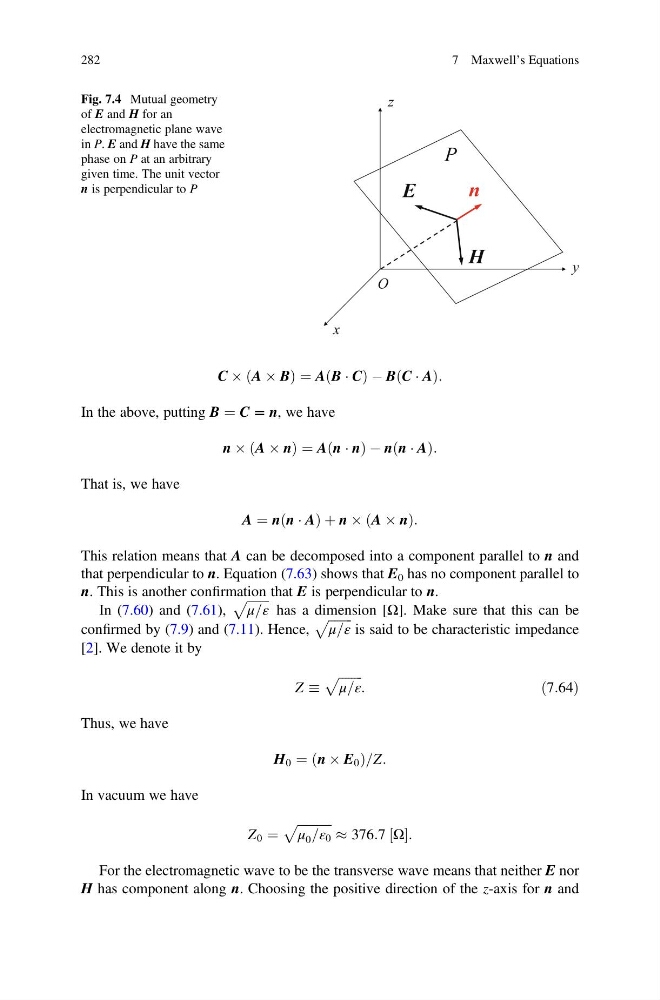
For the electromagnetic wave to be the transverse wave means that neither E nor
H has component along n. Choosing the positive direction of the z-axis for n and
y
x
n
P
O
z
E
H
Fig. 7.4 Mutual geometry
of E and H for an
electromagnetic plane wave
in P. E and H have the same
phase on P at an arbitrary
given time. The unit vector
n is perpendicular to P
282
7 Maxwell’s Equations
ð
Þ¼A B Á C
ð
ÞÀB C Á A
ð
Þ:
In the above, putting B ¼ C = n, we have
n  A  n
ð
Þ¼A n Á n
ð
ÞÀn n Á A
ð
Þ:
That is, we have
A ¼ n n Á A
ð
Þþn  A  n
ð
Þ:
This relation means that A can be decomposed into a component parallel to n and
that perpendicular to n. Equation (7.63) shows that E 0 has no component parallel to
n. This is another confirmation that E is perpendicular to n.
In (7.60) and (7.61),
ffiffiffiffiffiffiffi ffi
μ=ε
p
has a dimension [Ω]. Make sure that this can be
confirmed by (7.9) and (7.11). Hence,
ffiffiffiffiffiffiffi ffi
μ=ε
p
is said to be characteristic impedance
[2]. We denote it by
Z
ffiffiffiffiffiffiffi ffi
μ=ε
p :
ð7:64Þ
Thus, we have
H 0 ¼ n  E 0
ð
Þ=Z:
In vacuum we have
Z 0 ¼
ffiffiffiffiffiffiffiffiffiffiffi
μ 0 =ε 0
p
% 376:7 Ω
½ :
For the electromagnetic wave to be the transverse wave means that neither E nor
H has component along n. Choosing the positive direction of the z-axis for n and
y
x
n
P
O
z
E
H
Fig. 7.4 Mutual geometry
of E and H for an
electromagnetic plane wave
in P. E and H have the same
phase on P at an arbitrary
given time. The unit vector
n is perpendicular to P
282
7 Maxwell’s Equations