

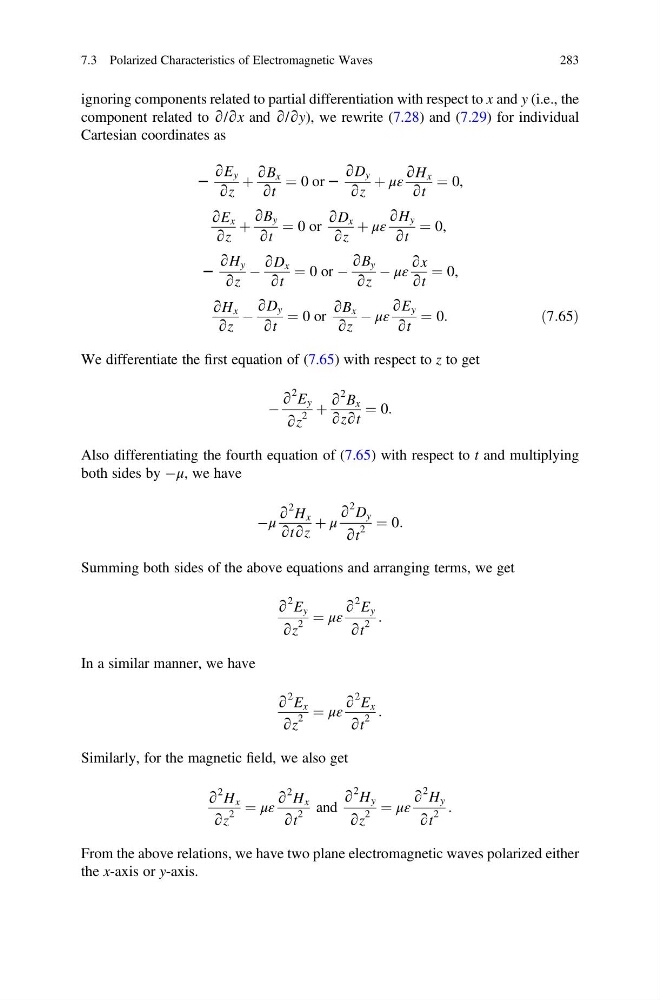
ignoring components related to partial differentiation with respect to x and y (i.e., the
component related to ∂/∂x and ∂/∂y), we rewrite (7.28) and (7.29) for individual
Cartesian coordinates as
2
∂E y
∂z
þ
∂B x
∂t
¼ 0 or 2
∂D y
∂z
þ με
∂H x
∂t
¼ 0,
∂E x
∂z
þ
∂B y
∂t
¼ 0 or
∂D x
∂z
þ με
∂H y
∂t
¼ 0,
2
∂H y
∂z
À
∂D x
∂t
¼ 0 or À
∂B y
∂z
À με
∂x
∂t
¼ 0,
∂H x
∂z
À
∂D y
∂t
¼ 0 or
∂B x
∂z
À με
∂E y
∂t
¼ 0:
ð7:65Þ
We differentiate the first equation of (7.65) with respect to z to get
À
∂
2 E y
∂z
2
þ
∂
2 B x
∂z∂t
¼ 0:
Also differentiating the fourth equation of (7.65) with respect to t and multiplying
both sides by Àμ, we have
Àμ
∂
2 H x
∂t∂z
þ μ
∂
2 D y
∂t
2
¼ 0:
Summing both sides of the above equations and arranging terms, we get
∂
2 E y
∂z
2
¼ με
∂
2 E y
∂t
2
:
In a similar manner, we have
∂
2 E x
∂z
2
¼ με
∂
2 E x
∂t
2
:
Similarly, for the magnetic field, we also get
∂
2 H x
∂z
2
¼ με
∂
2 H x
∂t
2
and
∂
2 H y
∂z
2
¼ με
∂
2 H y
∂t
2
:
From the above relations, we have two plane electromagnetic waves polarized either
the x-axis or y-axis.
7.3 Polarized Characteristics of Electromagnetic Waves
283
component related to ∂/∂x and ∂/∂y), we rewrite (7.28) and (7.29) for individual
Cartesian coordinates as
2
∂E y
∂z
þ
∂B x
∂t
¼ 0 or 2
∂D y
∂z
þ με
∂H x
∂t
¼ 0,
∂E x
∂z
þ
∂B y
∂t
¼ 0 or
∂D x
∂z
þ με
∂H y
∂t
¼ 0,
2
∂H y
∂z
À
∂D x
∂t
¼ 0 or À
∂B y
∂z
À με
∂x
∂t
¼ 0,
∂H x
∂z
À
∂D y
∂t
¼ 0 or
∂B x
∂z
À με
∂E y
∂t
¼ 0:
ð7:65Þ
We differentiate the first equation of (7.65) with respect to z to get
À
∂
2 E y
∂z
2
þ
∂
2 B x
∂z∂t
¼ 0:
Also differentiating the fourth equation of (7.65) with respect to t and multiplying
both sides by Àμ, we have
Àμ
∂
2 H x
∂t∂z
þ μ
∂
2 D y
∂t
2
¼ 0:
Summing both sides of the above equations and arranging terms, we get
∂
2 E y
∂z
2
¼ με
∂
2 E y
∂t
2
:
In a similar manner, we have
∂
2 E x
∂z
2
¼ με
∂
2 E x
∂t
2
:
Similarly, for the magnetic field, we also get
∂
2 H x
∂z
2
¼ με
∂
2 H x
∂t
2
and
∂
2 H y
∂z
2
¼ με
∂
2 H y
∂t
2
:
From the above relations, we have two plane electromagnetic waves polarized either
the x-axis or y-axis.
7.3 Polarized Characteristics of Electromagnetic Waves
283