

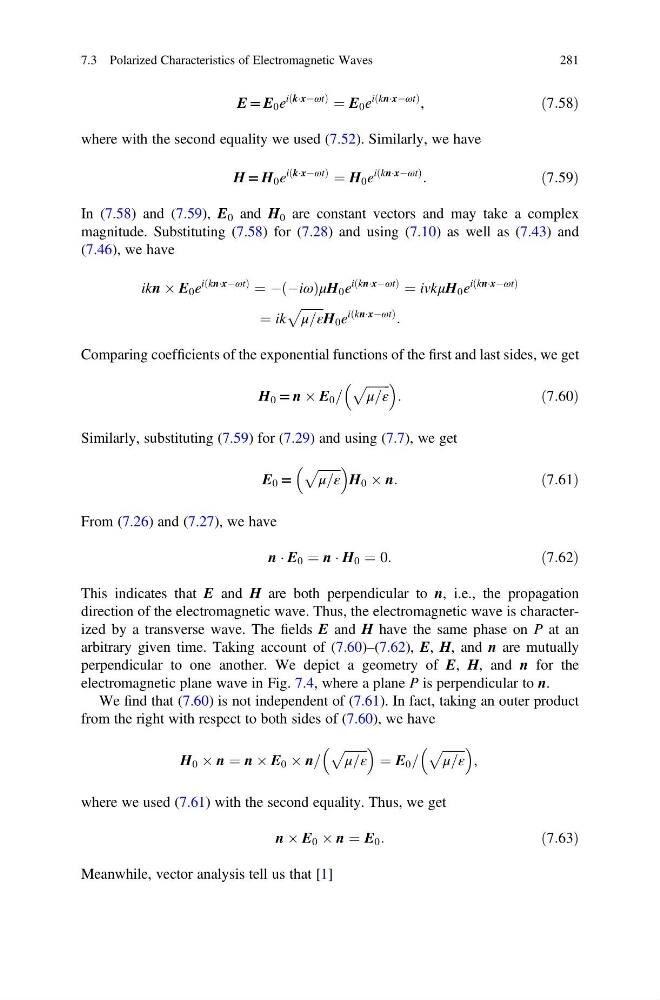
E = E 0 e
i kÁxÀωt
ð
Þ
¼ E 0 e
i knÁxÀωt
ð
Þ ,
ð7:58Þ
where with the second equality we used (7.52). Similarly, we have
H = H 0 e
i kÁxÀωt
ð
Þ
¼ H 0 e
i knÁxÀωt
ð
Þ
:
ð7:59Þ
In (7.58) and (7.59), E 0 and H 0 are constant vectors and may take a complex
magnitude. Substituting (7.58) for (7.28) and using (7.10) as well as (7.43) and
(7.46), we have
ikn  E 0 e
i knÁxÀωt
ð
Þ
¼ À Àiω
ð
ÞμH 0 e
i knÁxÀωt
ð
Þ
¼ ivkμH 0 e
i knÁxÀωt
ð
Þ
¼ ik
ffiffiffiffiffiffiffi ffi
μ=ε
p H 0 e
i knÁxÀωt
ð
Þ
:
Comparing coefficients of the exponential functions of the first and last sides, we get
H 0 = n  E 0 =
ffiffiffiffiffiffiffi ffi
μ=ε
p
:
ð7:60Þ
Similarly, substituting (7.59) for (7.29) and using (7.7), we get
E 0 =
ffiffiffiffiffiffiffi ffi
μ=ε
p
H 0 Â n:
ð7:61Þ
From (7.26) and (7.27), we have
n Á E 0 ¼ n Á H 0 ¼ 0:
ð7:62Þ
This indicates that E and H are both perpendicular to n, i.e., the propagation
direction of the electromagnetic wave. Thus, the electromagnetic wave is characterized by a transverse wave. The fields E and H have the same phase on P at an
arbitrary given time. Taking account of (7.60)–(7.62), E, H, and n are mutually
perpendicular to one another. We depict a geometry of E, H, and n for the
electromagnetic plane wave in Fig. 7.4, where a plane P is perpendicular to n.
We find that (7.60) is not independent of (7.61). In fact, taking an outer product
from the right with respect to both sides of (7.60), we have
H 0  n ¼ n  E 0  n=
ffiffiffiffiffiffiffi ffi
μ=ε
p
¼ E 0 =
ffiffiffiffiffiffiffi ffi
μ=ε
p
,
where we used (7.61) with the second equality. Thus, we get
n  E 0  n ¼ E 0 :
ð7:63Þ
Meanwhile, vector analysis tell us that [1]
7.3 Polarized Characteristics of Electromagnetic Waves
281
i kÁxÀωt
ð
Þ
¼ E 0 e
i knÁxÀωt
ð
Þ ,
ð7:58Þ
where with the second equality we used (7.52). Similarly, we have
H = H 0 e
i kÁxÀωt
ð
Þ
¼ H 0 e
i knÁxÀωt
ð
Þ
:
ð7:59Þ
In (7.58) and (7.59), E 0 and H 0 are constant vectors and may take a complex
magnitude. Substituting (7.58) for (7.28) and using (7.10) as well as (7.43) and
(7.46), we have
ikn  E 0 e
i knÁxÀωt
ð
Þ
¼ À Àiω
ð
ÞμH 0 e
i knÁxÀωt
ð
Þ
¼ ivkμH 0 e
i knÁxÀωt
ð
Þ
¼ ik
ffiffiffiffiffiffiffi ffi
μ=ε
p H 0 e
i knÁxÀωt
ð
Þ
:
Comparing coefficients of the exponential functions of the first and last sides, we get
H 0 = n  E 0 =
ffiffiffiffiffiffiffi ffi
μ=ε
p
:
ð7:60Þ
Similarly, substituting (7.59) for (7.29) and using (7.7), we get
E 0 =
ffiffiffiffiffiffiffi ffi
μ=ε
p
H 0 Â n:
ð7:61Þ
From (7.26) and (7.27), we have
n Á E 0 ¼ n Á H 0 ¼ 0:
ð7:62Þ
This indicates that E and H are both perpendicular to n, i.e., the propagation
direction of the electromagnetic wave. Thus, the electromagnetic wave is characterized by a transverse wave. The fields E and H have the same phase on P at an
arbitrary given time. Taking account of (7.60)–(7.62), E, H, and n are mutually
perpendicular to one another. We depict a geometry of E, H, and n for the
electromagnetic plane wave in Fig. 7.4, where a plane P is perpendicular to n.
We find that (7.60) is not independent of (7.61). In fact, taking an outer product
from the right with respect to both sides of (7.60), we have
H 0  n ¼ n  E 0  n=
ffiffiffiffiffiffiffi ffi
μ=ε
p
¼ E 0 =
ffiffiffiffiffiffiffi ffi
μ=ε
p
,
where we used (7.61) with the second equality. Thus, we get
n  E 0  n ¼ E 0 :
ð7:63Þ
Meanwhile, vector analysis tell us that [1]
7.3 Polarized Characteristics of Electromagnetic Waves
281