

n Á x À vt ¼ 0:
ð7:55Þ
Equation (7.55) defines a plane in a three-dimensional space and is called a Hesse’s
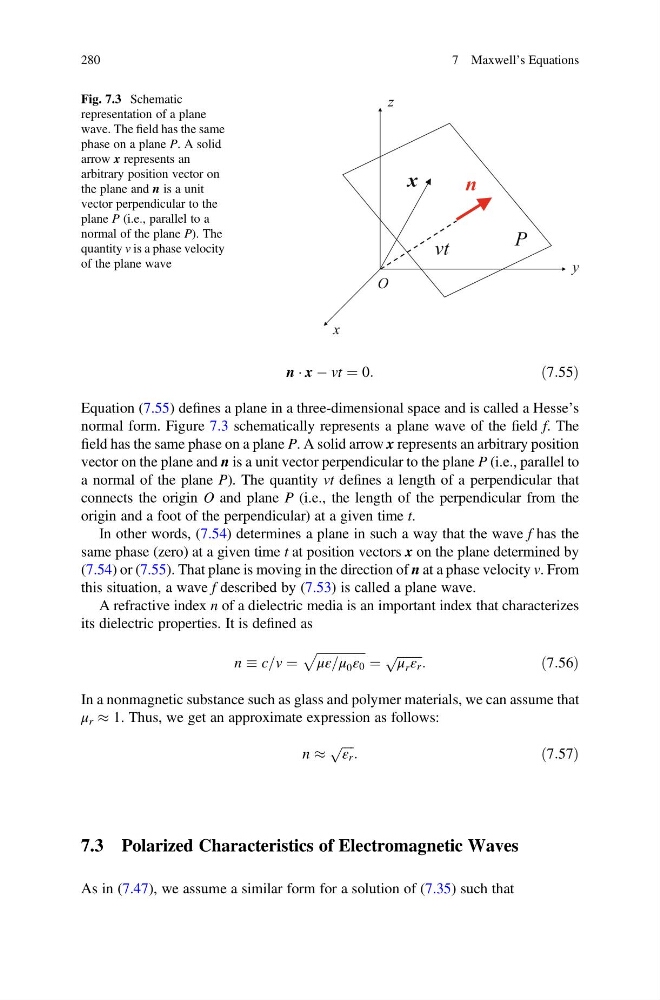
normal form. Figure 7.3 schematically represents a plane wave of the field f. The
field has the same phase on a plane P. A solid arrow x represents an arbitrary position
vector on the plane and n is a unit vector perpendicular to the plane P (i.e., parallel to
a normal of the plane P). The quantity vt defines a length of a perpendicular that
connects the origin O and plane P (i.e., the length of the perpendicular from the
origin and a foot of the perpendicular) at a given time t.
In other words, (7.54) determines a plane in such a way that the wave f has the
same phase (zero) at a given time t at position vectors x on the plane determined by
(7.54) or (7.55). That plane is moving in the direction of n at a phase velocity v. From
this situation, a wave f described by (7.53) is called a plane wave.
A refractive index n of a dielectric media is an important index that characterizes
its dielectric properties. It is defined as
n c=v ¼
ffiffiffiffiffiffiffiffiffiffiffiffiffiffiffi ffi
με=μ 0 ε 0
p
¼
ffiffiffiffiffiffiffiffi
μ r ε r
p
:
ð7:56Þ
In a nonmagnetic substance such as glass and polymer materials, we can assume that
μ r % 1. Thus, we get an approximate expression as follows:
n %
ffiffiffiffi
ε r
p :
ð7:57Þ
7.3 Polarized Characteristics of Electromagnetic Waves
As in (7.47), we assume a similar form for a solution of (7.35) such that
y
x
z
x
n
vt
P
O
Fig. 7.3 Schematic
representation of a plane
wave. The field has the same
phase on a plane P. A solid
arrow x represents an
arbitrary position vector on
the plane and n is a unit
vector perpendicular to the
plane P (i.e., parallel to a
normal of the plane P). The
quantity v is a phase velocity
of the plane wave
280
7 Maxwell’s Equations
ð7:55Þ
Equation (7.55) defines a plane in a three-dimensional space and is called a Hesse’s
normal form. Figure 7.3 schematically represents a plane wave of the field f. The
field has the same phase on a plane P. A solid arrow x represents an arbitrary position
vector on the plane and n is a unit vector perpendicular to the plane P (i.e., parallel to
a normal of the plane P). The quantity vt defines a length of a perpendicular that
connects the origin O and plane P (i.e., the length of the perpendicular from the
origin and a foot of the perpendicular) at a given time t.
In other words, (7.54) determines a plane in such a way that the wave f has the
same phase (zero) at a given time t at position vectors x on the plane determined by
(7.54) or (7.55). That plane is moving in the direction of n at a phase velocity v. From
this situation, a wave f described by (7.53) is called a plane wave.
A refractive index n of a dielectric media is an important index that characterizes
its dielectric properties. It is defined as
n c=v ¼
ffiffiffiffiffiffiffiffiffiffiffiffiffiffiffi ffi
με=μ 0 ε 0
p
¼
ffiffiffiffiffiffiffiffi
μ r ε r
p
:
ð7:56Þ
In a nonmagnetic substance such as glass and polymer materials, we can assume that
μ r % 1. Thus, we get an approximate expression as follows:
n %
ffiffiffiffi
ε r
p :
ð7:57Þ
7.3 Polarized Characteristics of Electromagnetic Waves
As in (7.47), we assume a similar form for a solution of (7.35) such that
y
x
z
x
n
vt
P
O
Fig. 7.3 Schematic
representation of a plane
wave. The field has the same
phase on a plane P. A solid
arrow x represents an
arbitrary position vector on
the plane and n is a unit
vector perpendicular to the
plane P (i.e., parallel to a
normal of the plane P). The
quantity v is a phase velocity
of the plane wave
280
7 Maxwell’s Equations