

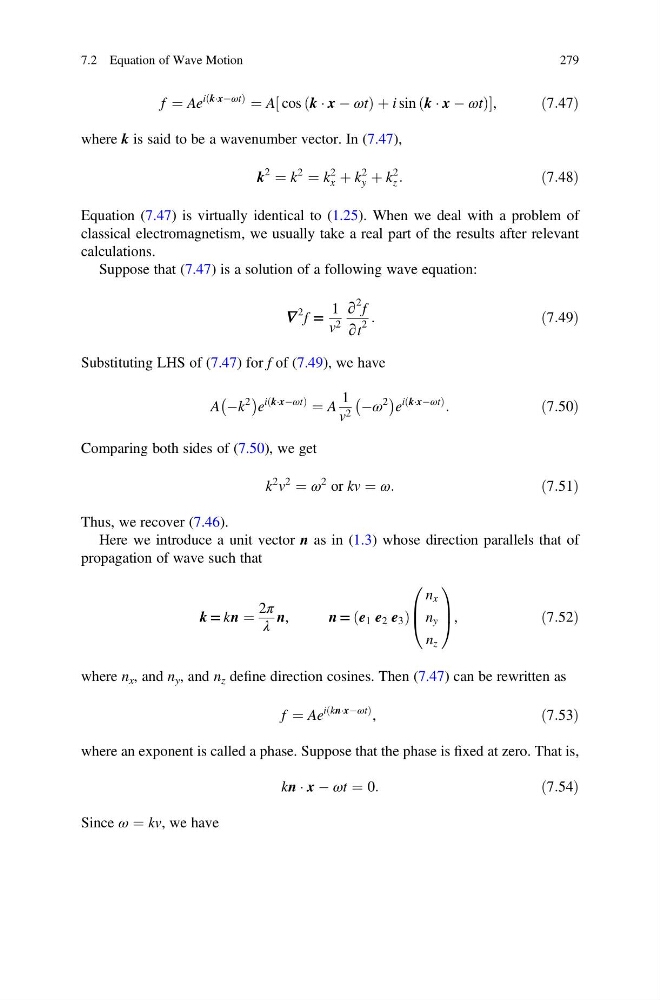
f ¼ Ae
i kÁxÀωt
ð
Þ
¼ A cos k Á x À ωt
ð
Þþi sin k Á x À ωt
ð
Þ
½
,
ð7:47Þ
where k is said to be a wavenumber vector. In (7.47),
k
2
¼ k
2
¼ k
2
x þ k
2
y þ k
2
z :
ð7:48Þ
Equation (7.47) is virtually identical to (1.25). When we deal with a problem of
classical electromagnetism, we usually take a real part of the results after relevant
calculations.
Suppose that (7.47) is a solution of a following wave equation:
—
2 f =
1
v 2
∂
2 f
∂t
2
:
ð7:49Þ
Substituting LHS of (7.47) for f of (7.49), we have
A Àk
2
À
Á
e
i kÁxÀωt
ð
Þ
¼ A
1
v 2 Àω
2
À
Á
e
i kÁxÀωt
ð
Þ
:
ð7:50Þ
Comparing both sides of (7.50), we get
k
2 v
2
¼ ω
2 or kv ¼ ω:
ð7:51Þ
Thus, we recover (7.46).
Here we introduce a unit vector n as in (1.3) whose direction parallels that of
propagation of wave such that
k = kn ¼
2π
λ
n,
n = e 1 e 2 e 3
ð
Þ
n x
n y
n z
0
B
@
1
C
A,
ð7:52Þ
where n x , and n y , and n z define direction cosines. Then (7.47) can be rewritten as
f ¼ Ae
i knÁxÀωt
ð
Þ ,
ð7:53Þ
where an exponent is called a phase. Suppose that the phase is fixed at zero. That is,
kn Á x À ωt ¼ 0:
ð7:54Þ
Since ω ¼ kv, we have
7.2 Equation of Wave Motion
279
i kÁxÀωt
ð
Þ
¼ A cos k Á x À ωt
ð
Þþi sin k Á x À ωt
ð
Þ
½
,
ð7:47Þ
where k is said to be a wavenumber vector. In (7.47),
k
2
¼ k
2
¼ k
2
x þ k
2
y þ k
2
z :
ð7:48Þ
Equation (7.47) is virtually identical to (1.25). When we deal with a problem of
classical electromagnetism, we usually take a real part of the results after relevant
calculations.
Suppose that (7.47) is a solution of a following wave equation:
—
2 f =
1
v 2
∂
2 f
∂t
2
:
ð7:49Þ
Substituting LHS of (7.47) for f of (7.49), we have
A Àk
2
À
Á
e
i kÁxÀωt
ð
Þ
¼ A
1
v 2 Àω
2
À
Á
e
i kÁxÀωt
ð
Þ
:
ð7:50Þ
Comparing both sides of (7.50), we get
k
2 v
2
¼ ω
2 or kv ¼ ω:
ð7:51Þ
Thus, we recover (7.46).
Here we introduce a unit vector n as in (1.3) whose direction parallels that of
propagation of wave such that
k = kn ¼
2π
λ
n,
n = e 1 e 2 e 3
ð
Þ
n x
n y
n z
0
B
@
1
C
A,
ð7:52Þ
where n x , and n y , and n z define direction cosines. Then (7.47) can be rewritten as
f ¼ Ae
i knÁxÀωt
ð
Þ ,
ð7:53Þ
where an exponent is called a phase. Suppose that the phase is fixed at zero. That is,
kn Á x À ωt ¼ 0:
ð7:54Þ
Since ω ¼ kv, we have
7.2 Equation of Wave Motion
279