

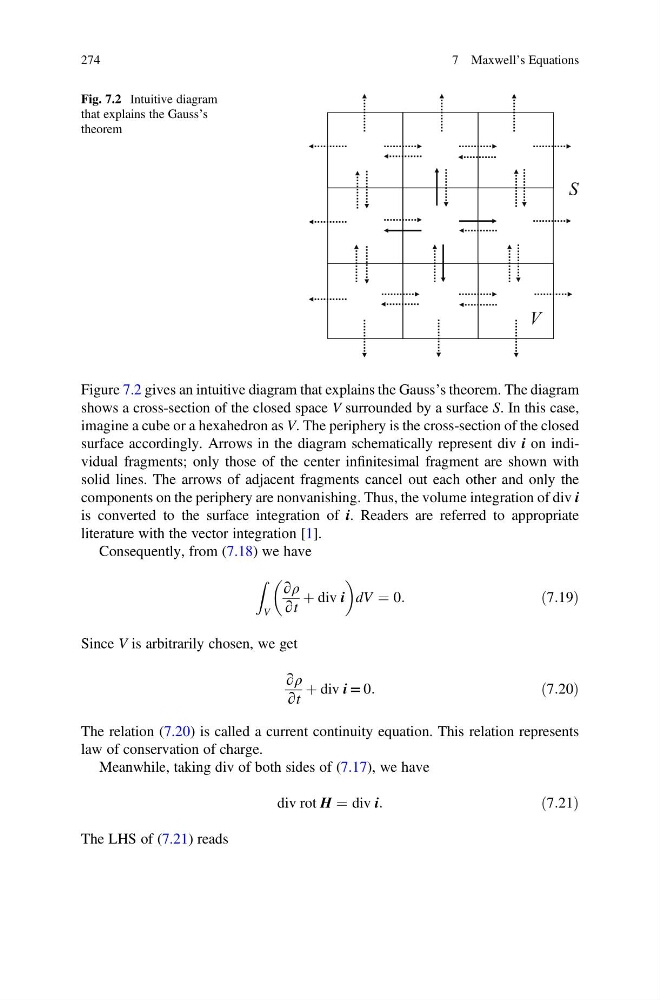
Figure 7.2 gives an intuitive diagram that explains the Gauss’s theorem. The diagram
shows a cross-section of the closed space V surrounded by a surface S. In this case,
imagine a cube or a hexahedron as V. The periphery is the cross-section of the closed
surface accordingly. Arrows in the diagram schematically represent div i on individual fragments; only those of the center infinitesimal fragment are shown with
solid lines. The arrows of adjacent fragments cancel out each other and only the
components on the periphery are nonvanishing. Thus, the volume integration of div i
is converted to the surface integration of i. Readers are referred to appropriate
literature with the vector integration [1].
Consequently, from (7.18) we have
Z
V
∂ρ
∂t
þ div i
dV ¼ 0:
ð7:19Þ
Since V is arbitrarily chosen, we get
∂ρ
∂t
þ div i = 0:
ð7:20Þ
The relation (7.20) is called a current continuity equation. This relation represents
law of conservation of charge.
Meanwhile, taking div of both sides of (7.17), we have
div rot H ¼ div i:
ð7:21Þ
The LHS of (7.21) reads
S
V
Fig. 7.2 Intuitive diagram
that explains the Gauss’s
theorem
274
7 Maxwell’s Equations
shows a cross-section of the closed space V surrounded by a surface S. In this case,
imagine a cube or a hexahedron as V. The periphery is the cross-section of the closed
surface accordingly. Arrows in the diagram schematically represent div i on individual fragments; only those of the center infinitesimal fragment are shown with
solid lines. The arrows of adjacent fragments cancel out each other and only the
components on the periphery are nonvanishing. Thus, the volume integration of div i
is converted to the surface integration of i. Readers are referred to appropriate
literature with the vector integration [1].
Consequently, from (7.18) we have
Z
V
∂ρ
∂t
þ div i
dV ¼ 0:
ð7:19Þ
Since V is arbitrarily chosen, we get
∂ρ
∂t
þ div i = 0:
ð7:20Þ
The relation (7.20) is called a current continuity equation. This relation represents
law of conservation of charge.
Meanwhile, taking div of both sides of (7.17), we have
div rot H ¼ div i:
ð7:21Þ
The LHS of (7.21) reads
S
V
Fig. 7.2 Intuitive diagram
that explains the Gauss’s
theorem
274
7 Maxwell’s Equations