

div rot H ¼
∂
∂x
∂H z
∂y
2
∂H y
∂z
þ
∂
∂y
∂H x
∂z
2
∂H z
∂x
þ
∂
∂z
∂H y
∂x
2
∂H x
∂y
¼
∂
2
∂x∂y
À
∂
2
∂y∂x
H z þ
∂
2
∂y∂z
À
∂
2
∂z∂y
H x þ
∂
2
∂z∂x
À
∂
2
∂x∂z
H y
¼ 0:
ð7:22Þ
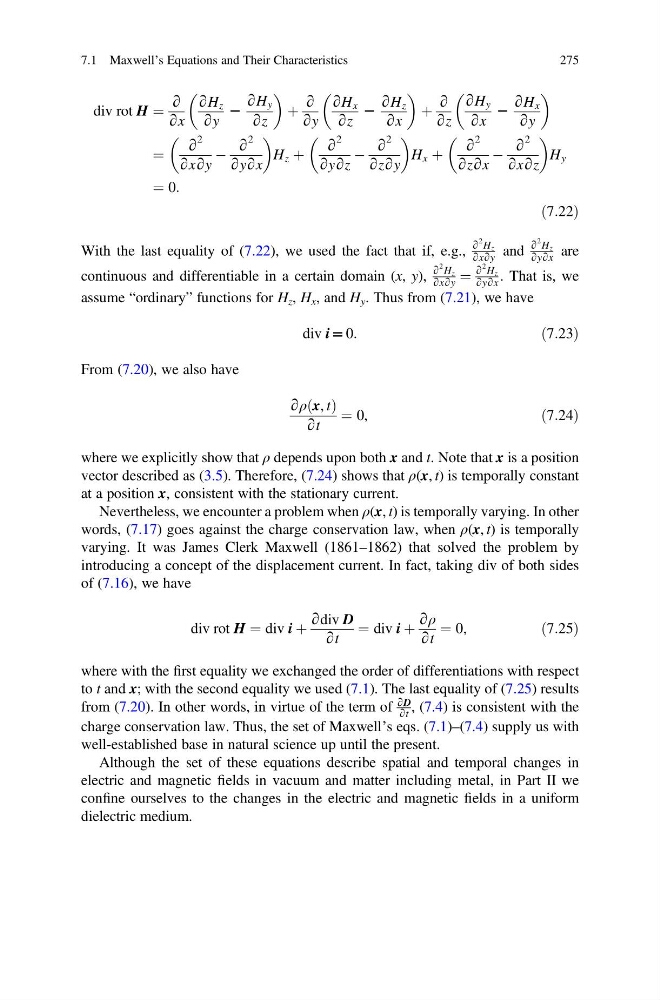
With the last equality of (7.22), we used the fact that if, e.g.,
∂
2 H z
∂x∂y
and
∂
2 H z
∂y∂x
are
continuous and differentiable in a certain domain (x, y),
∂
2 H z
∂x∂y
¼
∂
2 H z
∂y∂x
. That is, we
assume “ordinary” functions for H z , H x , and H y . Thus from (7.21), we have
div i = 0:
ð7:23Þ
From (7.20), we also have
∂ρ x, t
ð Þ
∂t
¼ 0,
ð7:24Þ
where we explicitly show that ρ depends upon both x and t. Note that x is a position
vector described as (3.5). Therefore, (7.24) shows that ρ(x, t) is temporally constant
at a position x, consistent with the stationary current.
Nevertheless, we encounter a problem when ρ(x, t) is temporally varying. In other
words, (7.17) goes against the charge conservation law, when ρ(x, t) is temporally
varying. It was James Clerk Maxwell (1861–1862) that solved the problem by
introducing a concept of the displacement current. In fact, taking div of both sides
of (7.16), we have
div rot H ¼ div i þ
∂div D
∂t
¼ div i þ
∂ρ
∂t
¼ 0,
ð7:25Þ
where with the first equality we exchanged the order of differentiations with respect
to t and x; with the second equality we used (7.1). The last equality of (7.25) results
from (7.20). In other words, in virtue of the term of
∂D
∂t
, (7.4) is consistent with the
charge conservation law. Thus, the set of Maxwell’s eqs. (7.1)–(7.4) supply us with
well-established base in natural science up until the present.
Although the set of these equations describe spatial and temporal changes in
electric and magnetic fields in vacuum and matter including metal, in Part II we
confine ourselves to the changes in the electric and magnetic fields in a uniform
dielectric medium.
7.1 Maxwell’s Equations and Their Characteristics
275
∂
∂x
∂H z
∂y
2
∂H y
∂z
þ
∂
∂y
∂H x
∂z
2
∂H z
∂x
þ
∂
∂z
∂H y
∂x
2
∂H x
∂y
¼
∂
2
∂x∂y
À
∂
2
∂y∂x
H z þ
∂
2
∂y∂z
À
∂
2
∂z∂y
H x þ
∂
2
∂z∂x
À
∂
2
∂x∂z
H y
¼ 0:
ð7:22Þ
With the last equality of (7.22), we used the fact that if, e.g.,
∂
2 H z
∂x∂y
and
∂
2 H z
∂y∂x
are
continuous and differentiable in a certain domain (x, y),
∂
2 H z
∂x∂y
¼
∂
2 H z
∂y∂x
. That is, we
assume “ordinary” functions for H z , H x , and H y . Thus from (7.21), we have
div i = 0:
ð7:23Þ
From (7.20), we also have
∂ρ x, t
ð Þ
∂t
¼ 0,
ð7:24Þ
where we explicitly show that ρ depends upon both x and t. Note that x is a position
vector described as (3.5). Therefore, (7.24) shows that ρ(x, t) is temporally constant
at a position x, consistent with the stationary current.
Nevertheless, we encounter a problem when ρ(x, t) is temporally varying. In other
words, (7.17) goes against the charge conservation law, when ρ(x, t) is temporally
varying. It was James Clerk Maxwell (1861–1862) that solved the problem by
introducing a concept of the displacement current. In fact, taking div of both sides
of (7.16), we have
div rot H ¼ div i þ
∂div D
∂t
¼ div i þ
∂ρ
∂t
¼ 0,
ð7:25Þ
where with the first equality we exchanged the order of differentiations with respect
to t and x; with the second equality we used (7.1). The last equality of (7.25) results
from (7.20). In other words, in virtue of the term of
∂D
∂t
, (7.4) is consistent with the
charge conservation law. Thus, the set of Maxwell’s eqs. (7.1)–(7.4) supply us with
well-established base in natural science up until the present.
Although the set of these equations describe spatial and temporal changes in
electric and magnetic fields in vacuum and matter including metal, in Part II we
confine ourselves to the changes in the electric and magnetic fields in a uniform
dielectric medium.
7.1 Maxwell’s Equations and Their Characteristics
275