

1 À ut ¼ 1 À 2tx þ t
2
À
Á 1=2 :
ð6:275Þ
Then we have
t ¼
2 u À x
ð
Þ
u 2 À 1
and dt ¼ 2 1 À ut
ð
Þdu= u
2
À 1
À
Á
with u 6 ¼ Æ1:
ð6:276Þ
Using these relations, we rewrite (6.274) as
c n x
ð Þ ¼
1
2πi
I
C
0
u
2
À 1
ð
Þ
n
2
n u À x
ð
Þ
nþ1
du ¼
1
2πi
I
C
0
À1
ð Þ
n 1 À u
2
ð
Þ
n
2
n u À x
ð
Þ
nþ1
du,
ð6:277Þ
where the contour C
0 encircles u ¼ x. Here using (6.118), we readily get
c n x
ð Þ ¼
1
2πi
I
C
0
À1
ð Þ
n 1 À u
2
ð
Þ
n
2
n u À x
ð
Þ
nþ1
du ¼
À1
ð Þ
n
2
n n!
d
n 1 À u
2
ð
Þ
n
du
n
u¼x
P n x
ð Þ: ð6:278Þ
The functions P n (x) are Legendre polynomials that have already appeared in
(3.145) and (3.207) of Sects. 3.5 and 3.6. In this manner, the above argument directly
confirms that the Legendre polynomials of (3.194) derived from the generating
function (3.180) or defined as Rodrigues formula of (3.145) are identical in the
complex domain. Originally, (3.145) and (3.207) were defined in the real domain.
The identical representations in both the domains real and complex are the consequence of the analytic continuation.
Substituting x ¼ Æ 1 for (6.277), we get
t
i
1
0
−i
(1 + )/ 2
(1 − )/ 2
−1
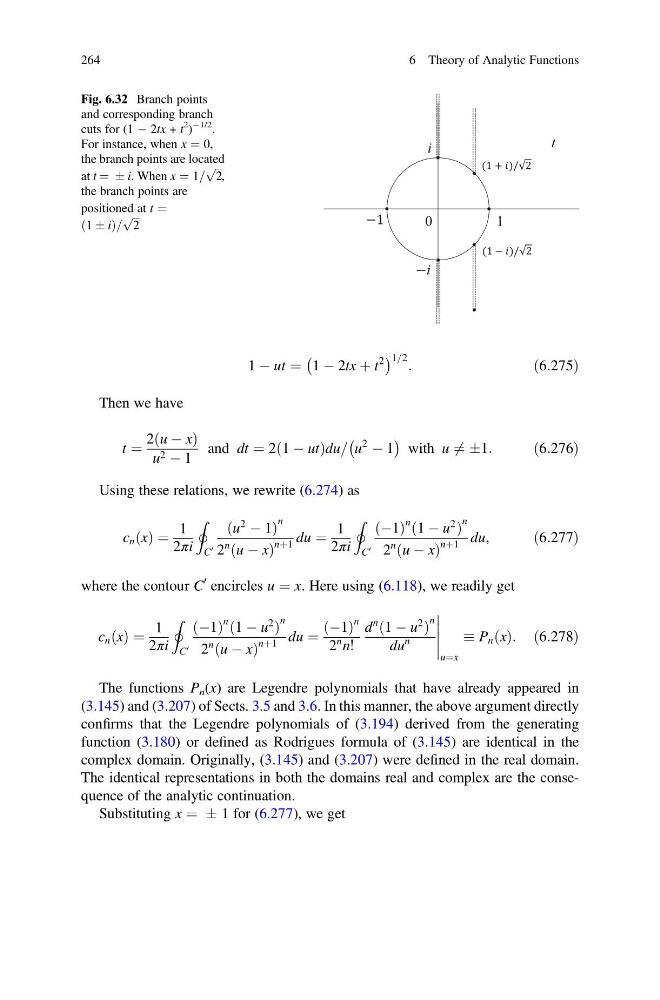
Fig. 6.32 Branch points
and corresponding branch
cuts for (1 À 2tx + t
2
)
À1/2
.
For instance, when x ¼ 0,
the branch points are located
at t ¼ Æ i. When x ¼ 1=
ffiffi ffi
2
p
,
the branch points are
positioned at t ¼
1 Æ i
ð
Þ=
ffiffi ffi
2
p
264
6 Theory of Analytic Functions
2
À
Á 1=2 :
ð6:275Þ
Then we have
t ¼
2 u À x
ð
Þ
u 2 À 1
and dt ¼ 2 1 À ut
ð
Þdu= u
2
À 1
À
Á
with u 6 ¼ Æ1:
ð6:276Þ
Using these relations, we rewrite (6.274) as
c n x
ð Þ ¼
1
2πi
I
C
0
u
2
À 1
ð
Þ
n
2
n u À x
ð
Þ
nþ1
du ¼
1
2πi
I
C
0
À1
ð Þ
n 1 À u
2
ð
Þ
n
2
n u À x
ð
Þ
nþ1
du,
ð6:277Þ
where the contour C
0 encircles u ¼ x. Here using (6.118), we readily get
c n x
ð Þ ¼
1
2πi
I
C
0
À1
ð Þ
n 1 À u
2
ð
Þ
n
2
n u À x
ð
Þ
nþ1
du ¼
À1
ð Þ
n
2
n n!
d
n 1 À u
2
ð
Þ
n
du
n
u¼x
P n x
ð Þ: ð6:278Þ
The functions P n (x) are Legendre polynomials that have already appeared in
(3.145) and (3.207) of Sects. 3.5 and 3.6. In this manner, the above argument directly
confirms that the Legendre polynomials of (3.194) derived from the generating
function (3.180) or defined as Rodrigues formula of (3.145) are identical in the
complex domain. Originally, (3.145) and (3.207) were defined in the real domain.
The identical representations in both the domains real and complex are the consequence of the analytic continuation.
Substituting x ¼ Æ 1 for (6.277), we get
t
i
1
0
−i
(1 + )/ 2
(1 − )/ 2
−1
Fig. 6.32 Branch points
and corresponding branch
cuts for (1 À 2tx + t
2
)
À1/2
.
For instance, when x ¼ 0,
the branch points are located
at t ¼ Æ i. When x ¼ 1=
ffiffi ffi
2
p
,
the branch points are
positioned at t ¼
1 Æ i
ð
Þ=
ffiffi ffi
2
p
264
6 Theory of Analytic Functions