

c n 1
ð Þ ¼
1
2πi
I
C
0
À1
ð Þ
n 1 À u
2
ð
Þ
n
2
n u À 1
ð
Þ
nþ1
du ¼
1
2
n Á
1
2πi
I
C
0
u þ 1
ð
Þ
n
u À 1
du ¼
1
2
n Á u þ 1
ð
Þ
n
u¼1
¼ 1
and
c n À1
ð Þ ¼
1
2πi
I
C
0
À1
ð Þ
n 1 À u
2
ð
Þ
n
2
n u þ 1
ð
Þ
nþ1
du ¼
1
2
n Á
1
2πi
I
C
0
u À 1
ð
Þ
n
u þ 1
du ¼
1
2
n Á u À 1
ð
Þ
n
u¼À1
¼ À1
ð Þ
n
ð6:279Þ
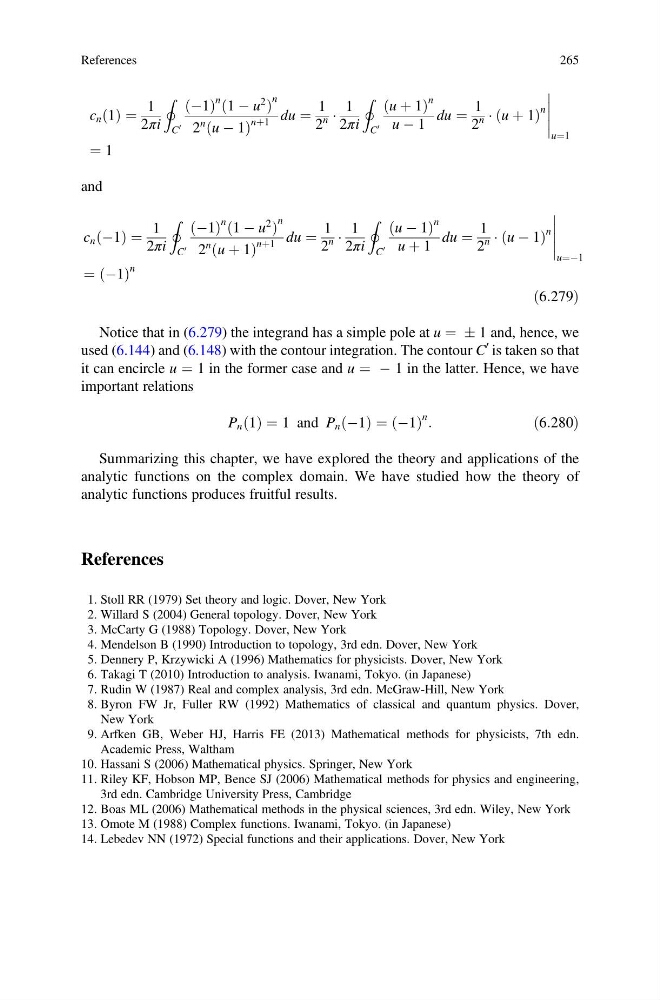
Notice that in (6.279) the integrand has a simple pole at u ¼ Æ 1 and, hence, we
used (6.144) and (6.148) with the contour integration. The contour C
0 is taken so that
it can encircle u ¼ 1 in the former case and u ¼ À 1 in the latter. Hence, we have
important relations
P n 1
ð Þ ¼ 1 and P n À1
ð Þ ¼ À1
ð Þ
n :
ð6:280Þ
Summarizing this chapter, we have explored the theory and applications of the
analytic functions on the complex domain. We have studied how the theory of
analytic functions produces fruitful results.
References
1. Stoll RR (1979) Set theory and logic. Dover, New York
2. Willard S (2004) General topology. Dover, New York
3. McCarty G (1988) Topology. Dover, New York
4. Mendelson B (1990) Introduction to topology, 3rd edn. Dover, New York
5. Dennery P, Krzywicki A (1996) Mathematics for physicists. Dover, New York
6. Takagi T (2010) Introduction to analysis. Iwanami, Tokyo. (in Japanese)
7. Rudin W (1987) Real and complex analysis, 3rd edn. McGraw-Hill, New York
8. Byron FW Jr, Fuller RW (1992) Mathematics of classical and quantum physics. Dover,
New York
9. Arfken GB, Weber HJ, Harris FE (2013) Mathematical methods for physicists, 7th edn.
Academic Press, Waltham
10. Hassani S (2006) Mathematical physics. Springer, New York
11. Riley KF, Hobson MP, Bence SJ (2006) Mathematical methods for physics and engineering,
3rd edn. Cambridge University Press, Cambridge
12. Boas ML (2006) Mathematical methods in the physical sciences, 3rd edn. Wiley, New York
13. Omote M (1988) Complex functions. Iwanami, Tokyo. (in Japanese)
14. Lebedev NN (1972) Special functions and their applications. Dover, New York
References
265
ð Þ ¼
1
2πi
I
C
0
À1
ð Þ
n 1 À u
2
ð
Þ
n
2
n u À 1
ð
Þ
nþ1
du ¼
1
2
n Á
1
2πi
I
C
0
u þ 1
ð
Þ
n
u À 1
du ¼
1
2
n Á u þ 1
ð
Þ
n
u¼1
¼ 1
and
c n À1
ð Þ ¼
1
2πi
I
C
0
À1
ð Þ
n 1 À u
2
ð
Þ
n
2
n u þ 1
ð
Þ
nþ1
du ¼
1
2
n Á
1
2πi
I
C
0
u À 1
ð
Þ
n
u þ 1
du ¼
1
2
n Á u À 1
ð
Þ
n
u¼À1
¼ À1
ð Þ
n
ð6:279Þ
Notice that in (6.279) the integrand has a simple pole at u ¼ Æ 1 and, hence, we
used (6.144) and (6.148) with the contour integration. The contour C
0 is taken so that
it can encircle u ¼ 1 in the former case and u ¼ À 1 in the latter. Hence, we have
important relations
P n 1
ð Þ ¼ 1 and P n À1
ð Þ ¼ À1
ð Þ
n :
ð6:280Þ
Summarizing this chapter, we have explored the theory and applications of the
analytic functions on the complex domain. We have studied how the theory of
analytic functions produces fruitful results.
References
1. Stoll RR (1979) Set theory and logic. Dover, New York
2. Willard S (2004) General topology. Dover, New York
3. McCarty G (1988) Topology. Dover, New York
4. Mendelson B (1990) Introduction to topology, 3rd edn. Dover, New York
5. Dennery P, Krzywicki A (1996) Mathematics for physicists. Dover, New York
6. Takagi T (2010) Introduction to analysis. Iwanami, Tokyo. (in Japanese)
7. Rudin W (1987) Real and complex analysis, 3rd edn. McGraw-Hill, New York
8. Byron FW Jr, Fuller RW (1992) Mathematics of classical and quantum physics. Dover,
New York
9. Arfken GB, Weber HJ, Harris FE (2013) Mathematical methods for physicists, 7th edn.
Academic Press, Waltham
10. Hassani S (2006) Mathematical physics. Springer, New York
11. Riley KF, Hobson MP, Bence SJ (2006) Mathematical methods for physics and engineering,
3rd edn. Cambridge University Press, Cambridge
12. Boas ML (2006) Mathematical methods in the physical sciences, 3rd edn. Wiley, New York
13. Omote M (1988) Complex functions. Iwanami, Tokyo. (in Japanese)
14. Lebedev NN (1972) Special functions and their applications. Dover, New York
References
265