

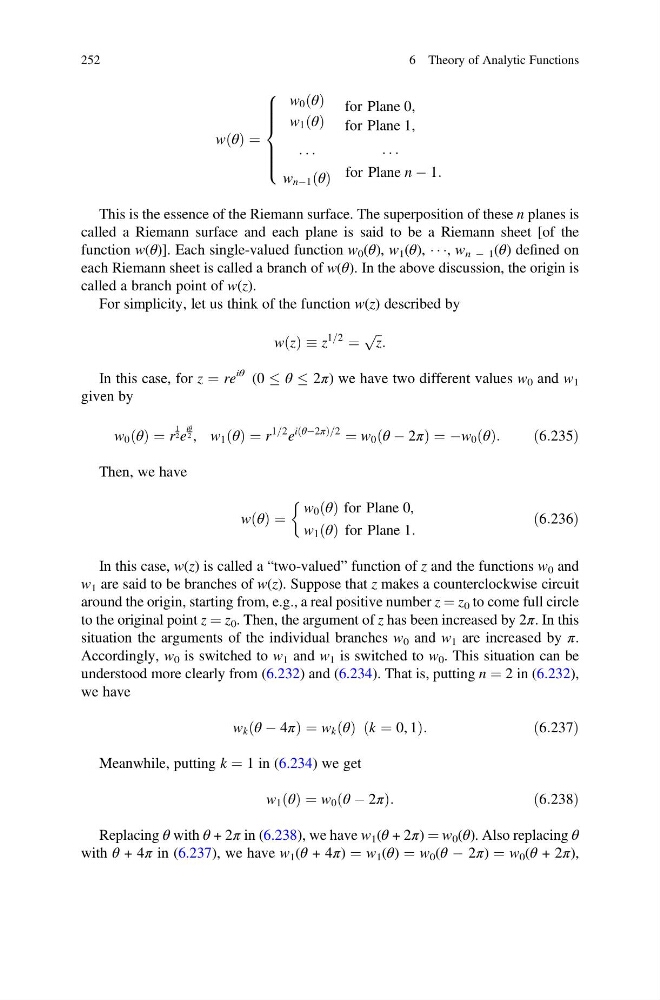
w θ
ð Þ ¼
w 0 θ
ð Þ
w 1 θ
ð Þ
Á Á Á
w nÀ1 θ
ð Þ
8
> > > > <
> > > > :
for Plane 0,
for Plane 1,
Á Á Á
for Plane n À 1:
This is the essence of the Riemann surface. The superposition of these n planes is
called a Riemann surface and each plane is said to be a Riemann sheet [of the
function w(θ)]. Each single-valued function w 0 (θ), w 1 (θ), Á Á Á, w n À 1 (θ) defined on
each Riemann sheet is called a branch of w(θ). In the above discussion, the origin is
called a branch point of w(z).
For simplicity, let us think of the function w(z) described by
w z
ð Þ z
1=2
¼
ffiffi
z
p :
In this case, for z ¼ re
iθ (0 θ 2π) we have two different values w 0 and w 1
given by
w 0 θ
ð Þ ¼ r
1
2 e
iθ
2 , w 1 θ
ð Þ ¼ r
1=2 e
i θÀ2π
ð
Þ =2
¼ w 0 θ À 2π
ð
Þ¼Àw 0 θ
ð Þ:
ð6:235Þ
Then, we have
w θ
ð Þ ¼
w 0 θ
ð Þ
w 1 θ
ð Þ
&
for Plane 0,
for Plane 1:
ð6:236Þ
In this case, w(z) is called a “two-valued” function of z and the functions w 0 and
w 1 are said to be branches of w(z). Suppose that z makes a counterclockwise circuit
around the origin, starting from, e.g., a real positive number z ¼ z 0 to come full circle
to the original point z ¼ z 0 . Then, the argument of z has been increased by 2π. In this
situation the arguments of the individual branches w 0 and w 1 are increased by π.
Accordingly, w 0 is switched to w 1 and w 1 is switched to w 0 . This situation can be
understood more clearly from (6.232) and (6.234). That is, putting n ¼ 2 in (6.232),
we have
w k θ À 4π
ð
Þ¼w k θ
ð Þ k ¼ 0, 1
ð
Þ :
ð6:237Þ
Meanwhile, putting k ¼ 1 in (6.234) we get
w 1 θ
ð Þ ¼ w 0 θ À 2π
ð
Þ:
ð6:238Þ
Replacing θ with θ + 2π in (6.238), we have w 1 (θ + 2π) ¼ w 0 (θ). Also replacing θ
with θ + 4π in (6.237), we have w 1 (θ + 4π) ¼ w 1 (θ) ¼ w 0 (θ À 2π) ¼ w 0 (θ + 2π),
252
6 Theory of Analytic Functions
ð Þ ¼
w 0 θ
ð Þ
w 1 θ
ð Þ
Á Á Á
w nÀ1 θ
ð Þ
8
> > > > <
> > > > :
for Plane 0,
for Plane 1,
Á Á Á
for Plane n À 1:
This is the essence of the Riemann surface. The superposition of these n planes is
called a Riemann surface and each plane is said to be a Riemann sheet [of the
function w(θ)]. Each single-valued function w 0 (θ), w 1 (θ), Á Á Á, w n À 1 (θ) defined on
each Riemann sheet is called a branch of w(θ). In the above discussion, the origin is
called a branch point of w(z).
For simplicity, let us think of the function w(z) described by
w z
ð Þ z
1=2
¼
ffiffi
z
p :
In this case, for z ¼ re
iθ (0 θ 2π) we have two different values w 0 and w 1
given by
w 0 θ
ð Þ ¼ r
1
2 e
iθ
2 , w 1 θ
ð Þ ¼ r
1=2 e
i θÀ2π
ð
Þ =2
¼ w 0 θ À 2π
ð
Þ¼Àw 0 θ
ð Þ:
ð6:235Þ
Then, we have
w θ
ð Þ ¼
w 0 θ
ð Þ
w 1 θ
ð Þ
&
for Plane 0,
for Plane 1:
ð6:236Þ
In this case, w(z) is called a “two-valued” function of z and the functions w 0 and
w 1 are said to be branches of w(z). Suppose that z makes a counterclockwise circuit
around the origin, starting from, e.g., a real positive number z ¼ z 0 to come full circle
to the original point z ¼ z 0 . Then, the argument of z has been increased by 2π. In this
situation the arguments of the individual branches w 0 and w 1 are increased by π.
Accordingly, w 0 is switched to w 1 and w 1 is switched to w 0 . This situation can be
understood more clearly from (6.232) and (6.234). That is, putting n ¼ 2 in (6.232),
we have
w k θ À 4π
ð
Þ¼w k θ
ð Þ k ¼ 0, 1
ð
Þ :
ð6:237Þ
Meanwhile, putting k ¼ 1 in (6.234) we get
w 1 θ
ð Þ ¼ w 0 θ À 2π
ð
Þ:
ð6:238Þ
Replacing θ with θ + 2π in (6.238), we have w 1 (θ + 2π) ¼ w 0 (θ). Also replacing θ
with θ + 4π in (6.237), we have w 1 (θ + 4π) ¼ w 1 (θ) ¼ w 0 (θ À 2π) ¼ w 0 (θ + 2π),
252
6 Theory of Analytic Functions