

w k θ
ð Þ ¼ w 0 θ À 2kπ
ð
Þ :
ð6:234Þ
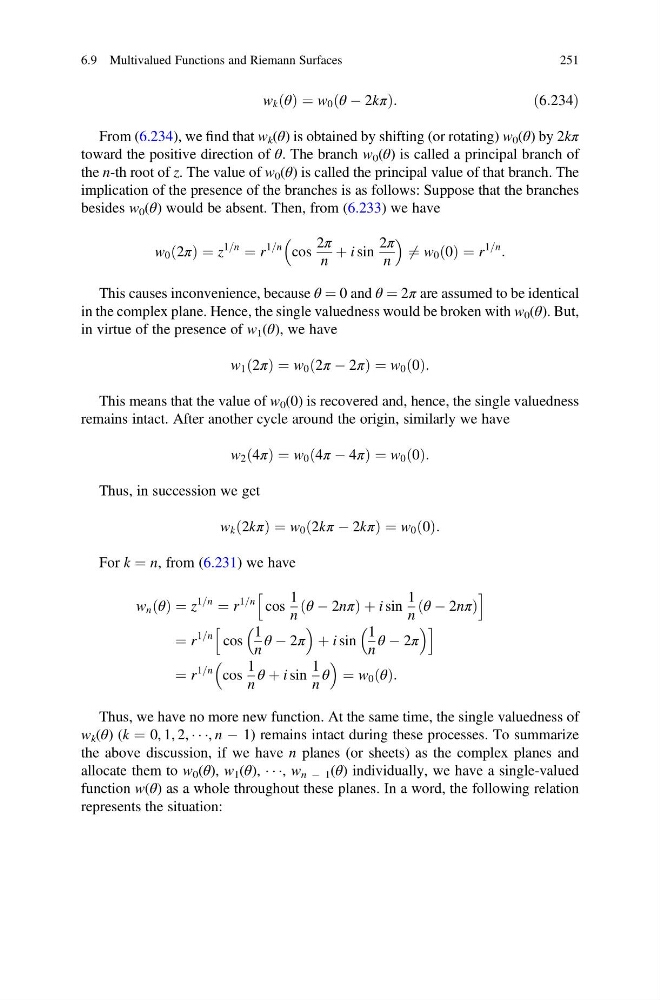
From (6.234), we find that w k (θ) is obtained by shifting (or rotating) w 0 (θ) by 2kπ
toward the positive direction of θ. The branch w 0 (θ) is called a principal branch of
the n-th root of z. The value of w 0 (θ) is called the principal value of that branch. The
implication of the presence of the branches is as follows: Suppose that the branches
besides w 0 (θ) would be absent. Then, from (6.233) we have
w 0 2π
ð Þ ¼ z
1=n
¼ r
1=n cos
2π
n
þ i sin
2π
n
6 ¼ w 0 0
ð Þ ¼ r
1=n
:
This causes inconvenience, because θ ¼ 0 and θ ¼ 2π are assumed to be identical
in the complex plane. Hence, the single valuedness would be broken with w 0 (θ). But,
in virtue of the presence of w 1 (θ), we have
w 1 2π
ð Þ ¼ w 0 2π À 2π
ð
Þ¼w 0 0
ð Þ:
This means that the value of w 0 (0) is recovered and, hence, the single valuedness
remains intact. After another cycle around the origin, similarly we have
w 2 4π
ð Þ ¼ w 0 4π À 4π
ð
Þ¼w 0 0
ð Þ:
Thus, in succession we get
w k 2kπ
ð
Þ ¼ w 0 2kπ À 2kπ
ð
Þ¼w 0 0
ð Þ:
For k ¼ n, from (6.231) we have
w n θ
ð Þ ¼ z
1=n
¼ r
1=n cos
1
n
θ À 2nπ
ð
Þþi sin
1
n
θ À 2nπ
ð
Þ
h
i
¼ r
1=n cos
1
n
θ À 2π
þ i sin
1
n
θ À 2π
h
i
¼ r
1=n cos
1
n
θ þ i sin
1
n
θ
¼ w 0 θ
ð Þ:
Thus, we have no more new function. At the same time, the single valuedness of
w k (θ) (k ¼ 0, 1, 2, Á Á Á, n À 1) remains intact during these processes. To summarize
the above discussion, if we have n planes (or sheets) as the complex planes and
allocate them to w 0 (θ), w 1 (θ), Á Á Á, w n À 1 (θ) individually, we have a single-valued
function w(θ) as a whole throughout these planes. In a word, the following relation
represents the situation:
6.9 Multivalued Functions and Riemann Surfaces
251
ð Þ ¼ w 0 θ À 2kπ
ð
Þ :
ð6:234Þ
From (6.234), we find that w k (θ) is obtained by shifting (or rotating) w 0 (θ) by 2kπ
toward the positive direction of θ. The branch w 0 (θ) is called a principal branch of
the n-th root of z. The value of w 0 (θ) is called the principal value of that branch. The
implication of the presence of the branches is as follows: Suppose that the branches
besides w 0 (θ) would be absent. Then, from (6.233) we have
w 0 2π
ð Þ ¼ z
1=n
¼ r
1=n cos
2π
n
þ i sin
2π
n
6 ¼ w 0 0
ð Þ ¼ r
1=n
:
This causes inconvenience, because θ ¼ 0 and θ ¼ 2π are assumed to be identical
in the complex plane. Hence, the single valuedness would be broken with w 0 (θ). But,
in virtue of the presence of w 1 (θ), we have
w 1 2π
ð Þ ¼ w 0 2π À 2π
ð
Þ¼w 0 0
ð Þ:
This means that the value of w 0 (0) is recovered and, hence, the single valuedness
remains intact. After another cycle around the origin, similarly we have
w 2 4π
ð Þ ¼ w 0 4π À 4π
ð
Þ¼w 0 0
ð Þ:
Thus, in succession we get
w k 2kπ
ð
Þ ¼ w 0 2kπ À 2kπ
ð
Þ¼w 0 0
ð Þ:
For k ¼ n, from (6.231) we have
w n θ
ð Þ ¼ z
1=n
¼ r
1=n cos
1
n
θ À 2nπ
ð
Þþi sin
1
n
θ À 2nπ
ð
Þ
h
i
¼ r
1=n cos
1
n
θ À 2π
þ i sin
1
n
θ À 2π
h
i
¼ r
1=n cos
1
n
θ þ i sin
1
n
θ
¼ w 0 θ
ð Þ:
Thus, we have no more new function. At the same time, the single valuedness of
w k (θ) (k ¼ 0, 1, 2, Á Á Á, n À 1) remains intact during these processes. To summarize
the above discussion, if we have n planes (or sheets) as the complex planes and
allocate them to w 0 (θ), w 1 (θ), Á Á Á, w n À 1 (θ) individually, we have a single-valued
function w(θ) as a whole throughout these planes. In a word, the following relation
represents the situation:
6.9 Multivalued Functions and Riemann Surfaces
251