

I ¼
Z 0
À1
dx
1 þ x 3 ¼
π
3
ffiffi ffi
3
p :
ð6:191Þ
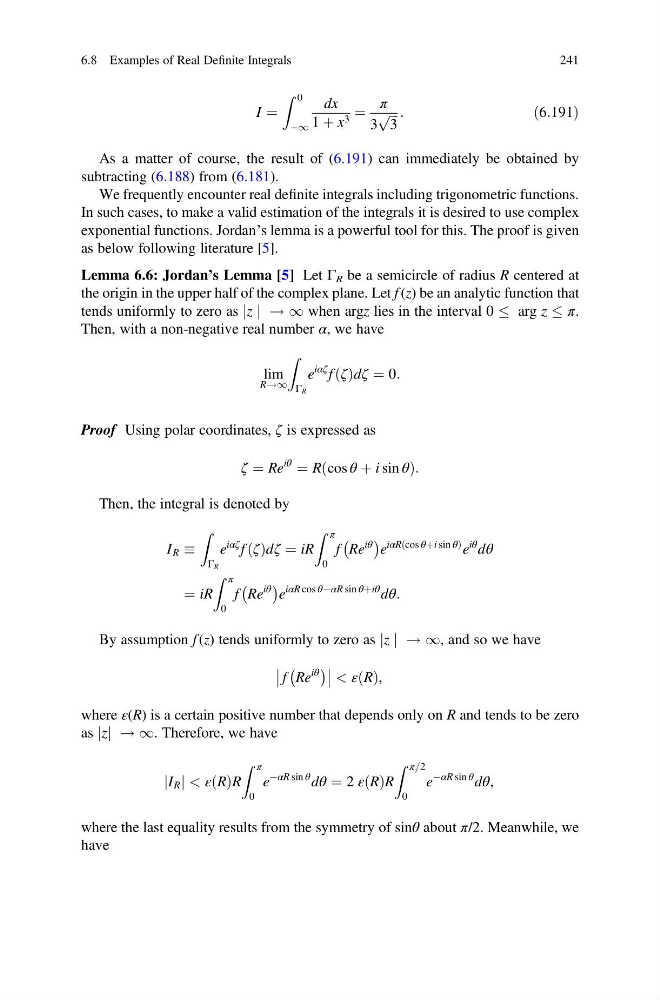
As a matter of course, the result of (6.191) can immediately be obtained by
subtracting (6.188) from (6.181).
We frequently encounter real definite integrals including trigonometric functions.
In such cases, to make a valid estimation of the integrals it is desired to use complex
exponential functions. Jordan’s lemma is a powerful tool for this. The proof is given
as below following literature [5].
Lemma 6.6: Jordan’s Lemma [5] Let Γ R be a semicircle of radius R centered at
the origin in the upper half of the complex plane. Let f (z) be an analytic function that
tends uniformly to zero as jz j ! 1 when argz lies in the interval 0
arg z π.
Then, with a non-negative real number α, we have
lim
R!1
Z
Γ R
e
iαζ f ζ
ð Þdζ ¼ 0:
Proof Using polar coordinates, ζ is expressed as
ζ ¼ Re
iθ
¼ R cos θ þ i sin θ
ð
Þ :
Then, the integral is denoted by
I R
Z
Γ R
e
iαζ f ζ
ð Þdζ ¼ iR
Z π
0
f Re
iθ
À
Á
e
iαR cos θþi sin θ
ð
Þ e
iθ dθ
¼ iR
Z π
0
f Re
iθ
À
Á
e
iαR cos θÀαR sin θþiθ dθ:
By assumption f (z) tends uniformly to zero as jz j ! 1, and so we have
f Re
iθ
À
Á
< ε R
ð Þ,
where ε(R) is a certain positive number that depends only on R and tends to be zero
as jzj ! 1. Therefore, we have
I R
j j < ε R
ð ÞR
Z π
0
e
ÀαR sin θ dθ ¼ 2 ε R
ð ÞR
Z π=2
0
e
ÀαR sin θ dθ,
where the last equality results from the symmetry of sinθ about π/2. Meanwhile, we
have
6.8 Examples of Real Definite Integrals
241
Z 0
À1
dx
1 þ x 3 ¼
π
3
ffiffi ffi
3
p :
ð6:191Þ
As a matter of course, the result of (6.191) can immediately be obtained by
subtracting (6.188) from (6.181).
We frequently encounter real definite integrals including trigonometric functions.
In such cases, to make a valid estimation of the integrals it is desired to use complex
exponential functions. Jordan’s lemma is a powerful tool for this. The proof is given
as below following literature [5].
Lemma 6.6: Jordan’s Lemma [5] Let Γ R be a semicircle of radius R centered at
the origin in the upper half of the complex plane. Let f (z) be an analytic function that
tends uniformly to zero as jz j ! 1 when argz lies in the interval 0
arg z π.
Then, with a non-negative real number α, we have
lim
R!1
Z
Γ R
e
iαζ f ζ
ð Þdζ ¼ 0:
Proof Using polar coordinates, ζ is expressed as
ζ ¼ Re
iθ
¼ R cos θ þ i sin θ
ð
Þ :
Then, the integral is denoted by
I R
Z
Γ R
e
iαζ f ζ
ð Þdζ ¼ iR
Z π
0
f Re
iθ
À
Á
e
iαR cos θþi sin θ
ð
Þ e
iθ dθ
¼ iR
Z π
0
f Re
iθ
À
Á
e
iαR cos θÀαR sin θþiθ dθ:
By assumption f (z) tends uniformly to zero as jz j ! 1, and so we have
f Re
iθ
À
Á
< ε R
ð Þ,
where ε(R) is a certain positive number that depends only on R and tends to be zero
as jzj ! 1. Therefore, we have
I R
j j < ε R
ð ÞR
Z π
0
e
ÀαR sin θ dθ ¼ 2 ε R
ð ÞR
Z π=2
0
e
ÀαR sin θ dθ,
where the last equality results from the symmetry of sinθ about π/2. Meanwhile, we
have
6.8 Examples of Real Definite Integrals
241