

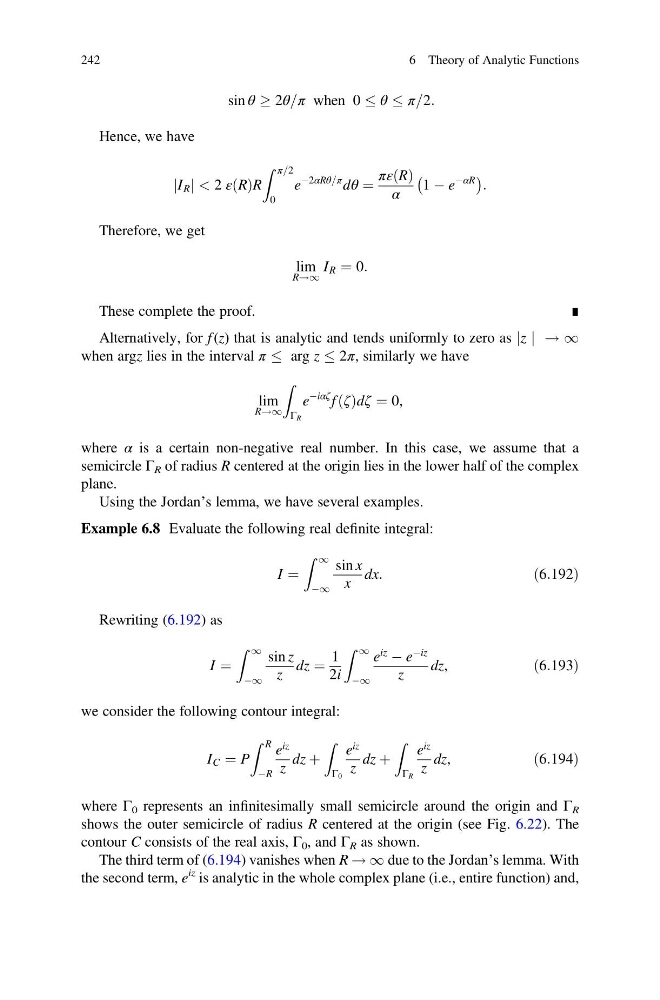
sin θ ! 2θ=π when 0 θ π=2:
Hence, we have
I R
j j < 2 ε R
ð ÞR
Z π=2
0
e
À2αRθ=π dθ ¼
πε R
ð Þ
α
1 À e
ÀαR
À
Á :
Therefore, we get
lim
R!1
I R ¼ 0:
These complete the proof.
∎
Alternatively, for f (z) that is analytic and tends uniformly to zero as jz j ! 1
when argz lies in the interval π
arg z 2π, similarly we have
lim
R!1
Z
Γ R
e
Àiαζ f ζ
ð Þdζ ¼ 0,
where α is a certain non-negative real number. In this case, we assume that a
semicircle Γ R of radius R centered at the origin lies in the lower half of the complex
plane.
Using the Jordan’s lemma, we have several examples.
Example 6.8 Evaluate the following real definite integral:
I ¼
Z 1
À1
sin x
x
dx:
ð6:192Þ
Rewriting (6.192) as
I ¼
Z 1
À1
sin z
z
dz ¼
1
2i
Z 1
À1
e
iz
À e
Àiz
z
dz,
ð6:193Þ
we consider the following contour integral:
I C ¼ P
Z R
ÀR
e
iz
z
dz þ
Z
Γ 0
e
iz
z
dz þ
Z
Γ R
e
iz
z
dz,
ð6:194Þ
where Γ 0 represents an infinitesimally small semicircle around the origin and Γ R
shows the outer semicircle of radius R centered at the origin (see Fig. 6.22). The
contour C consists of the real axis, Γ 0 , and Γ R as shown.
The third term of (6.194) vanishes when R ! 1 due to the Jordan’s lemma. With
the second term, e
iz is analytic in the whole complex plane (i.e., entire function) and,
242
6 Theory of Analytic Functions
Hence, we have
I R
j j < 2 ε R
ð ÞR
Z π=2
0
e
À2αRθ=π dθ ¼
πε R
ð Þ
α
1 À e
ÀαR
À
Á :
Therefore, we get
lim
R!1
I R ¼ 0:
These complete the proof.
∎
Alternatively, for f (z) that is analytic and tends uniformly to zero as jz j ! 1
when argz lies in the interval π
arg z 2π, similarly we have
lim
R!1
Z
Γ R
e
Àiαζ f ζ
ð Þdζ ¼ 0,
where α is a certain non-negative real number. In this case, we assume that a
semicircle Γ R of radius R centered at the origin lies in the lower half of the complex
plane.
Using the Jordan’s lemma, we have several examples.
Example 6.8 Evaluate the following real definite integral:
I ¼
Z 1
À1
sin x
x
dx:
ð6:192Þ
Rewriting (6.192) as
I ¼
Z 1
À1
sin z
z
dz ¼
1
2i
Z 1
À1
e
iz
À e
Àiz
z
dz,
ð6:193Þ
we consider the following contour integral:
I C ¼ P
Z R
ÀR
e
iz
z
dz þ
Z
Γ 0
e
iz
z
dz þ
Z
Γ R
e
iz
z
dz,
ð6:194Þ
where Γ 0 represents an infinitesimally small semicircle around the origin and Γ R
shows the outer semicircle of radius R centered at the origin (see Fig. 6.22). The
contour C consists of the real axis, Γ 0 , and Γ R as shown.
The third term of (6.194) vanishes when R ! 1 due to the Jordan’s lemma. With
the second term, e
iz is analytic in the whole complex plane (i.e., entire function) and,
242
6 Theory of Analytic Functions