

6.8 Examples of Real Definite Integrals
The calculus of residues is of great practical importance. For instance, it is directly
associated with the calculations of definite integrals. In particular, even if one finds
the real integration to be hard to perform in order to solve a related problem, it is
often easy to solve it using complex integration, especially the calculus of residues.
Here we study several examples.
Example 6.4 Let us consider the following real definite integral:
I ¼
Z 1
À1
dx
1 þ x 2 :
ð6:150Þ
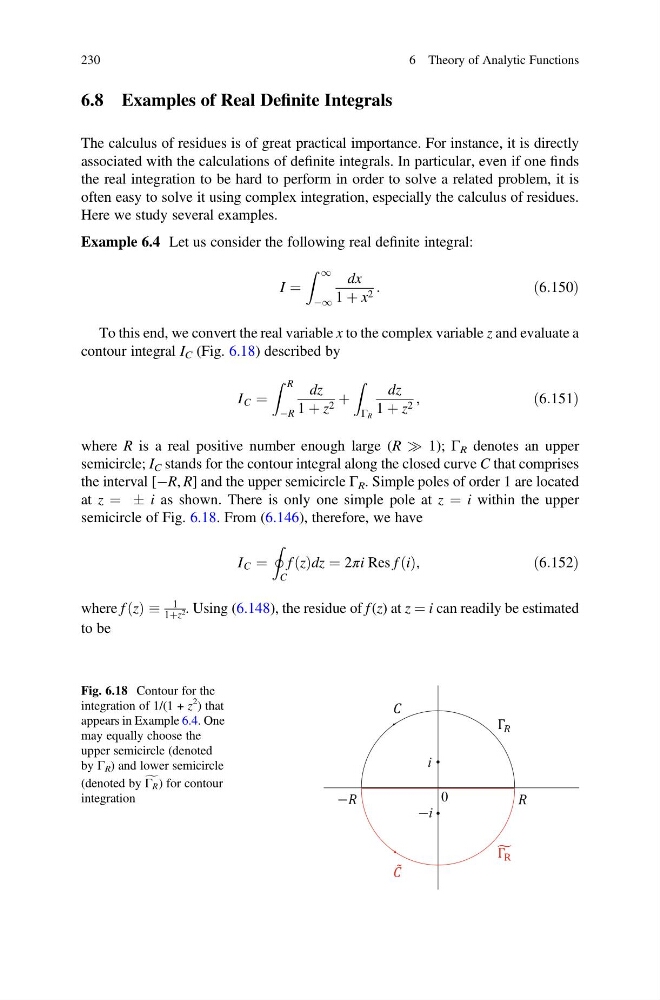
To this end, we convert the real variable x to the complex variable z and evaluate a
contour integral I C (Fig. 6.18) described by
I C ¼
Z R
ÀR
dz
1 þ z 2 þ
Z
Γ R
dz
1 þ z 2 ,
ð6:151Þ
where R is a real positive number enough large (R ) 1); Γ R denotes an upper
semicircle; I C stands for the contour integral along the closed curve C that comprises
the interval [ÀR, R] and the upper semicircle Γ R . Simple poles of order 1 are located
at z ¼ Æ i as shown. There is only one simple pole at z ¼ i within the upper
semicircle of Fig. 6.18. From (6.146), therefore, we have
I C ¼
I
C
f z
ð Þdz ¼ 2πi Res f i
ð Þ,
ð6:152Þ
where f z
ð Þ
1
1þz 2 . Using (6.148), the residue of f (z) at z ¼ i can readily be estimated
to be
i
0
−
Γ
−i
Γ
Fig. 6.18 Contour for the
integration of 1/(1 + z
2
) that
appears in Example 6.4. One
may equally choose the
upper semicircle (denoted
by Γ R ) and lower semicircle
(denoted by f
Γ R ) for contour
integration
230
6 Theory of Analytic Functions
The calculus of residues is of great practical importance. For instance, it is directly
associated with the calculations of definite integrals. In particular, even if one finds
the real integration to be hard to perform in order to solve a related problem, it is
often easy to solve it using complex integration, especially the calculus of residues.
Here we study several examples.
Example 6.4 Let us consider the following real definite integral:
I ¼
Z 1
À1
dx
1 þ x 2 :
ð6:150Þ
To this end, we convert the real variable x to the complex variable z and evaluate a
contour integral I C (Fig. 6.18) described by
I C ¼
Z R
ÀR
dz
1 þ z 2 þ
Z
Γ R
dz
1 þ z 2 ,
ð6:151Þ
where R is a real positive number enough large (R ) 1); Γ R denotes an upper
semicircle; I C stands for the contour integral along the closed curve C that comprises
the interval [ÀR, R] and the upper semicircle Γ R . Simple poles of order 1 are located
at z ¼ Æ i as shown. There is only one simple pole at z ¼ i within the upper
semicircle of Fig. 6.18. From (6.146), therefore, we have
I C ¼
I
C
f z
ð Þdz ¼ 2πi Res f i
ð Þ,
ð6:152Þ
where f z
ð Þ
1
1þz 2 . Using (6.148), the residue of f (z) at z ¼ i can readily be estimated
to be
i
0
−
Γ
−i
Γ
Fig. 6.18 Contour for the
integration of 1/(1 + z
2
) that
appears in Example 6.4. One
may equally choose the
upper semicircle (denoted
by Γ R ) and lower semicircle
(denoted by f
Γ R ) for contour
integration
230
6 Theory of Analytic Functions