

Res f i
ð Þ ¼ f z
ð Þ z À i
ð
Þj z¼i ¼
1
2i
:
ð6:153Þ
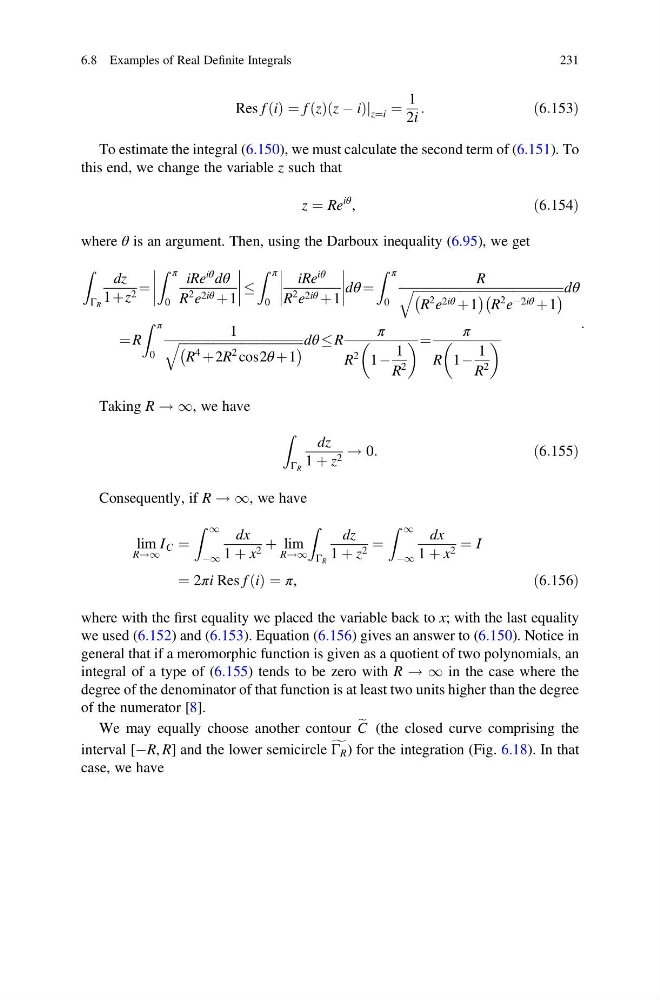
To estimate the integral (6.150), we must calculate the second term of (6.151). To
this end, we change the variable z such that
z ¼ Re
iθ ,
ð6:154Þ
where θ is an argument. Then, using the Darboux inequality (6.95), we get
Z
Γ R
dz
1þz 2 ¼
Z π
0
iRe
iθ dθ
R
2 e 2iθ þ1
Z π
0
iRe
iθ
R
2 e 2iθ þ1
dθ ¼
Z π
0
R
ffiffiffiffiffiffiffiffiffiffiffiffiffiffiffiffiffiffiffiffiffiffiffiffiffiffiffiffiffiffiffiffiffiffiffiffiffiffiffiffiffiffiffiffiffiffiffiffi
R
2 e 2iθ þ1
À
Á
R
2 e À2iθ þ1
À
Á
q
dθ
¼ R
Z π
0
1
ffiffiffiffiffiffiffiffiffiffiffiffiffiffiffiffiffiffiffiffiffiffiffiffiffiffiffiffiffiffiffiffiffiffiffiffiffiffiffiffi
R
4
þ2R
2 cos2θ þ1
À
Á
q
dθ R
π
R
2 1À
1
R
2
¼
π
R 1À
1
R
2
:
Taking R ! 1, we have
Z
Γ R
dz
1 þ z 2 ! 0:
ð6:155Þ
Consequently, if R ! 1, we have
lim
R!1
I C ¼
Z 1
À1
dx
1 þ x 2 þ lim
R!1
Z
Γ R
dz
1 þ z 2 ¼
Z 1
À1
dx
1 þ x 2 ¼ I
¼ 2πi Res f i
ð Þ ¼ π,
ð6:156Þ
where with the first equality we placed the variable back to x; with the last equality
we used (6.152) and (6.153). Equation (6.156) gives an answer to (6.150). Notice in
general that if a meromorphic function is given as a quotient of two polynomials, an
integral of a type of (6.155) tends to be zero with R ! 1 in the case where the
degree of the denominator of that function is at least two units higher than the degree
of the numerator [8].
We may equally choose another contour e
C (the closed curve comprising the
interval [ÀR, R] and the lower semicircle f
Γ R ) for the integration (Fig. 6.18). In that
case, we have
6.8 Examples of Real Definite Integrals
231
ð Þ ¼ f z
ð Þ z À i
ð
Þj z¼i ¼
1
2i
:
ð6:153Þ
To estimate the integral (6.150), we must calculate the second term of (6.151). To
this end, we change the variable z such that
z ¼ Re
iθ ,
ð6:154Þ
where θ is an argument. Then, using the Darboux inequality (6.95), we get
Z
Γ R
dz
1þz 2 ¼
Z π
0
iRe
iθ dθ
R
2 e 2iθ þ1
Z π
0
iRe
iθ
R
2 e 2iθ þ1
dθ ¼
Z π
0
R
ffiffiffiffiffiffiffiffiffiffiffiffiffiffiffiffiffiffiffiffiffiffiffiffiffiffiffiffiffiffiffiffiffiffiffiffiffiffiffiffiffiffiffiffiffiffiffiffi
R
2 e 2iθ þ1
À
Á
R
2 e À2iθ þ1
À
Á
q
dθ
¼ R
Z π
0
1
ffiffiffiffiffiffiffiffiffiffiffiffiffiffiffiffiffiffiffiffiffiffiffiffiffiffiffiffiffiffiffiffiffiffiffiffiffiffiffiffi
R
4
þ2R
2 cos2θ þ1
À
Á
q
dθ R
π
R
2 1À
1
R
2
¼
π
R 1À
1
R
2
:
Taking R ! 1, we have
Z
Γ R
dz
1 þ z 2 ! 0:
ð6:155Þ
Consequently, if R ! 1, we have
lim
R!1
I C ¼
Z 1
À1
dx
1 þ x 2 þ lim
R!1
Z
Γ R
dz
1 þ z 2 ¼
Z 1
À1
dx
1 þ x 2 ¼ I
¼ 2πi Res f i
ð Þ ¼ π,
ð6:156Þ
where with the first equality we placed the variable back to x; with the last equality
we used (6.152) and (6.153). Equation (6.156) gives an answer to (6.150). Notice in
general that if a meromorphic function is given as a quotient of two polynomials, an
integral of a type of (6.155) tends to be zero with R ! 1 in the case where the
degree of the denominator of that function is at least two units higher than the degree
of the numerator [8].
We may equally choose another contour e
C (the closed curve comprising the
interval [ÀR, R] and the lower semicircle f
Γ R ) for the integration (Fig. 6.18). In that
case, we have
6.8 Examples of Real Definite Integrals
231